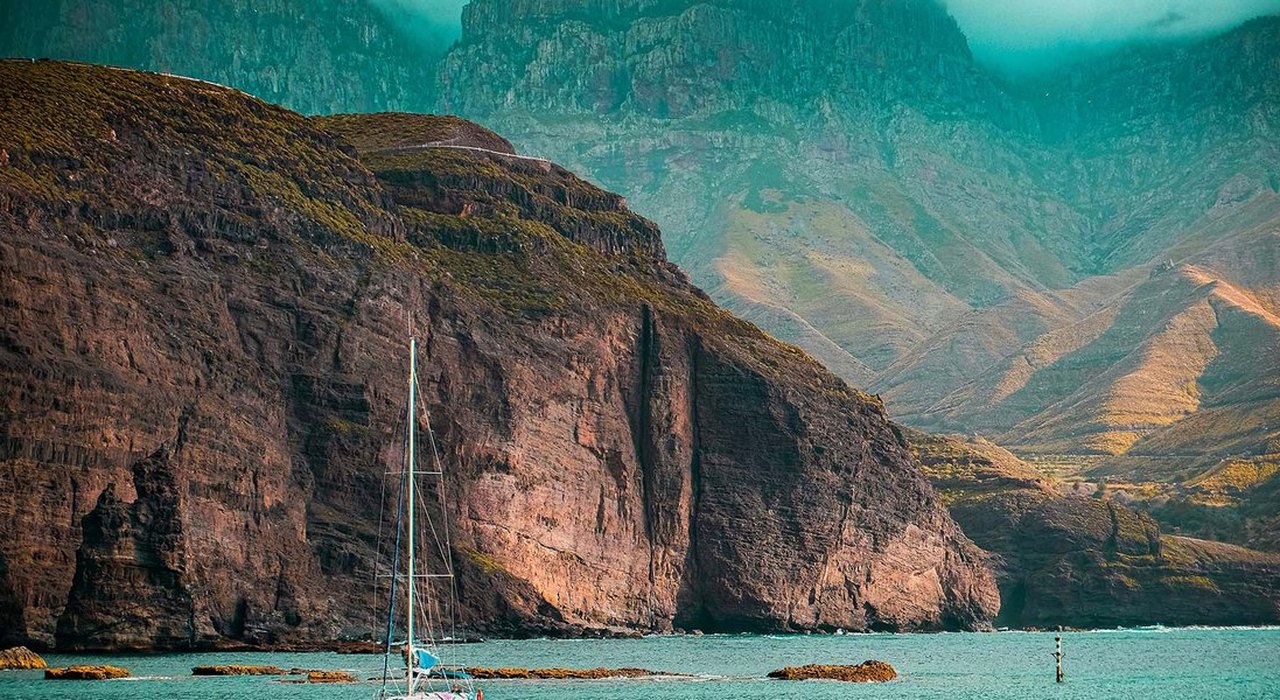
The weather: forget the island — the compass point decides
Both islands earn their "eternal spring" billing: temperatures rarely dip below 20°C even in winter, and summers seldom turn uncomfortably hot. But the real weather trick lies not in the island's name but in which way you face. The same rule of thumb applies to both — the south is dry, sunny and warm; the north greener, cooler and more prone to cloud. Book in the wrong part of the north expecting wall-to-wall sun and you will be surprised, whichever island you are on.
Tenerife pushes this to the extreme. The 3,715-metre Teide stands like a bouncer between the climate zones: while cloud tends to gather over the green north around Puerto de la Cruz, the south around Costa Adeje bakes in the sun. The curious result: on some winter days you can lie on the beach in the morning and watch snow glinting on the summit in the afternoon. Gran Canaria is smaller, lower and more even-tempered overall — and the dry south around Maspalomas ranks among the most reliable wintering addresses in all of Europe, a fact not lost on the many Britons who decamp there for the cold months.
The beaches: golden desert versus black lava
This is where opinions split most visibly. Gran Canaria's trump card is the dunes of Maspalomas — a roaming sea of sand that looks more Sahara than Atlantic island, flanked by miles of pale beaches in the south. This is the picture-postcard beach holiday many have in mind. Tenerife answers with drama rather than postcard: many beaches shimmer volcanic-dark, and in places pale sand has been brought in specially, as at the golden Playa de las Teresitas near Santa Cruz. In short: if you want broad pale sand with no searching, you will be happy sooner on Gran Canaria. If you love the raw, black-glinting volcanic backdrop, Tenerife wins.
Nature: the Teide is the trump card Gran Canaria lacks
If you had to defend Tenerife with a single word, it would be: Teide. The highest mountain in Spain, a UNESCO World Heritage Site and the third-highest island volcano on Earth, it is a natural spectacle Gran Canaria simply cannot match. A cable car eases you up to 3,555 metres; for the final step to the summit, though, you need a permit you should secure online weeks in advance — only 200 are issued a day. Leave it too late and you will be watching from below.
Gran Canaria counters with a nickname that says it all: the "miniature continent". Over the shortest distances you move between dunes, green ravines, pine forests and the defiant rock massif of Roque Nublo. Translated: Tenerife is more spectacular in its heights, Gran Canaria more varied in a small space — you drive less and see more different things sooner. And the theme parks? Tenerife leads here, with the Siam Park (repeatedly voted the best in the world) and Loro Parque. Gran Canaria plays its strength in short distances and family-friendly resorts.
| Category | Gran Canaria | Tenerife |
|---|---|---|
| Character | "miniature continent", compact | island of contrasts, large |
| Beaches | pale dunes (Maspalomas) | often volcanic-dark, coves |
| Nature highlight | Roque Nublo (1,813 m) | Teide (3,715 m, UNESCO) |
| Theme parks | family-friendly, compact | Siam Park, Loro Parque |
| Best time for beaches | year-round (south) | year-round (south) |
| Best time for hiking | winter, spring | spring, autumn |
Getting there and costs: barely anything between them
On access, the two are evenly matched: both are reachable on direct flights of around four to five hours from most UK and central European airports, and both have large international airports — Tenerife in fact has two (south and north). On money, too, there is rarely much in it: accommodation, hire cars and restaurants sit at similar levels, with the usual mark-ups in the southern tourist strongholds. The most honest money-saving truth applies equally to both islands: book away from the centres and you will pay noticeably less.