Which beaches does La Palma have, and how do they differ?
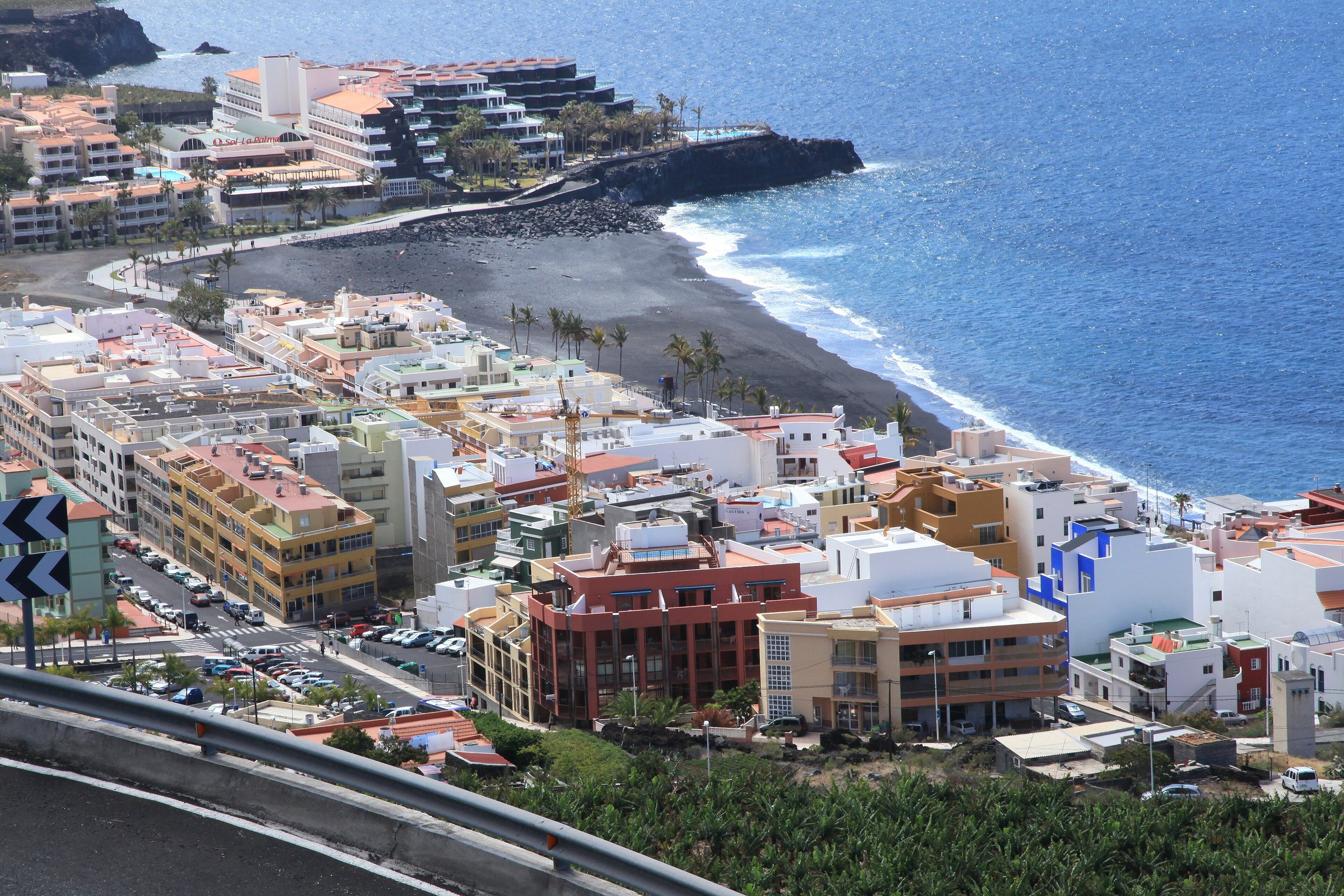
La Palma's beaches are volcanic and dark, according to Hola (report of 8 September 2026). That sets the island apart from the pale sandy beaches of Fuerteventura and Lanzarote.
Visitors should expect black or dark sand, shingle and, at times, strong surf. The sources give no verified figures that would allow a comparison.
Puerto Naos in Los Llanos de Aridane, on the west coast, is the island's biggest beach according to Hola. Los Cancajos in Breña Baja lies on the east coast between Santa Cruz and the airport.
Tazacorte, also on the west coast, has a bathing area behind a mole. Nogales in Puntallana, in the north-east, is a lonely beach with strong waves.
Hola describes four more beaches in its 2026 guide. La Zamora in Fuencaliente is reached by a stone staircase, and its deep water and strong waves draw surfers and divers.
Echentive was formed in the Teneguía eruption of 1971 and lies in the Volcanes de Teneguía natural monument. Bajamar near Santa Cruz has about 700 metres of black sand, and the city beach in Santa Cruz opened in 2017.
The sources give no verified prices for any beach, whether for parking or sunbeds. Visiting seems to be free, but no source says so explicitly.
Lifeguard hours for 2026 are not confirmed either. Visitors should ask on the spot or at the operator.
Is Puerto Naos beach open again?
The main beach at Puerto Naos has reopened, according to Hola (8 September 2026), and much of the tourist centre has recovered. The magazine says emissions are still being monitored.
Hola reports that the small Playa Chica finally reopened to the public in summer 2026. That is a magazine's statement, not an announcement from the authorities, and no official confirmation exists.
The Tajogaite eruption began on 19 September 2021 and lasted 85 days (EFE/El Debate, 7 June 2026). Hola writes that volcanic gases afterwards brought major restrictions to the beach.
On 3 June 2024, RTVC reported that Peinpal, the island emergency plan, had scrapped the QR-code requirement for entering Puerto Naos. Fences would now only mark off the restricted zones around the Playa Chica.
Cabildo president Sergio Rodríguez told RTVC in 2024 that Puerto Naos had 1,080 gas sensors, with 600 more requested. The Cabildo hoped the health authority would raise the limit from 700 to 1,000 ppm.
The sources do not say whether the rise was approved. No update after 2024 is available.
On the advice of the Peinpal emergency committee, the Cabildo closed access to the Playa Chica from 7 March, 00:00, to 13 March 2026, 23:59. The reason was stepped-up data collection for gas-reduction work.
Sergio Rodríguez said, according to RTVC of 3 March 2026: “the priority is to guarantee the safety of residents and visitors”. Travellers should check Cabildo and Peinpal notices beforehand.
According to the official website, Puerto Naos has flown the Blue Flag since 2007, and Hola says the same. Whether it applies in 2026 is not confirmed.
The sand is black with a greenish shimmer from olivine, and the surf is moderate. The page lists a car park, public transport, a tourist office, toilets, showers, sunbed and parasol hire, water sports, a chiringuito (beach bar) and wheelchair access.
The page names no gas warnings, opening hours or lifeguards. It carries no date either.
What is Los Cancajos beach on La Palma like?
Los Cancajos in Breña Baja is 624 metres long and 31 metres wide, with dark sand over rock, according to the official website. The page calls it a semi-urban beach with heavy use, calm water and moderate surf.
The page gives the water temperature as 23 degrees. That is a figure from the page, not a monthly average or a climate value.
Hola puts the calm water down to a mole of volcanic rock. It says the beach suits snorkelling and beginner divers.
Hola also mentions lava caves and tunnels on the seabed. For families and snorkellers, Los Cancajos is an easy alternative if the situation at Puerto Naos feels uncertain.
The official website lists toilets, showers and hire of sunbeds, parasols and watercraft. There are also bins, a cleaning service and a telephone.
Access is easy on foot or by car. The page puts the Santa Cruz marina 2 kilometres away.
The Blue Flag is not confirmed for Los Cancajos, because the official website's page shows a logo but names no season. Anyone who values the award should check the 2026 list, which the sources do not include.
What does Tazacorte offer among La Palma's beaches?
Tazacorte's main beach is about 200 metres long and 8 metres wide, with dark gravel and sand and moderate surf, according to the official website. The mouth of the Barranco de las Angustias splits it into two parts.
A swimming pool has been built on the beach. Hola describes black sand, a promenade and restaurants.
A breakwater (espigón) shelters the bathing area. Hola calls the beach calm and family-friendly, and one of the best spots for the sunset.
The official website lists showers, sunbed and watercraft hire, a children's area and a sports area. Playa Nueva lies nearby and is 470 metres long and 7 metres wide, calm and aimed at surfers, according to the official website.
Hola describes Los Guirres in similar terms and adds the name Playa Nueva. Whether both names refer to the same beach is unclear.
The sources do not confirm a Playa Chica in Tazacorte, and the Playa Chica they mention belongs to Puerto Naos. None of the sources confirms a Blue Flag for Tazacorte.
Prices for sunbeds, water sports or parking are missing as well. According to the sources, the state and Canarian coastal authority (Costas) and the Cabildo are responsible for the beaches.
How do you get to Nogales beach, and what about the waves?
Nogales beach in Puntallana is 500 metres long and 6 metres wide, with dark sand, showers and a surfing area, according to the official website. It lies in the Sauces Mountains and Punta Llana natural park.
Use is low and the setting remote. The official website shows no Blue Flag.
Hola describes a path of about 500 metres from the car park. It calls the beach wild, under a cliff and with strong surf, and says swimmers should take care.
Surfers use the beach, and the official website calls access on foot easy. Verplayas gives a walking time of 15 to 20 minutes.
Hola also warns of underestimated waves at La Zamora. The sources do not mention lifeguards at Nogales.
Visit La Palma sets out a few rules under the motto “Enjoy responsibly”: no stacking of stone towers, no litter, no leaving the paths and fires only in permitted zones. In an emergency, call 112.
Where else can you go, and what about the new lava beaches?
Charco Verde near Puerto Naos is about 150 metres long, according to Hola, with mostly calm water, a car park, a chiringuito, showers and adapted access. Anyone unsure about Puerto Naos can switch to Charco Verde, Tazacorte or Los Cancajos, which Hola says offer facilities and calmer water.
A team from the ULPGC university under Nicolás Ferrer Valero documented up to 34 new beaches on the lava deltas. Each formed 24 to 48 hours after the lava front came to a halt.
The study appeared in the journal Geomorphology, and RTVC and EFE reported it on 13 July 2023. The shape of the new beaches changed sharply.
The two lava deltas (fajanas) near Tazacorte cover about 48 hectares (EFE, 7 June 2026). The Cabildo is working with the state and Canarian coastal authorities on a project for access and use.
The preliminary project is finished and the execution plan is being drawn up. Funding is being negotiated with Costas de Canarias, and the sources give no date.
In future, locals and visitors are to be allowed to use individual coves under basic environmental criteria, but that is an announcement, not a dated decision. For now, the new beaches cannot be recommended as official bathing spots.
No source says anything about the coastal law or about who owns the new lava ground. Gas limits, lifeguards, prices and the 2026 Blue Flags also remain open.