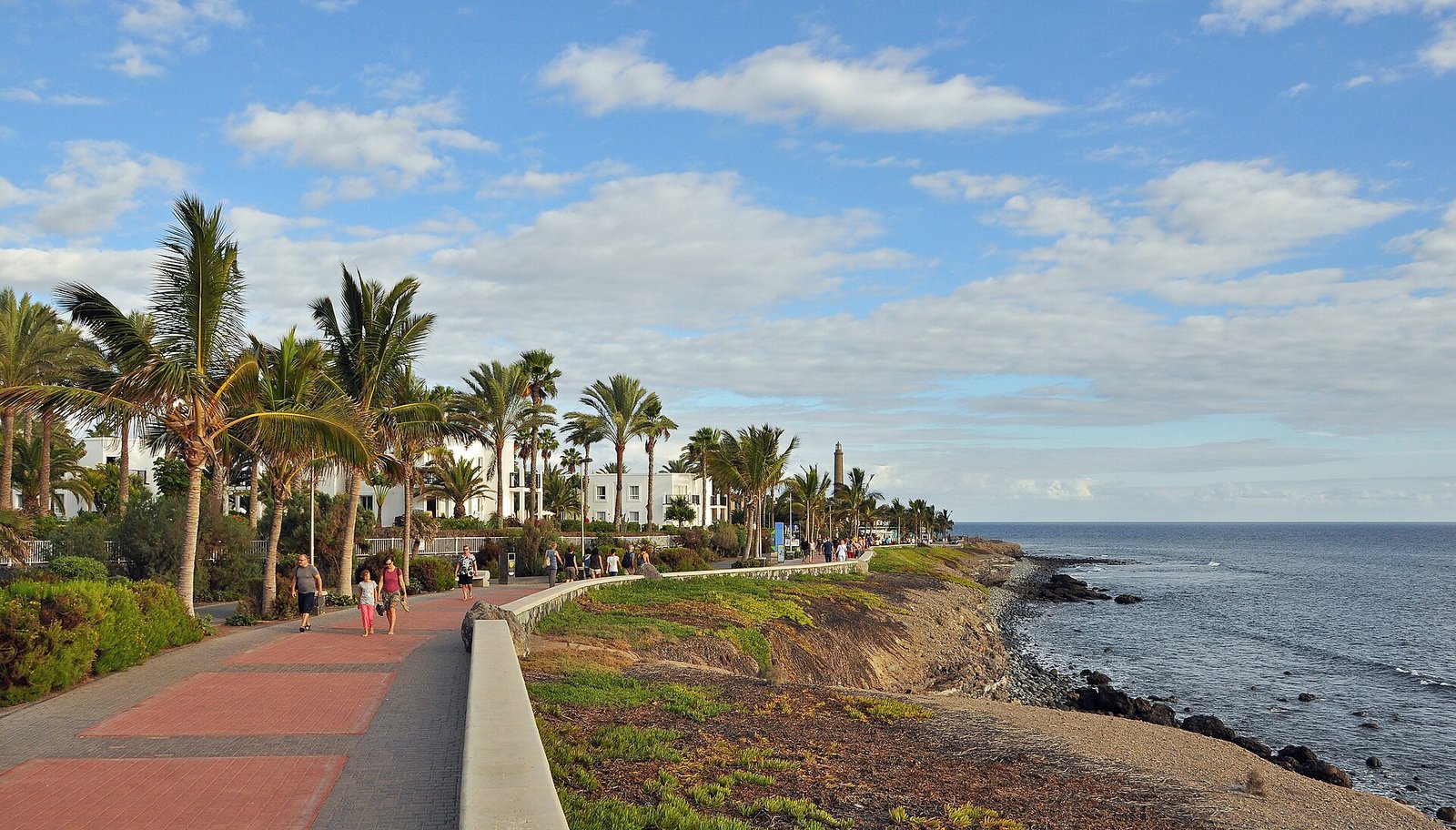
Stroll the Paseo de Meloneras at dusk and you pass a chain of big holiday resorts — pools, palms, colonnades. Much of it belongs to the Lopesan world. Yet behind the façades sits something you rarely think about over a cocktail: a company traded on a German stock exchange called LS Invest. It is the investment vehicle Lopesan uses to buy, rebuild and build hotels — and it is going through a transformation the local ticker Maspalomas24h aptly calls the “metamorphosis”.
The intriguing part is an architectural contrast that almost sounds too good to be true: the same firm owns both the massive concrete holiday blocks on Germany's Baltic coast and the playful Caribbean resorts of Punta Cana. Between those two worlds — sober “Baltic brutalism” on one side, sweeping wave-shaped architecture on the other — sits Maspalomas as the strategic hub. Here we unpack, calmly, what lies behind it and what actually changes for holidaymakers.
What is LS Invest — and why is it on the stock market?
LS Invest AG used to be called IFA Hotel & Touristik AG. Founded in 1982 as a marketer of Spanish hotels and apartment complexes, it floated on the Frankfurt and Düsseldorf exchanges in 1995. Lopesan, from the Canary Islands, took majority control from 1999 and today holds around 90 percent of the shares. The company is registered in Duisburg, with share capital of roughly 128.7 million euros.
In 2022 the firm withdrew from the regulated market; its shares have since traded mainly on Hamburg's open market. To a holidaymaker that sounds like dry finance — but it is exactly why Lopesan's plans are at least partly public: as a listed company, LS Invest has to disclose figures and projects. That is what gives us this look behind the scenes of Meloneras.
Baltic concrete, Caribbean waves: the metamorphosis
The charm of the story is the contrast. On one side stand the old IFA holiday complexes on the Baltic Sea — in Binz on Rügen, on Fehmarn, in Graal-Müritz: large, functional concrete blocks in the style of the 1970s and 80s, the kind critics like to call “Baltic brutalism”. On the other, the brand-new Lopesan resorts in Punta Cana in the Dominican Republic — lagoons, curves, wave motifs, tropical ease. The same listed company, two utterly different visual worlds.
That rebuild is precisely the “metamorphosis”: LS Invest has lately sold older European hotel properties and channelled the money into new, gleaming resorts. It even showed up in the accounts — a loss in 2022 turned into a clear profit in 2023, driven above all by property sales. Maspalomas24h describes the structure, half in admiration and half in scepticism, as an “investment bank in construction-and-tourism clothing”. For guests it simply means: a lot of money is flowing, and the face of the resorts is changing.
What is changing in Maspalomas and Meloneras
The metamorphosis gets concrete in the south of Gran Canaria. The Lopesan Villa del Conde Resort & Thalasso in Meloneras — the five-star property with its distinctive church-tower backdrop — has been granted permission to grow by 103 rooms. That would take the resort past 660 units; the investment is put at around 16.4 million euros. It is an expansion of the existing building, not a demolition — the familiar look stays, the resort simply gets bigger and thoroughly refreshed.
In parallel, Lopesan is planning a wholly new themed luxury resort in Meloneras with around 950 units — the larger, more spectacular project that we cover in depth in a separate article. Together the two schemes show how LS Invest is sorting its capital right now: out of older European holdings, into the Canary south and into the Caribbean, where three new Punta Cana hotels launch in spring 2026.
What it means for holidaymakers
For guests the news is mostly upbeat: more modernised rooms, freshened-up resorts and a resort town drifting further towards the upmarket five-star segment. Meloneras was already the smarter counterpart to bustling Playa del Inglés — and that direction continues. Book for the coming seasons and you should reckon with the odd construction phase at individual properties, but also with fresher products.
An honest reading also notes that the south's rapid expansion is not uncontested locally: the Canaries have long debated tourism density, land use and how much growth the islands can bear. LS Invest is no special case here, but a particularly visible example of the investment surge that has shaped Maspalomas for years.
Common questions
- What is LS Invest?
- The Lopesan group's listed investment and hotel company, formerly IFA Hotel & Touristik AG, based in Duisburg.
- Why “Baltic brutalism”?
- LS Invest owns large concrete holiday complexes on Germany's Baltic coast (Rügen, Fehmarn, Graal-Müritz) — a contrast with the playful Caribbean resorts in Punta Cana.
- What is happening in Meloneras?
- The Villa del Conde may add 103 rooms to reach over 660 (around 16.4 million euros); a new luxury resort with roughly 950 units is also planned.
- Will I notice it as a guest?
- Mainly modernised resorts and occasional building work; Meloneras' upmarket five-star profile is getting stronger.
- Where does the “metamorphosis” come from?
- The term is used by the local ticker Maspalomas24h for LS Invest's shift between old European property and new resorts.
Read on
- Gran Canaria weather 13 October: wet north, dry southGran Canaria · 13 October
- Gran Canaria this weekend, 16–18 October: Miralta, Walking FestivalGran Canaria · 12 October
- Maspalomas Winter Pride: 2–8 November 2026Gran Canaria · 12 October
- Maspalomas forum 25–26 Nov: cooking, science and AIGran Canaria · 12 October
- Gran Canaria: Meloneras Beach Fest on 10 and 11 OctoberGran Canaria · 11 October
- Maspalomas Guide: food, nightlife, tips and events
- All events on Gran Canaria →
Details as of July 2026, per company and press information (including Maspalomas24h, Alimarket, the commercial register). Figures, sums and dates may change.