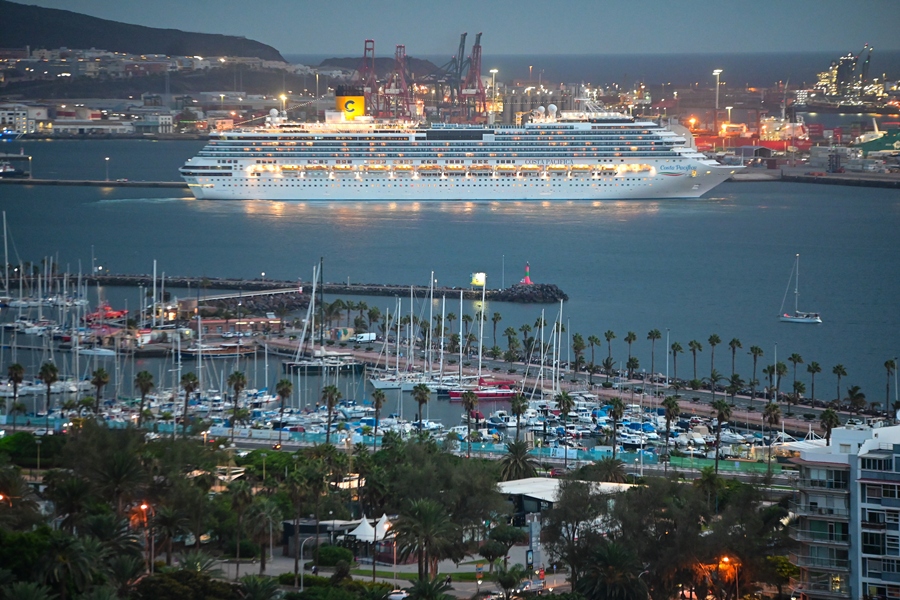
Key Facts
Power deficit: Gran Canaria lacks 120–140 megawatts
Solution: Powership from Turkish firm Karpowership, Shark class, 125 MW
Problem: The vessel occupies 200 metres of berth in the busiest Atlantic port
Contract: Minimum 3 years, annually renewable
Political conflict: Calzada (CC), Darias (PSOE), Morales (NC) blocking each other
Geopolitical context: Suez and Iran crises make Las Palmas a mandatory stop for global shipping
The Situation: A Port Under Pressure
The Port of Las Palmas (Puerto de la Luz) has just had one of the busiest years in its history. Since shipping through the Red Sea became unsafe due to the Houthi conflict, major carriers like MSC, Maersk and CMA-CGM have been using the Cape of Good Hope route — and Las Palmas sits directly on it. MSC has declared the port a permanent hub, no longer just an emergency stopover. Bunkering volumes reached around 2.6 million tonnes in 2025.
The escalation over Iran and the closure of the Strait of Hormuz has intensified the trend further. Major shipping lines have rerouted again. More ships mean more demand for berths, storage and logistics — and precisely at this moment, space is running out.
The Powership: 200 Metres of Berth for Electricity
Gran Canaria has a power problem. The island faces a deficit of 120 to 140 megawatts, and existing plants are at their limit. The solution from the Canary Islands energy ministry: a floating power plant (powership) from the Turkish firm Karpowership, Shark class, 125 MW, to berth at the port and feed electricity into the grid.
The vessel occupies roughly 200 metres of quay — in the middle of the busiest port in the Atlantic. The port community is sceptical. The contract runs for at least three years, with annual extensions, until new power plants on land are ready. Nobody knows exactly when that will be.
Critics — including doctors, environmentalists and politicians — argue that the powership extends fossil fuel dependence, pollutes the air in the densely populated port area, and solves no structural problem. Some academics have even proposed a floating nuclear reactor as an alternative.
The Powership in Numbers
→ Karpowership Shark class, 125 MW
→ Runs on low-sulphur fuel oil or marine diesel
→ Approx. 200 metres of berth space
→ Contract: minimum 3 years
→ Purpose: bridge solution until land-based plants are built
The Political Power Struggle
The board of the Port Authority (Autoridad Portuaria de Las Palmas) is supposed to be a technical body. In practice, it has become a battleground — fuelled by the approaching 2027 elections.
Three figures are at the centre: Beatriz Calzada (Coalición Canaria), president of the port authority. Carolina Darias (PSOE), mayor of Las Palmas. Antonio Morales (Nueva Canarias), president of the Cabildo of Gran Canaria.
The conflicts have piled up. The Puerto-Ciudad project — an integration of port and city with green spaces and public use — was agreed between the port authority and the city council, until a chain of misunderstandings between Calzada and Darias broke the consensus. The port authority went ahead and built the Istmo park unilaterally.
Then came the dispute over the Totisa gas plant: Morales and Darias fought jointly against it, the regional government issued a negative report, and Totisa withdrew its application. That was a defeat for Calzada.
Morales has also sharply criticised Calzada's outreach to the port of Dakhla in Western Sahara — calling it a strategic error, since Dakhla could become a direct competitor to Las Palmas.
The latest clash: the appointment of the new managing director of the Puertos de Las Palmas Foundation as the port authority's representative to the university foundation FULP. Morales accused Calzada of using the foundation for party-political purposes.
The Players
→ Beatriz Calzada (CC) — Port Authority president
→ Carolina Darias (PSOE) — Mayor of Las Palmas
→ Antonio Morales (NC) — Cabildo president, Gran Canaria
→ Conflicts: Puerto-Ciudad, gas plant, Dakhla, foundation
The Geopolitical Bonus
While the politicians are feuding, business is booming. The Suez crisis since 2023 and now the Iran escalation have made Las Palmas a mandatory stop for global shipping. Carriers like MSC have built long-term capacity — this goes beyond one-off emergency rerouting.
Bunkering remains strong, container throughput is rising, and port operators report a shortage of space. It is precisely at this moment that a 200-metre vessel for power generation is set to occupy one of the best berths. The irony is lost on no one.
What Is at Stake
The Port of Las Palmas has a historic opportunity: global shipping needs it more than ever. At the same time, three institutions are blocking each other, the energy crisis is eating up port capacity, and the campaign interests of 2027 are overshadowing technical decisions.
The questions that matter: Where exactly does the powership go — and at whose expense? Can the board function beyond the election cycle? And will Las Palmas seize the geopolitical moment — or sleep through it between three offices?
Sources: AtlánticoHoy (11 April 2026), Canarias7, COPE Gran Canaria, Puente de Mando, elPeriódico de la Energía, CrónicasLanzarote.