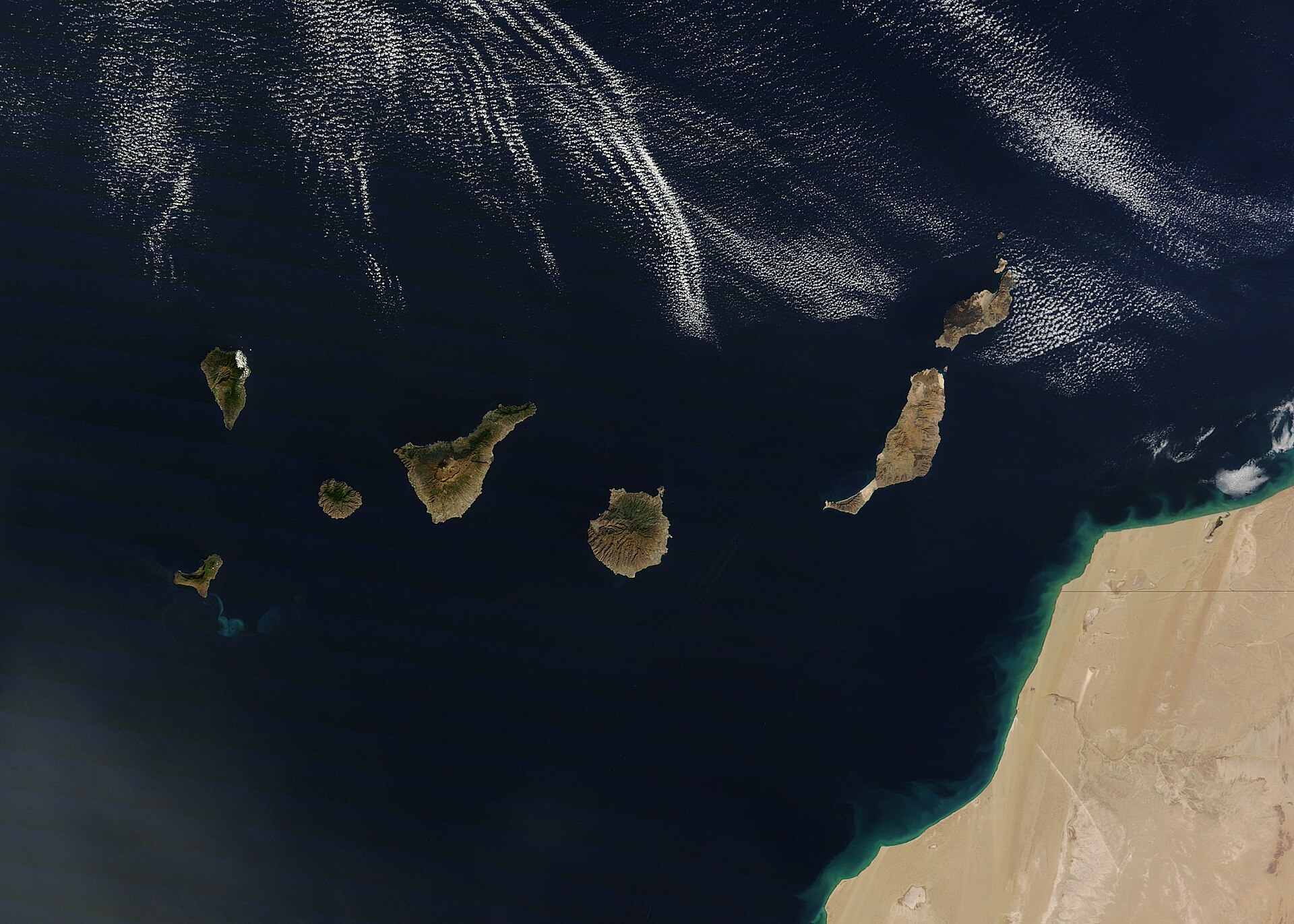
What climate can I expect on Tenerife?
The official climate normals for Tenerife Sur Airport come from AEMET and apply to the period 1981–2010. The mean annual temperature there is 21.4 °C, the mean daily maximum is 24.8 °C and the mean minimum is 17.9 °C.
Annual precipitation is 132 mm, spread over an average of 15.2 rainy days, according to AEMET. AEMET also records 114 clear days. These figures apply only to the Tenerife Sur station.
The official tourism information gives an average annual temperature of around 23 °C for Tenerife and describes summers as mild and winters as warm. The data cannot simply be applied to Santa Cruz, La Laguna, Puerto de la Cruz or mountain areas.
AEMET normals for calima frequency, sea temperatures and trade-wind seasons are not included in the available sources. For current values and warnings: CITA weather (cita.news/de/wetter.html) and AEMET.
Where should I live on Tenerife?
According to the official tourism information, three factors are particularly important when choosing where to live. The south-west and south are sunnier and drier; key places include Adeje, Arona, Los Cristianos, Playa de las Américas, Granadilla de Abona and El Médano.
The metropolitan area of Santa Cruz de Tenerife and San Cristóbal de La Laguna offers the greatest urban density of administration, education and services. The north, including Puerto de la Cruz and La Orotava, is more strongly affected by the north-east trade winds and cloud cover.
Rents, purchase prices, deposits and municipal fees should only be published with a current source, municipality and survey year. The available official results do not contain reliable figures for these.
For remote work, it is advisable to rent furnished accommodation first and check internet quality, noise, damp and parking. Without a car, the best places to live are Santa Cruz, La Laguna or larger southern municipalities.
Which official procedures are needed before the move?
For a longer stay in Spain, EU citizens typically need the Spanish foreigner identification number, the NIE. If staying for more than three months, they must register in the Spanish central register for EU citizens.
For non-EU citizens, the residence route depends on the specific visa or residence permit. The competent Spanish authorities and the relevant immigration office should be linked as primary sources.
The electronic portal of the Government of the Canary Islands refers to procedures of the Directorate-General for Emigration. However, this result does not provide a complete checklist for the NIE, social security, tax residence, health insurance or starting work.
Before moving, the following points should be clarified in the right order: accommodation and tenancy agreement, empadronamiento with the relevant municipality, NIE or residence registration, tax residence, social security and health insurance, employment contract or proof of self-employment, bank account and digital identification, driving licence, vehicle import and insurance, school place, and powers of attorney and certified translations.
How do I get around Tenerife?
Tenerife has two airports: Tenerife Norte–Ciudad de La Laguna (TFN) and Tenerife Sur (TFS). TFS is the main international airport for the south; the official tourism information describes the public transport network as an island-wide network.
Tenerife's buses are called guaguas and are operated by TITSA. According to the official tourism information, the network reaches all parts of the island.
Because fares can change, the validity year or retrieval date should be stated explicitly. Residents should also check the current TITSA fares page.
What do I need to know about work and residence?
EU citizens may enter Spain and initially move freely. For stays of more than three months, registration as an EU foreigner, a NIE and proof of sufficient means, health insurance or employment are generally required.
Non-EU citizens need, depending on the purpose, a work visa, a residence permit, a non-lucrative visa or a digital nomad permit. The specific assessment should be made with Spanish authorities or an authorised specialist adviser.
The Canary Islands belong to Spain and the EU, but have their own indirect tax system. In the Canaries, IGIC generally applies instead of Spanish VAT. Tax residence does not arise merely from a registered address.
Length of stay, economic interests and family ties are among the decisive factors. Tenerife offers the widest range of jobs, healthcare, education, transport and services in the Canary Islands.
What is confirmed for 2026 and what remains open?
The AEMET pages were updated in 2026, but continue to publish climate normals for Tenerife Sur from the 1981–2010 period. The available official results do not confirm any specific new residence rule or any new 2026 housing or transport fares.
Such statements should only be included after checking the BOE, BOC, Cabildo, municipalities and the relevant transport operators. None of the available sources gave a start date for new rules as of Sunday, 4 October 2026.
Strict spatial planning and nature conservation rules also apply to housing and construction. Tenerife has protected categories such as national park, natural park, rural parks, reserves, natural monuments and Natura 2000 sites.
In Teide National Park and other protected areas, paths, access, overnight stays, fires, drones, plant collecting and structural changes may be restricted. Before buying, the land register, building permit, tourist rental eligibility, community rules and possible protected areas should be checked.