Where can you watch whales in Tenerife?
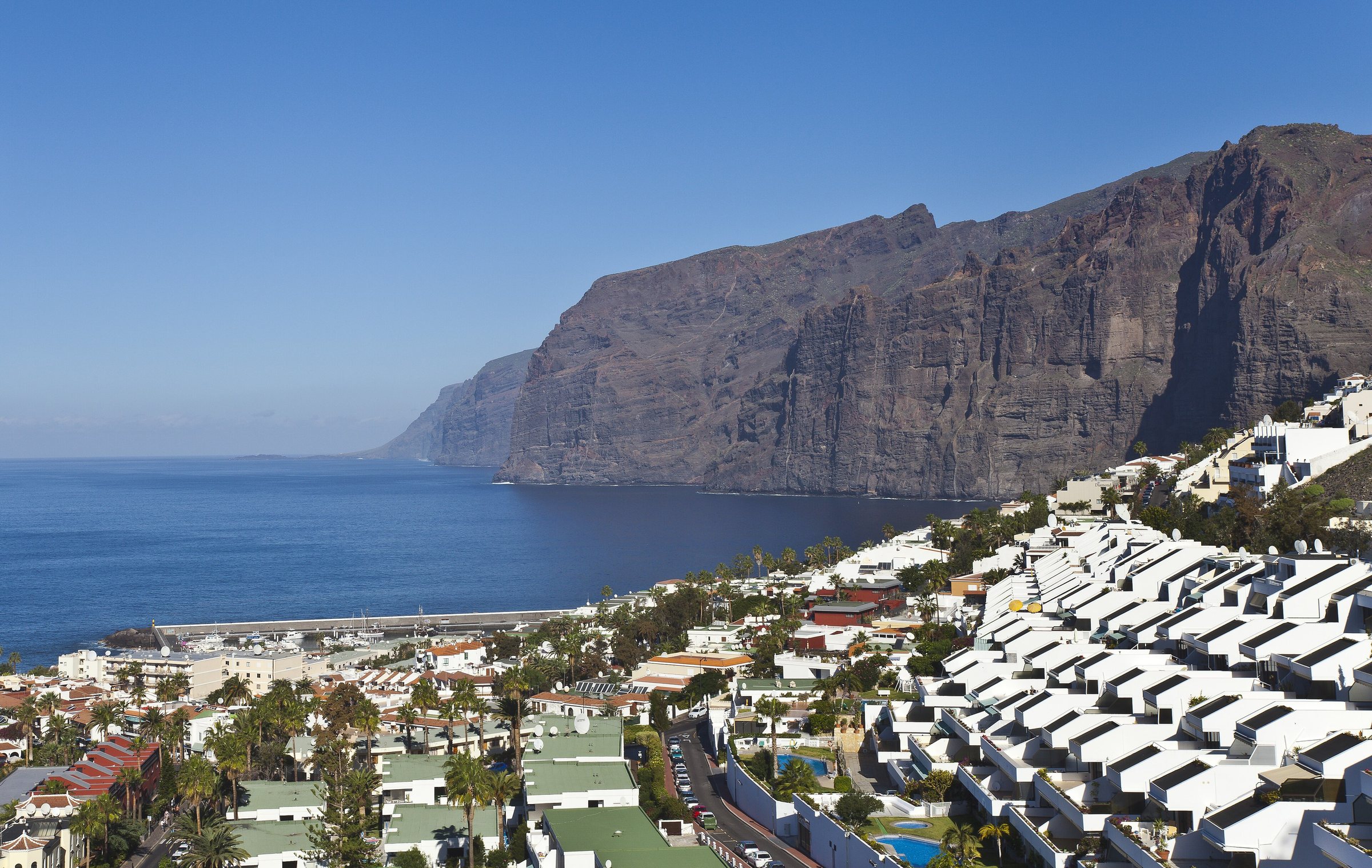
Most boats sail from the Teno-Rasca zone off Tenerife's south-west coast, according to operator listings. The main departure ports are Los Gigantes, Puerto Colón in Costa Adeje and Los Cristianos, and a few boats leave from Las Galletas and Marina del Sur.
The Canarian broadcaster RTVC described the zone on 14 February 2022 as a sea strip 22 kilometres long. It runs from Punta del Fraile (Teno, Buenavista del Norte) to Punta Salema, also called Rasca (Las Galletas, Arona).
Los Gigantes belongs to the municipality of Santiago del Teide and lies inside the protected area. The zone is a special conservation area (Zona Especial de Conservación, ZEC), declared in September 2011.
The sources disagree on the size of the area: a Biosphere and Tenerife Dolphin source gave exactly 76,648 hectares in July 2024, while one operator gives 69,489.68 hectares. Which figure applies is not settled.
In January 2021 the World Cetacean Alliance named Tenerife–La Gomera a Whale Heritage Site, the first in Europe, with around 22 kilometres of coast. The title comes from the alliance, not from UNESCO.
The operator Tenerife Dolphin says it switched to whale watching in 1985. That is one firm's account, not the start of the industry.
Which whales can you see from Los Gigantes, and when is the best time?
Turismo de Tenerife, the island's tourism body, counts up to 21 species in these waters. Other sources give different totals, as shown below.
According to World Animal Protection, pilot whales live there all year. It is one of the few resident populations in the world.
The species counts differ by source: Turismo de Tenerife gives up to 21, RTVC 26 sighted species, and the Olive Press of 30 December 2025 around 23. They probably count different things, such as every species ever seen against the common ones, but none explains it.
Turismo de Tenerife says sightings are possible on 80% of days and close to 100% on trips. Some species are more common in May and June.
A sighting is still never guaranteed, although some operators advertise one outright. Operator and blog sites most often name December to May as the best time.
March to May is the window for migrating species such as the fin whale and the sperm whale. Sightings are possible all year because dolphins and pilot whales are resident, but the sources give no official season calendar.
How much does whale watching in Tenerife cost?
A whale and dolphin trip from Los Gigantes costs from 79 euros in the Manawa listing and lasts about 3 hours 15 minutes. A guided dolphin trip starts at 55 euros.
These are 2026 list prices from an agent, not official tariffs. Funbooker lists a five-hour catamaran trip including Masca Bay at 59 euros per adult and 37 euros for children aged 3 to 11.
A two-hour trip from Puerto Colón costs from 55 euros in listings, and a catamaran with underwater viewing costs 50 euros. Teneriffa-News puts the average at about 55 euros per adult.
The listings give a range of roughly 50 to 80 euros. No price was found for a small inflatable boat carrying 10 people at most.
No price list from the Cabildo (island government) or the regional government is known. According to Turismo de Tenerife and operator listings, trips last about 2 to 3 hours, and up to 5 hours on some boats.
No source gives fixed departure times, which vary by operator. Travellers should have prices and times confirmed by the operator before booking.
Which rules apply on the water?
Real Decreto 1727/2007 of 21 December 2007 governs whale watching at national level. It was published as BOE-A-2008-516 in issue 11 of the BOE, Spain's official state gazette, on 12 January 2008.
The activity is called AROC (Actividad recreativa de observación de cetáceos). The consolidated version was not reviewed, so later amendments may differ.
The moving protection space is a cylinder with a 500-metre radius, 500 metres of airspace and 60 metres of depth. In the exclusion zone of at least 60 metres' radius, boats must not move propeller or engine while animals are within 60 metres.
Swimming and diving there are banned (article 4.2.f). Between 60 and 300 metres, no more than two boats may be present at once.
Boats may not enter when a single adult with calves, or single calves, are present. Between 300 and 500 metres, at most two boats wait.
Speed must be constant and no more than 4 knots. It must not exceed the speed of the slowest animal in the group.
Boats approach at about 30 degrees, never head-on, but from behind or across the direction of travel. Reversing is allowed only in an emergency, while circling and passing through a group are banned (article 4.2.c).
Sonar or sound devices to find or drive the animals are prohibited. The decree sets no maximum time in minutes, but a boat must turn away as fast as possible if the animals are disturbed (article 5.1).
Turismo de Tenerife recommends at most 30 minutes of watching and slow sailing. It advises against swimming with the animals, feeding, touching, dumping rubbish at sea and noise.
A 30-minute limit in law was not confirmed. For injured or stranded animals, call the emergency number 112.
How can you spot a trustworthy operator from Los Gigantes?
MITECO publishes a searchable list of approved firms, which can be filtered by island and port. If it reads “Tenerife excepto ZEC Franja Teno-Rasca”, the boat is approved only outside the protected area.
Los Gigantes lies inside the protected area. Such a boat is therefore not approved for whale watching from Los Gigantes, Puerto Colón or Los Cristianos.
According to the MITECO page, a notice from its biodiversity directorate dated 26 September 2023 calls for a moratorium on new AROC permits in the ZEC. Its length and current status are not confirmed.
A 2026 guide says no new permits are issued there any more.
The yellow “Barco Azul” flag is seen as a sign of approved boats. Who awards it is unclear: one source names the Canarian government, another the island's tourism body.
A third source says the flag alone is not enough, and the MITECO list remains the check. Turismo de Tenerife also describes the Carta por la Sostenibilidad as a voluntary pledge by operators.
According to Canarian Weekly, in a report dated 03-10-2025, Tenerife records the most illegal whale and dolphin trips in the Canaries, with almost 200 official actions. Since 2018 inspectors have issued more than 1,700 proposed penalties.
The Guardia Civil recently fined seven visitors who jumped into the sea beside a group, but the amount was not given. Warning signs are boats without a flag, very cheap offers and skippers who chase animals.
What are the alternatives, and what is still open?
Small inflatable boats with a hydrophone and marine biologists leave from Los Gigantes, according to listings. Catamaran and sailing trips with swim stops away from the animals also appear, as do small-group kayak tours where dolphins sometimes surface.
No confirmed land viewpoints for whales at Teno or Rasca were found. In April 2024 the Cabildo (island government) opened talks on stronger protection for Teno-Rasca, modelled on La Graciosa and El Hierro.
Planned rules cover fishing methods and permitted activities. According to Canarian Weekly, the proposal sat with the fisheries ministry, and no later result is known.
The number of approved boats, the number of visitors and the status of the moratorium also remain open. The Whale Heritage Site is called Tenerife–La Gomera, but no rules or figures for La Gomera are available.
Neither new rules nor price changes are documented for 2026. According to Canarian Weekly, the regional government plans AI-supported coastal cameras.