Valle de Jinámar: one neglected valley, two town halls
The Valle de Jinámar, one of the most disadvantaged areas of Gran Canaria, sits on an unusual administrative line: part of it belongs to the municipality of Telde, part to Las Palmas de Gran Canaria. On 17 August 2026 two separate developments put the valley's long-standing sense of neglect back in the spotlight.
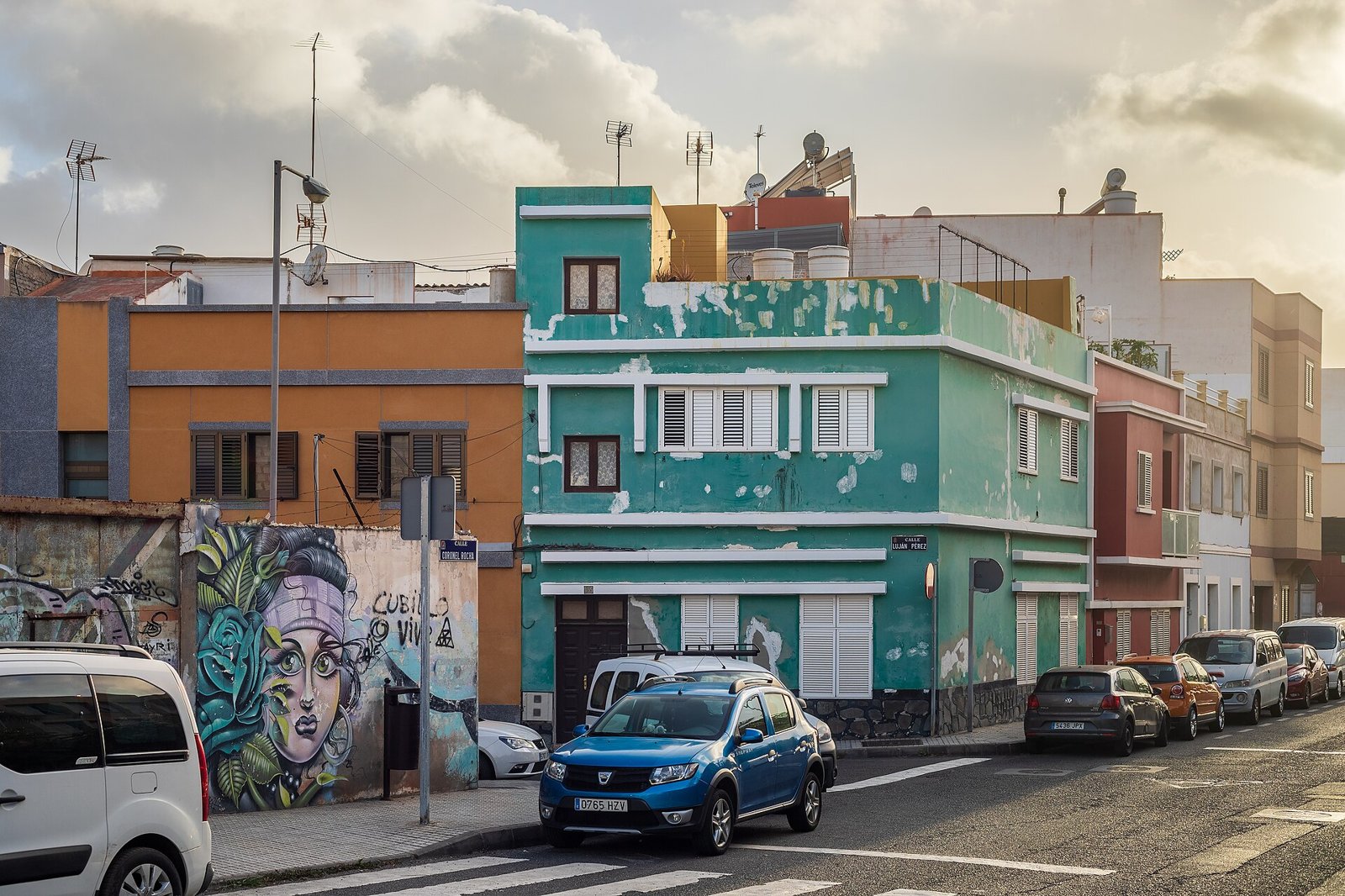
Photo: Ximonic (Simo Räsänen), CC BY-SA 4.0 (Symbolbild).
On the Telde side, residents of ageing 1970s housing blocks protested over buildings they consider unsafe. On the Las Palmas de Gran Canaria side, an administrative court ordered the city council to pay a contractor close to one million euros for a sports pavilion that was started, abandoned and never finished. The two stories are distinct, and so are the authorities responsible — but together they sketch a valley that residents feel has been left waiting.
One valley, two town halls
The Valle de Jinámar is a large residential area on the eastern edge of Gran Canaria, built largely with social and public housing and long cited among the island's most vulnerable neighbourhoods. Its distinctive feature is administrative: the valley is split between two municipalities, Telde and Las Palmas de Gran Canaria, each with its own council, budget and responsibilities.
That division matters when it comes to accountability. The crumbling housing blocks that residents protested about lie in Telde; the failed pavilion on which the courts have now ruled belongs to Las Palmas de Gran Canaria. Keeping the two apart is essential: they are different projects, different administrations and different legal situations, even if they share the same valley and the same feeling of abandonment.
The crumbling blocks in Telde
According to eldiario.es / Canarias Ahora, residents of Blocks 7 and 9 on calle Manuel Alemán Álamo, in the Telde section of the valley, took to the streets on 17 August 2026. The buildings date from the late 1970s and, the residents say, suffer structural problems that compromise the safety of their homes. They warned that the issue is not confined to those two blocks but extends to others and to the nearby Llano de las Brujas area.
"Una vivienda segura no es un favor, es un derecho" ("Safe housing is not a favour, it is a right"), residents said, according to the report. Spokespeople framed the situation as systemic rather than isolated — "No es un caso aislado, es un problema estructural" ("This is not an isolated case, it is a structural problem") — and vowed: "No esperaremos a que nuestras viviendas se derrumben" ("We will not wait for our homes to collapse"). The number of affected families was not specified.
The €1 million pavilion in Las Palmas de Gran Canaria
The second story unfolds on the Las Palmas de Gran Canaria side. As reported by Canarias7, the administrative chamber of the Tribunal de Instancia de Las Palmas de Gran Canaria ordered the city council to pay the contractor Comsa close to one million euros. Comsa had claimed €903,178.03 in unpaid invoices, plus late-payment interest and court costs.
The pavilion, managed by the municipal sports institute (IMD, Instituto Municipal de Deportes), had an original budget of €2,602,694.73 for 1,370.35 square metres. It was designed as a flexible multi-use hall — for futsal, basketball, three minibasket courts and four volleyball courts, plus changing rooms and a medical office. Works began in 2021, but today, according to the report, the site is an unfinished concrete skeleton damaged by vandalism.
Who answers for what
The two cases involve different chains of responsibility, and conflating them would be a mistake. For the Telde housing blocks, residents point to three authorities: the national Ministerio de Vivienda, the Gobierno de Canarias — specifically the regional minister Pablo Rodríguez, responsible for Obras Públicas, Vivienda y Movilidad — and the Ayuntamiento de Telde under mayor Juan Antonio Peña. Their central demand is that the promised regeneration works finally be carried out.
The pavilion, by contrast, is a matter for the Ayuntamiento de Las Palmas de Gran Canaria. The contract with Comsa was rescinded in April 2024; the court ruling came in August 2026. Politically, the opposition PP said the city's sports-infrastructure policy "se va a pique" ("is sinking") after the rescission was confirmed, while community voices lamented the abandonment of a facility meant for an underserved neighbourhood. In March 2023, during the campaign, the then-mayor Augusto Hidalgo and the then-sports councillor Aridany Romero had visited the works.
What residents want, and what comes next
On the Telde side, residents are demanding execution of the ARRU works — the Plan de Regeneración y Renovación Urbana, an urban regeneration and renewal scheme — together with clarity on how the planned works are funded and where they stand. Their slogan captured the mood: "hechos y no palabras" ("facts, not words"). The report did not detail the concrete funding figures for the plan.
On the Las Palmas de Gran Canaria side, the ruling leaves the city facing not only the payment to Comsa but also the cost of finishing the building. Completing the pavilion, according to the report, would require a new tender costing "more than one million euros" on top of what has already been spent. For now, both the blocks and the pavilion remain, in the residents' telling, symbols of a valley kept waiting.
Residents who want to know the status of works on their block can request information from the Ayuntamiento de Telde and from the Gobierno de Canarias housing department (Consejería de Obras Públicas, Vivienda y Movilidad).
Key figures
- The Valle de Jinámar straddles two municipalities: Telde and Las Palmas de Gran Canaria
- Telde: residents of Blocks 7 and 9, calle Manuel Alemán Álamo, protested on 17 Aug 2026; buildings from the late 1970s (eldiario.es/Canarias Ahora)
- Telde authorities cited: Ministerio de Vivienda, Gobierno de Canarias (Pablo Rodríguez) and Ayuntamiento de Telde (Juan Antonio Peña)
- Las Palmas de Gran Canaria: a court ordered payment to Comsa; the contractor claimed €903,178.03 plus interest and court costs (Canarias7)
- Pavilion: original budget €2,602,694.73 for 1,370.35 m²; managed by the IMD; contract rescinded April 2024
- Finishing the pavilion would cost "more than €1 million" more via a new tender (Canarias7)
FAQ
- Where is the Valle de Jinámar?
- On the eastern edge of Gran Canaria, split between the municipalities of Telde and Las Palmas de Gran Canaria.
- What were residents protesting about?
- Structural problems in the 1970s housing blocks 7 and 9 on calle Manuel Alemán Álamo in Telde, which they say make the homes unsafe, according to eldiario.es/Canarias Ahora.
- How much must Las Palmas de Gran Canaria pay for the pavilion?
- Close to one million euros; the contractor Comsa claimed €903,178.03 plus interest and court costs, according to Canarias7.
- Are the two cases the responsibility of the same authority?
- No. The housing blocks are in Telde; the pavilion is a Las Palmas de Gran Canaria project. Different administrations are responsible.
- What are the ARRU works?
- The Plan de Regeneración y Renovación Urbana, an urban regeneration scheme that residents want executed on the Telde housing blocks.
Read on
- Canary Islands health insurance: €60 convenio especialCanary Islands · 20 November
- Lozoyuela fire: Madrid forest work, no impact on CanariesCanary Islands · 20 November
- Canary Islands 20-22 Nov: Feria del Atún, Opera, FiestasCanary Islands · 20 November
- Canary Islands: 4% fewer beds in 45,555 holiday letsCanary Islands · 20 November
- Canary Islands: when you must exchange your driving licenceCanary Islands · 20 November
- All events on the Canary Islands →