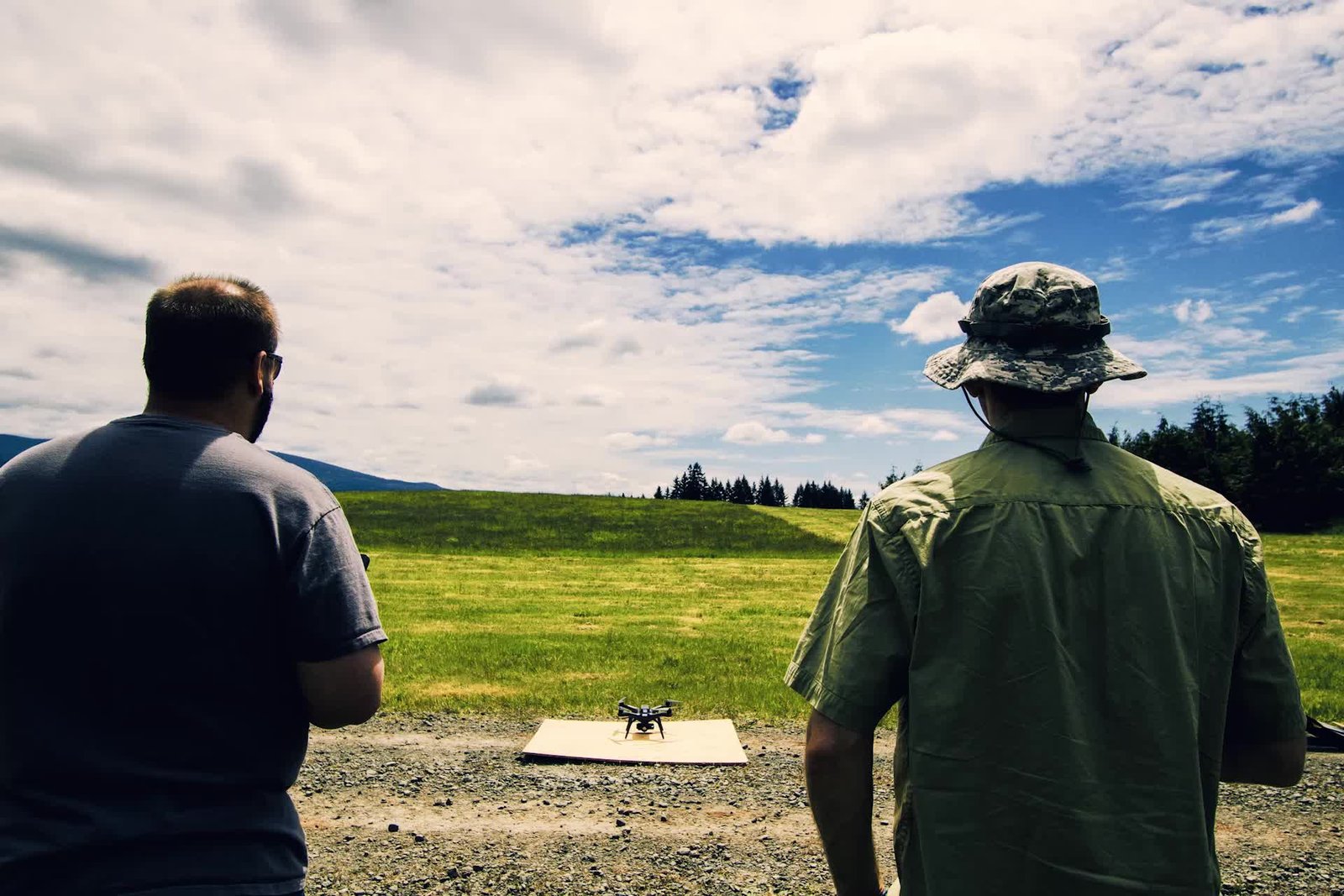
If you have spent time on the islands recently, you have probably heard the faint buzz of a drone overhead — filming a dramatic cliffside for a hotel promo, inspecting a wind turbine, or helping emergency crews map a fire. Behind many of those flights is a growing need for skilled, certified pilots who understand both the technology and the rules. That is where Alisios Dron comes in.
Registered as a driving and piloting school under Spanish law, this small Santa Cruz de Tenerife firm has made drone-pilot training its core mission. Its stated purpose is “the provision of training activities and classes for the handling and piloting of remotely piloted aircraft and drones, for individuals, companies or collectives, through non-official teaching systems.” In plain English: they teach people how to fly drones safely and professionally, without being a formal state school. Alongside the classroom work, the company also offers advisory services and carries out professional drone jobs itself — a combination that, its director Antonio Bolaños Higuera argues, makes it a driving force in the sector.
What the Company Actually Does
Public records and the firm’s own LinkedIn profile paint a picture of three interconnected activities. First and foremost is pilot training. Alisios Dron runs courses aimed at individuals, businesses and organisations that want to operate drones legally and competently. Because it is a private entity offering “non-official” instruction, it is not a state-accredited school, but its curriculum is almost certainly built around the competency exams that Spain’s aviation safety agency, AESA, requires for different categories of flight.
Second is advisory work. For a local business or town hall that wants to start using drones but has no idea where to begin with registrations, insurance, authorisations or no-fly zones, Alisios Dron offers consultancy. In practice, this means helping clients navigate the dense thicket of EU and Spanish rules that govern everything from flying near people to operating at night.
Third, the company flies missions itself. Its LinkedIn profile lists “professional work with drones” as a service line. While the company does not publish a detailed menu of specific jobs, the typical professional applications in Spain and the Canaries are well established: infrastructure and building inspection, surveying of solar parks and wind farms, agricultural monitoring, filming for tourism and real estate, and support for emergency services. It is reasonable to assume that Alisios Dron operates in several of these areas, though the exact mix is not publicly documented.
Why the Canary Islands Are a Natural Drone Laboratory
Several factors make the archipelago an unusually good place for a drone business to grow. The first is the regulatory framework itself. Spain applies the EU’s EASA rules, which classify drone operations into Open, Specific and Certified categories, each with increasing levels of risk and red tape. To work commercially, an operator must register with AESA, pass competency exams, hold third-party liability insurance, and comply with strict limits on altitude, distance from people and buildings, and airspace restrictions. New rules under Royal Decree 517/2024 have added Remote ID requirements and dual registration of both operator and aircraft. This complexity creates a steady demand for training and advice — exactly the niche Alisios Dron occupies.
The second factor is practical demand. Tourism and real estate companies constantly need fresh aerial footage to market hotels, villas and landscapes. Renewable energy operators — and the Canaries have plenty of solar and wind farms — use drones for inspection and maintenance, cutting costs and keeping workers out of risky situations. Farmers and environmental agencies are turning to drones for precision agriculture and erosion monitoring. And emergency services have used them during volcanic crises and forest fires, operations that Spain’s rules explicitly allow with the right authorisations.
The Training Landscape: What Pilots Learn
Alisios Dron’s training is built around the AESA competency pathway that any serious operator in Spain must follow. While the company does not publish detailed course syllabi, the structure of the regulatory system gives us a clear idea of what its students study. For basic Open-category flights, pilots need the A1/A3 certificate, which covers airspace rules, safety, privacy and technical fundamentals. For flights closer to people, the A2 certificate is required. More complex commercial work — flying over populated areas, at night, or beyond visual line of sight — falls under the Specific category and demands standard-scenario authorisations or full safety studies.
A comparable Canary Islands entity, CanariasDron, acts as an AESA-recognised training organisation. Alisios Dron’s positioning is similar, though there is no public record confirming formal AESA recognition for Alisios Dron specifically. That does not mean its training is less valuable; many private schools effectively prepare students for the official exams without being accredited exam centres themselves. The firm’s registered corporate object explicitly covers “non-official” instruction, so students would likely take their final competency tests through AESA’s own channels after completing the course.
A Wider Opportunity for the Islands
Zooming out, the drone sector represents a genuine medium-term opportunity for the Canarian economy. The islands’ dispersed infrastructure and growing renewable-energy footprint are perfectly suited to drone-based inspection and mapping. High-value landscapes create continuous demand for licensed aerial filmmakers. Precision agriculture is increasingly standard in Spain, and the Canaries’ mix of vineyards, subtropical crops and protected natural areas offers a rich field for monitoring work. Public initiatives, such as Fuerteventura’s free drone-pilot courses targeting A1, A2 and STS certifications, show that regional governments see drone literacy as a strategic skill for employability.
Within this ecosystem, Alisios Dron operates as a specialised micro-player. Claims that it “leads” the sector or is “driving professionalisation” come from the company itself and reflect its ambition rather than any independent market ranking. What the available data supports is a more modest but still valuable picture: an early, locally focused training and services provider that is helping to build the skilled workforce the islands’ drone economy will need.
Common Questions
- Do I need a licence to fly a drone in the Canary Islands?
- Yes. Even for recreational use, you must register as a UAS operator with AESA and pass at least the A1/A3 online competency exam. Commercial work requires additional certifications.
- What kind of training does Alisios Dron offer?
- The company provides non-official private instruction aimed at preparing pilots for AESA competency exams and professional drone operations, covering theory, safety and practical skills.
- Can I fly a drone anywhere in the Canaries?
- No. There are strict no-fly zones around airports, national parks and certain urban areas. You must check AESA’s official maps and obtain any required municipal permits before flying.
- Is drone insurance mandatory in Spain?
- Yes. Third-party liability insurance is required for all drone flights in Spain, and it is mandatory for any commercial operation under AESA rules.
- What professional drone services are common on the islands?
- Typical applications include infrastructure inspection, renewable-energy surveys, agricultural monitoring, tourism filming, real-estate photography and emergency-response support.
Read on
- Tenerife: Teide film Donde duele el aire on 21 OctoberTenerife · 21 October
- TF-5 Tenerife: widening from November, 24-hour workingTenerife · 21 October
- Gáldar Drone Spectacle 2026: A Sky Full of Light Over the Historic QuarterGran Canaria · 22 July
- Tenerife: Feria Tricontinental from 24 October in Santa CruzTenerife · 21 October
- Tenerife: two-year jail term for fake rental adsTenerife · 21 October
- All events on Tenerife →
Stand 23 July 2026. This article is based on publicly available company registrations, regulatory documents and the firm's own statements. Specific course details and AESA recognition status have not been independently verified.