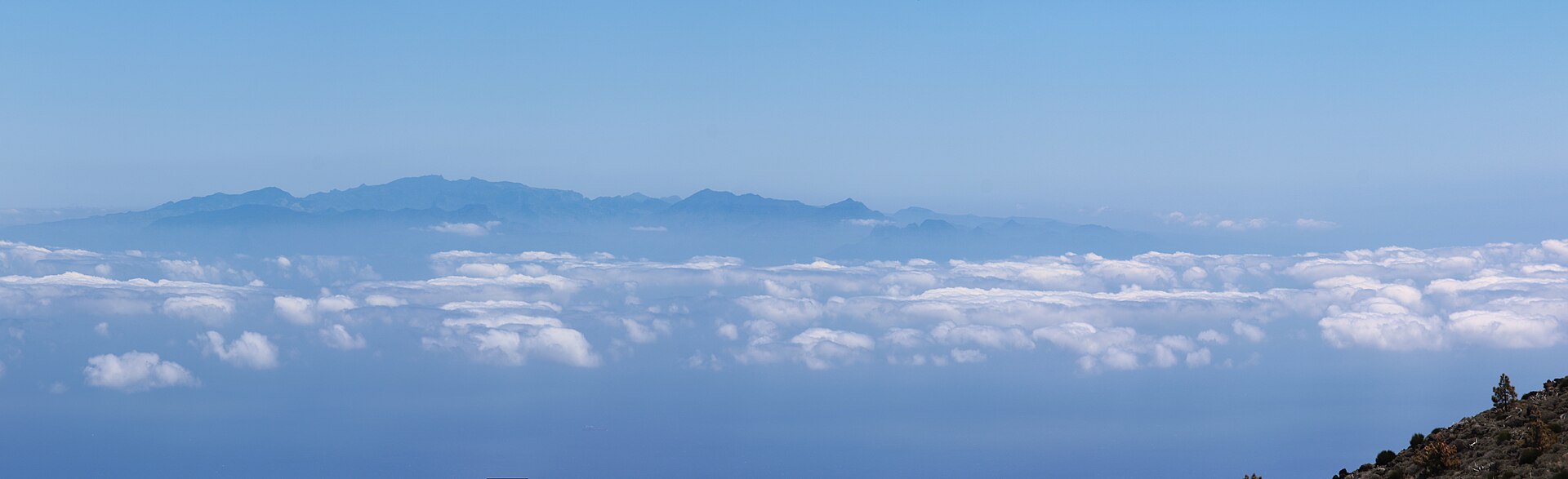
What makes Tejeda on Gran Canaria so special?
Tejeda lies in the central Caldera de Tejeda, a high-mountain landscape shaped by volcanism and erosion. The town sits at around 1,050 m above sea level and is therefore noticeably cooler than the coastal resorts of Gran Canaria.
The Roque Nublo is the best-known landmark. The basaltic monolith stands within the municipality of Tejeda; depending on the official tourism website, its height is given as more than 70 or almost 90 metres.
According to municipal material, the Roque Bentayga was an important religious and cultural site for the indigenous population. Caves, rock carvings, burial sites and former dwellings bear witness to the pre-Hispanic use of the region.
The protected areas around the Roque Nublo lie within the Gran Canaria Biosphere Reserve. Cruz de Tejeda, Degollada de Becerra and the surroundings of the Roque Bentayga are regarded as particularly important viewpoints.
How do I get to the Roque Nublo and what applies in 2026?
Access via the S-70 path at Degollada de La Goleta requires a reservation through the official booking system. Entry is limited to 60 people per hour and checked by QR code.
The official tourism website gives Monday to Sunday, 10:00 to 17:00, as the access times. Another official information page gives 09:00 to 17:00; because of this discrepancy, the time currently shown in the official reservation system should be checked before visiting.
Parking around the Roque Nublo is prohibited. The town centre of Tejeda and Cruz de los Llanos serve as alternative car parks. From there, shuttle buses on Global route 18 operate.
Route 18 does not run every 30 minutes on the relevant stretch, but at specific departure times. From Tejeda towards Faro de Maspalomas via Roque Nublo, for example, departures are listed at 09:30, 10:30, 11:30, 13:00, 14:00, 15:30, 16:30 and 17:30; in the opposite direction from Tejeda via Ayacata–Roque Nublo, among others at 09:00, 11:00, 12:30, 13:30, 15:00, 17:00 and 18:00.
People with reduced mobility may use the reserved spaces at Degollada de La Goleta, provided they are free and the relevant proof is shown to the control staff.
How do I reach Tejeda by car or bus?
From Las Palmas de Gran Canaria, the route goes via the GC-15 through Santa Brígida and San Mateo.
The winding mountain road can take longer in bad weather or heavy traffic. For the Roque Nublo, the starting point given is Degollada de La Goleta on the GC-600, kilometre 11.3, between Llanos de la Pez and Ayacata.
By bus, travel from Las Palmas on route 303 to San Mateo and then on route 305 to Tejeda. Route 18 runs between Tejeda, San Bartolomé de Tirajana and Faro de Maspalomas.
The Cabildo also mentions a direct or connecting route 18 from the south with three return trips daily to the Roque Nublo area. Timetables can change seasonally; before setting off, the current times from Global and the Cabildo should be checked.
How much does a visit cost and what rules apply?
In the available official information, no entrance fee is mentioned for the hiking trail to the Roque Nublo. The regular Global fare applies for the shuttle; no specific fare is stated in the information available.
The official sources that can be found do not give a reliably published, uniform entrance or parking fee for Tejeda for 2026. Museums and visitor centres may have different prices or free admission.
The official recommendations are: carry ID, pack enough water and food, wear sturdy footwear, and take sun protection as well as extra warm clothing. Use only marked paths and do not collect or damage plants, animals or other elements of nature.
In an emergency, call 112. In the highlands, wind, fog, strong sun and rapid temperature changes can occur. Access may be temporarily restricted due to weather conditions, forest fire risk or protection measures.
When is the best time to visit Tejeda?
For a reliable presentation of monthly averages for temperature, rainy days, sunshine hours and sea temperature, the current AEMET climate normals for the appropriate weather station must be used. The available search results do not contain these monthly figures; therefore no unconfirmed numbers are given here.
In the highlands, autumn to spring are often pleasant for hiking, but cooler than the coast. In winter, nights and higher altitudes can become distinctly cold; in summer, solar radiation is strong and walks should be started early.
Calima, the arrival of Saharan dust, can generally occur at various times of year and affect visibility, air quality and heat. Trade winds are a recurring climatic feature of the Canary Islands; their strength and effect differ depending on location and altitude.
Current values and warnings: CITA weather (cita.news/de/wetter.html) and AEMET.
What alternatives are there to Tejeda on Gran Canaria?
If you do not want to stay overnight in Tejeda or prefer to avoid the town at busy times, you can stay in San Mateo or Las Palmas and make a day trip. Artenara, with its cave houses and highland scenery, is an alternative.
Valleseco and Teror offer agriculture, tradition and pilgrimage culture. The viewpoints at Cruz de Tejeda, Degollada de Becerra or in the area around the Roque Bentayga can be combined.
Instead of a demanding summit tour, a shorter, officially designated route can be chosen. The official tourism bodies recommend both the tourist information office in the town centre and the information point at Cruz de Tejeda.
Tejeda differs clearly from the coastal towns: beaches, resorts and nightlife are mainly in the south of Gran Canaria. The central location makes Tejeda a good addition to a Gran Canaria stay, but not an equivalent substitute for a coastal base.