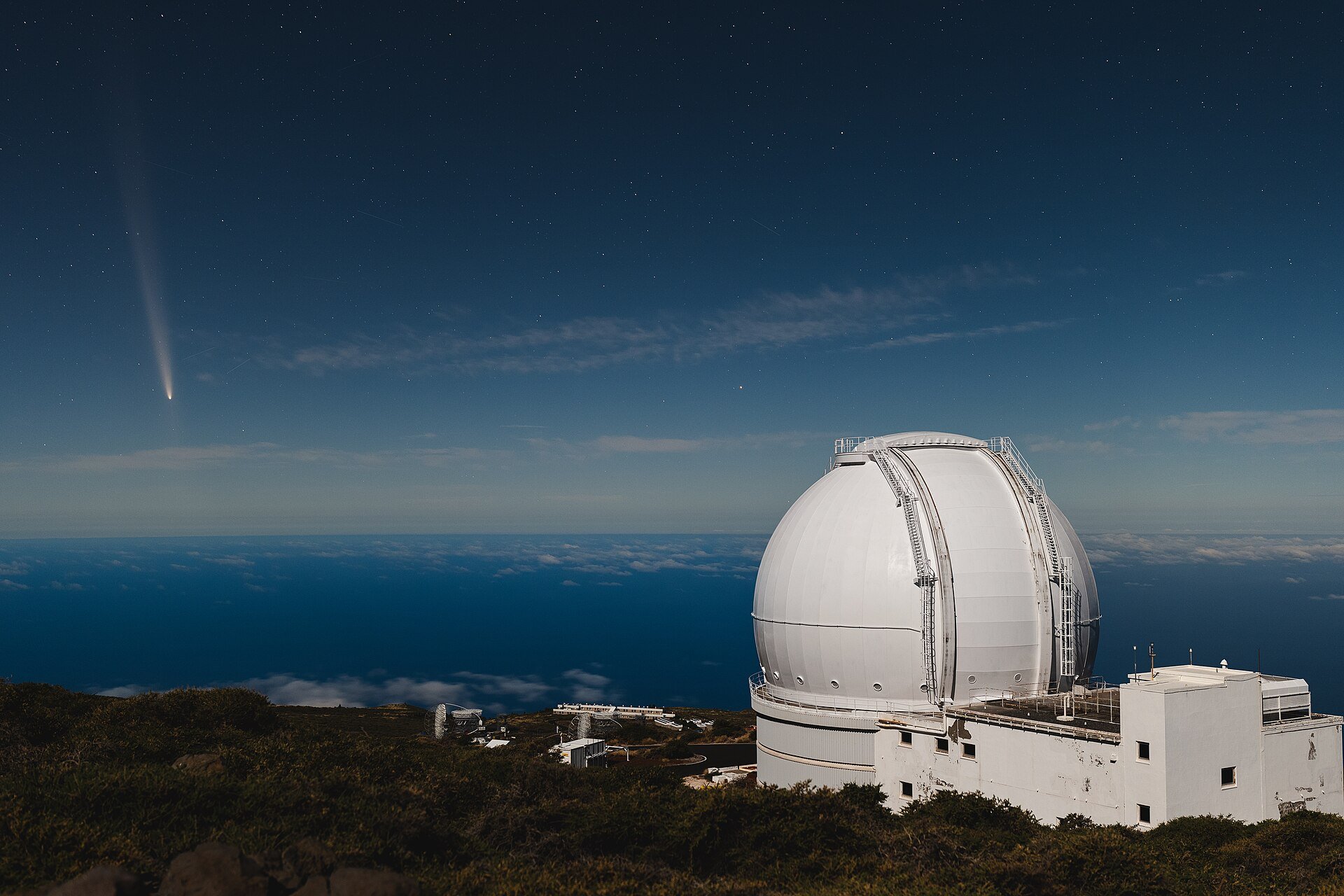
There are places where you simply look up at night and fall silent. La Palma is one of them. Because the island rises steeply out of the Atlantic, in the evening you're often above the sea of clouds — the trade-wind clouds stay below you, and overhead stretches a deep-black, clear sky. What you then see, many people know only from books: the Milky Way as a glowing band, shooting stars, planets.
Keeping it that way is hard work. La Palma has declared its sky a resource and protects it rigorously. That is exactly what makes the island one of the best places in the world to see stars — for professionals with giant telescopes and for holidaymakers with the naked eye alike.
A sky under protection
As early as 1988 the Canary Islands passed the «Ley del Cielo», the Sky Law — a worldwide pioneer. It limits light pollution, regulates lighting and keeps interference away from the observatories. In 2012 La Palma was designated the world's first Starlight Reserve and a Starlight Tourist Destination; the whole island is also a UNESCO Biosphere Reserve.
To the law is added the geography: the altitude above the sea of clouds, the clean Atlantic air and the remoteness make for exceptionally clear, steady nights. No wonder astronomers from all over the world come here.
One of the best observatories in the world
High on the island's summit, at around 2,400 metres, sits the Roque de los Muchachos Observatory. In operation since 1985, it ranks among the three most important astrophysical observatories in the world and hosts telescopes from many countries. Its best known is the Gran Telescopio Canarias (GTC), inaugurated in 2009: the largest optical telescope in the world, with a 10.4-metre mirror.
Where you can see the stars yourself
You don't have to be an astronomer. Scattered across the island is a network of astronomical viewpoints where you can marvel with the naked eye alone. If you want more, book a guided stargazing session: local operators and Starlight-certified guides bring telescopes, show planets, nebulae and distant galaxies and explain the sky. Especially lovely is combining a sunset over the sea of clouds with the starry sky that follows.
Practical notes for the night
A few things make the difference. Up there it's cold even in summer — warm clothing is a must. It's darkest on moonless nights; a glance at the lunar calendar is worthwhile. Near the observatory the rule is: no white light, it disturbs the measurements. And the drive up to the Roque winds a long way uphill — allow enough time and, if you can, book a guided tour.
Frequently asked questions
- Why is La Palma's sky so special?
- Because of the altitude above the sea of clouds, the clear Atlantic air and strict protection against light pollution. La Palma was the world's first Starlight Reserve.
- What is the «Ley del Cielo»?
- A Sky Law from 1988 — a worldwide pioneer — that limits light pollution and interference with the observatories.
- Can you visit the observatory?
- Daytime tours of the domes are offered at the visitor centre. Night-time stargazing takes place elsewhere.
- Where can you best see the stars?
- At the island's astronomical viewpoints, with the naked eye or — better — on a guided tour with a telescope.
- What should you bring?
- Warm clothes, a red (not white) lamp and patience; moonless nights are the darkest.
Read on
- La Palma diesel at €1.90: 57 cents more since FebruaryLa Palma · 12 October
- La Palma: AstroFest links sun viewing and Awara cosmosLa Palma · 10 October
- La Palma: 100+ classic Land Rovers meet in Mazo, 10 OctLa Palma · 9 October
- La Palma: 220 cruise calls by Aug 2027, 48 in DecemberLa Palma · 9 October
- La Palma: renting a flat – prices, areas and tipsLa Palma · 6 October
- All events on La Palma →
As of 11.07.2026. Details based on La Palma Turismo. Offers, opening hours and access to the observatory may change and are given without guarantee; the road can be closed in snow.