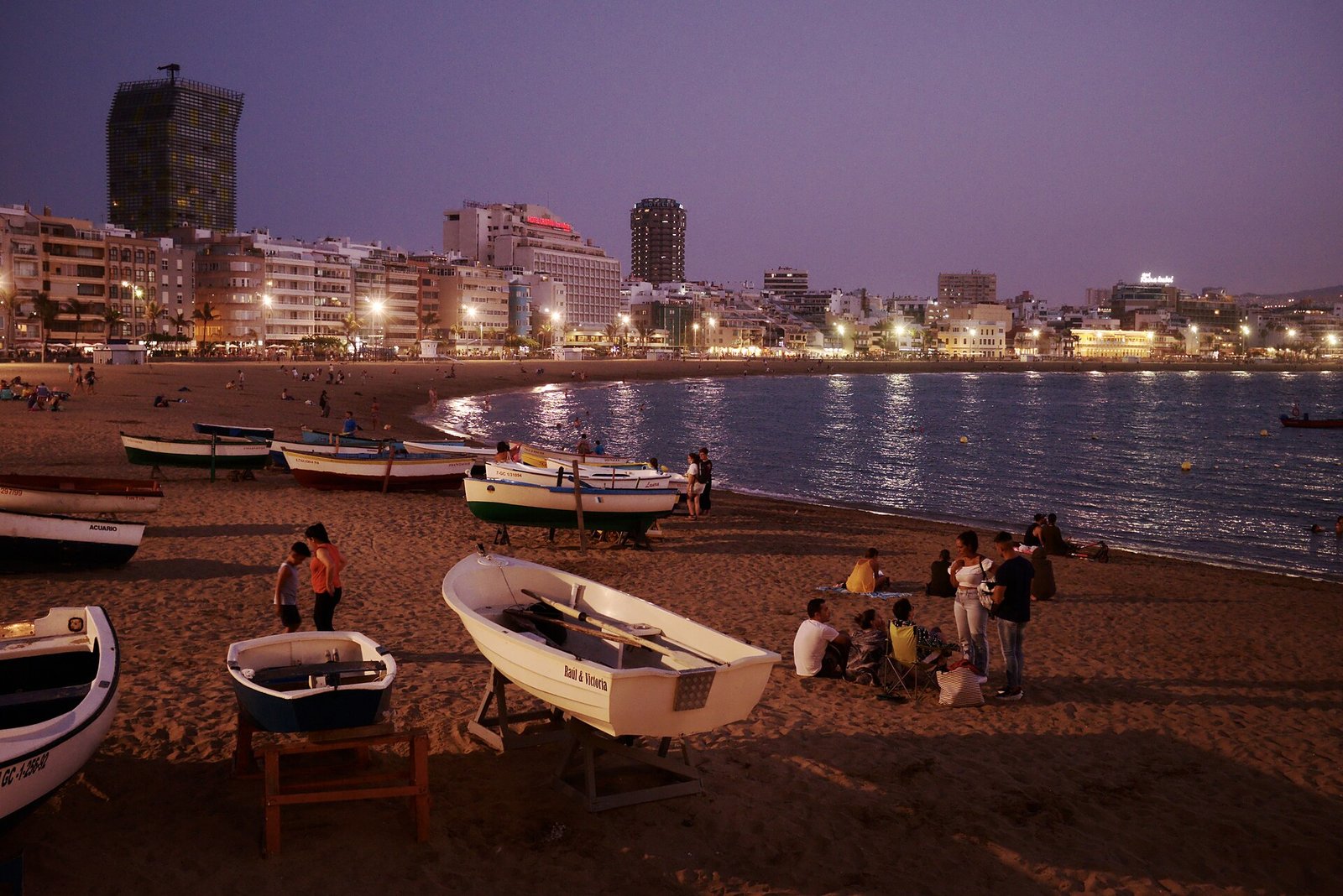
Summer turns Las Palmas de Gran Canaria into a relaxed Atlantic city: the beach sits right in the middle of things, the sun sets late and spectacularly over the sea, and in the evenings the terraces fill up from Vegueta to Las Canteras. This is an “Atlantic summer” — warm, but rarely oppressive, because the trade wind almost always keeps a fresh breeze going.
Whether you are here for a few days or living on the island year-round, that warmth invites a very concrete plan: a swim in the morning, a siesta or an old-town stroll in the afternoon, fish and a glass of wine in the evening, and the odd fiesta along the way. Here is our practical guide to summer in the city.
The beaches: Las Canteras, El Confital and Las Alcaravaneras
The centrepiece is Playa de Las Canteras, a city beach running for roughly three kilometres through the middle of Las Palmas. A natural rock reef, La Barra, lies just offshore and breaks the Atlantic swell: at low tide it almost surfaces and turns much of the bay into a calm, shallow pool — perfect for swimming and snorkelling, children included. The paseo, the seafront promenade, runs the length of the sand, lined with cafés, ice-cream parlours and fish restaurants.
If you like it wilder, walk on to Playa de El Confital at the tip of the La Isleta peninsula: rugged nature, clear water and one of the city's best-known surf spots. And on the harbour side you will find Playa de Las Alcaravaneras, a calm, sheltered beach right next to the marina — handy when the wind is up at Las Canteras.
Summer tradition: the Fiestas del Carmen and San Lorenzo
Canarian summer is fiesta season, and Las Palmas is no exception. Around mid-July the old fishing quarters — above all La Isleta by the port — celebrate the Fiestas del Carmen in honour of the Virgen del Carmen, patron saint of seafarers. The highlight is the maritime procession: her figure is carried onto a decorated boat and taken out to sea, escorted by a colourful flotilla — an atmospheric spectacle that brings the whole neighbourhood out.
Early August brings San Lorenzo, the feast of the city's patron in the district of the same name, with music, a verbena (open-air dance) and fireworks. Between and after them, smaller street parties string together across the districts. You need no ticket and you need to know no one — joining in is precisely the point.
Stars, warm nights and the Atlantic light
“Stars” belong to the Atlantic summer — but with an honest caveat: in the middle of the lit-up city, Las Palmas is not a place for serious stargazing. What the city offers instead are long, mild evenings, the special Atlantic light of the blue hour and nights that rarely turn truly cold. To see a sky full of stars, you head up into the island's interior, to the cumbre around Roque Nublo and Pico de las Nieves, where it gets dark and clear — the Canaries' real stargazing country lies on the summits and, above all, on the neighbouring island of La Palma.
In the city itself the evening happens elsewhere: in the historic old town of Vegueta, with its cobbled lanes and cathedral, in neighbouring Triana for a stroll, and of course along the Las Canteras promenade. The city's food scene is surprisingly varied — from simple fish restaurants serving the day's catch, through Canarian cooking with papas arrugadas and mojo, to modern kitchens. By the sea you dine outdoors, almost with your feet in the sand.
Plan it well: weather, the trade wind and getting there
Summer in Las Palmas is mild rather than scorching: daytime highs usually sit in the pleasant mid-twenties to low thirties, tempered by the steady trade wind (alisio) that keeps the air fresh and usually holds humid heat at bay. That makes the city one of Spain's more comfortable summer destinations — even if the wind can pick up noticeably at Las Canteras on some afternoons. A light layer for the evening never hurts.
The city is easy to explore on foot and by public guaguas (buses); from the airport you are there in about half an hour. Sunscreen, water and a hat belong in the bag even with a breeze — the Canarian sun is easy to underestimate.
Common questions
- When is the best time for Las Palmas in summer?
- The whole summer is mild; July and August are warm but, thanks to the trade wind, rarely oppressive.
- Can you swim right in the middle of Las Palmas?
- Yes. Playa de Las Canteras is a city beach about three kilometres long, and the La Barra reef keeps much of it calm.
- When are the Fiestas del Carmen?
- Around mid-July, above all in the port district of La Isleta, with the maritime procession as the highlight.
- Can you stargaze in Las Palmas?
- Only to a limited degree in the lit-up city; for a dark, starry sky you head up into the island's interior.
- Is it very hot in summer?
- Usually pleasantly warm; the alisio trade wind keeps temperatures bearable, though an evening layer can still be useful.
Read on
- Las Palmas Gran Cabalgata 20 Feb: 7 km, 100,000+ taking partGran Canaria · 14 October
- Vecindario: San Rafael 2026 fiestas with Braulio, GofionesGran Canaria · 14 October
- Michelin Stars Under the Maspalomas Sky: The New Summer Gourmet SeriesGran Canaria · 22 July
- Free Cinema by the Sea in Gran Canaria: Open-Air Screenings This SummerGran Canaria · 20 July
- Maspalomas Winter Pride: 2–8 November 2026Gran Canaria · 12 October
- All events on Gran Canaria →
Details as of July 2026. Fiesta dates, opening hours and weather can change; please check locally or with the town hall.