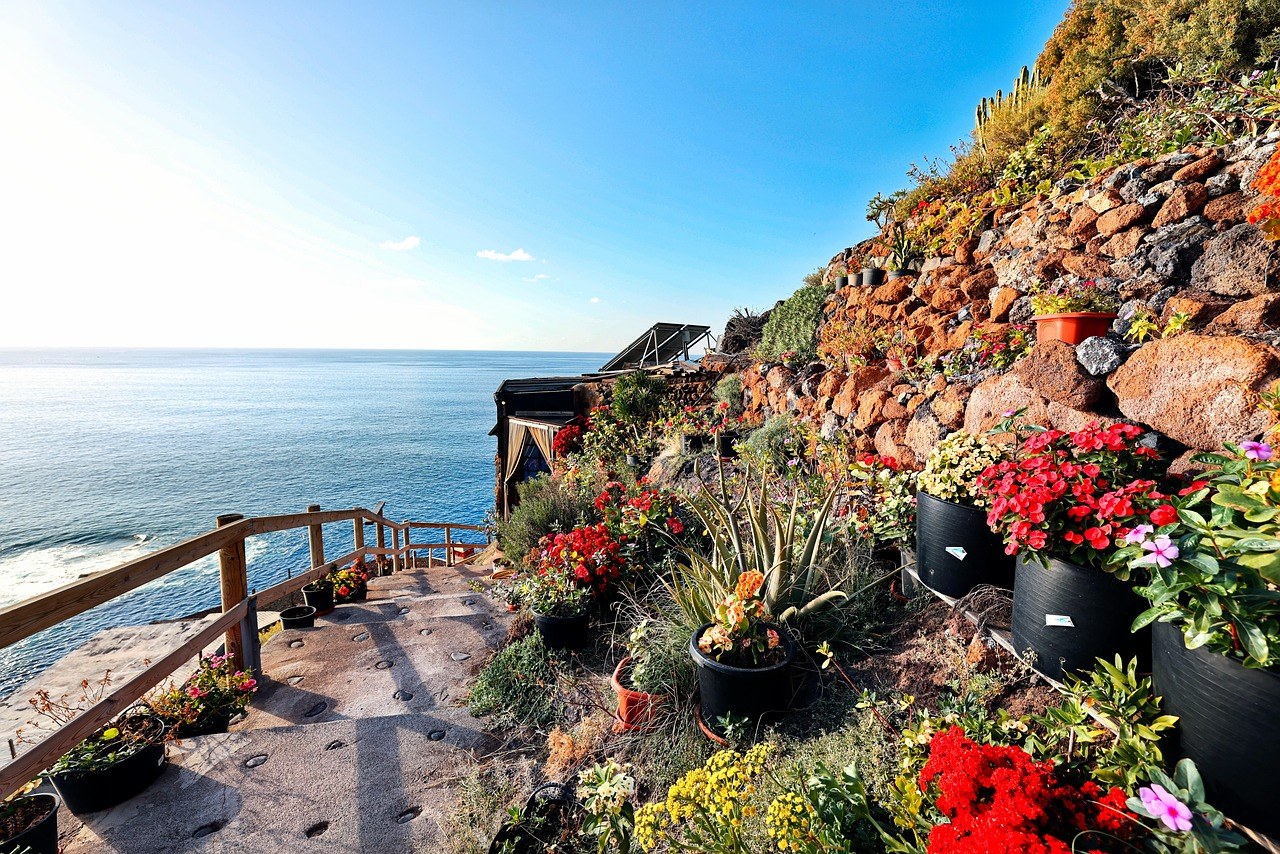
You do not find it by chance. Anyone who wants to see Porís de Candelaria has to look for it — and then descend a road that ranks among the steepest and most winding on the island. At the end, at the foot of a cliff, a cave opens. And inside it, beneath a rock roof some 50 metres high, white houses crowd together while the waves beat against the stone outside.
It is one of La Palma's most unusual places — and one where history, legend and raw nature meet.
A harbour built by nature
The cave is of volcanic origin, carved out over long ages by the Atlantic swell. Inside, the sea was calmer than out in the open — which made the inlet a natural mooring. That is exactly what the Canarian word «Porís» (also «Proís») means: a small, natural landing place.
More than a hundred years ago, the fishing boats bound for Tijarafe put in here, unloaded goods and took shelter. Little by little the fishermen raised humble huts and fitted out the natural caves as quarters. So the peculiar cave houses came into being.
The place appears in the records for the first time in 1588, then as a harbour from which wheat was shipped. From this coast, many Palmerans later set out for the Americas.
The Virgin who wanted to stay
The second part of the name is explained by a legend. In the sixteenth century an image of the Virgen de Candelaria was to be carried along the coast by ship. During a storm the sailors took shelter in the cave. When the weather calmed and they wanted to continue, every time they tried to take the image with them, the storm returned.
The sailors read it as a sign: the Virgin wished to remain here. So she became the protector of the fishermen. The figure was later moved to the church in Tijarafe, where she is venerated each August at the patronal festival. In the village itself, a small, well-kept Marian altar on the rocks still recalls the story.
What it is like today
Porís is neither a museum village nor a holiday resort. The 60 to 70 or so cottages and caves are privately owned; some families from Tijarafe keep them as second homes, drawn by the closeness of the sea and the complete seclusion. Some of the houses are more than 80 years old.
What makes the place special is precisely what is missing: no shops, no restaurants, no internet, not even bins. Whoever comes brings everything with them — and takes all their rubbish away again. The sound of the sea, amplified by the cone-shaped rock wall, fills the whole space.
How to get there
There are three ways. By car: in Tijarafe a narrow, steeply descending and winding road branches off towards the coast, partly unpaved; it is not signposted, so a navigation device helps. It ends at two car parks, the second one closer — from there it is about a five-minute walk.
On foot: the PR LP 12.2 trail runs as a circular route from Tijarafe through the Monumento Natural del Barranco del Jurado. Around 10 to 11 kilometres there and back, four to five hours, moderate to difficult, with a considerable change in altitude — one for experienced walkers.
By boat or kayak: from the harbour of Tazacorte, operators offer excursions that pass Porís and take in the neighbouring Cueva Bonita; along the way you often see dolphins, sometimes whales.
Frequently asked questions
- Where is Porís de Candelaria?
- On the west coast of La Palma, in the municipality of Tijarafe, around four kilometres from the town, at the foot of a cliff.
- Why are there houses in a cave?
- The cave offered a natural, sheltered mooring. Fishermen built huts here more than a hundred years ago and fitted out the natural caves as quarters. Today they are mostly second homes.
- Can you visit the houses?
- Only from outside. They are inhabited private property belonging to families from Tijarafe; the settlement is not a museum and has no tourist infrastructure.
- Can you swim there?
- When the sea is calm, yes, in the natural pool Charco Redondo with a ladder fixed by locals. The access is open to the sea and the swell can be strong — only with caution.
- How do you get there?
- By car along a steep, winding road from Tijarafe (two car parks, then a five-minute walk), on foot via the PR LP 12.2 trail, or by boat or kayak from Tazacorte.
Read on
- La Palma diesel at €1.90: 57 cents more since FebruaryLa Palma · 12 October
- La Palma: AstroFest links sun viewing and Awara cosmosLa Palma · 10 October
- La Palma: 100+ classic Land Rovers meet in Mazo, 10 OctLa Palma · 9 October
- La Palma: 220 cruise calls by Aug 2027, 48 in DecemberLa Palma · 9 October
- La Palma: renting a flat – prices, areas and tipsLa Palma · 6 October
- All events on La Palma →
As of 11.07.2026. Sources include eldiario.es, El Día, Banano Meridiano, EscapadaRural and Turismo de Canarias. Details of access, trails and bathing may change and are given without guarantee; a visit is undertaken at your own responsibility and in accordance with local conditions. The houses are private property.