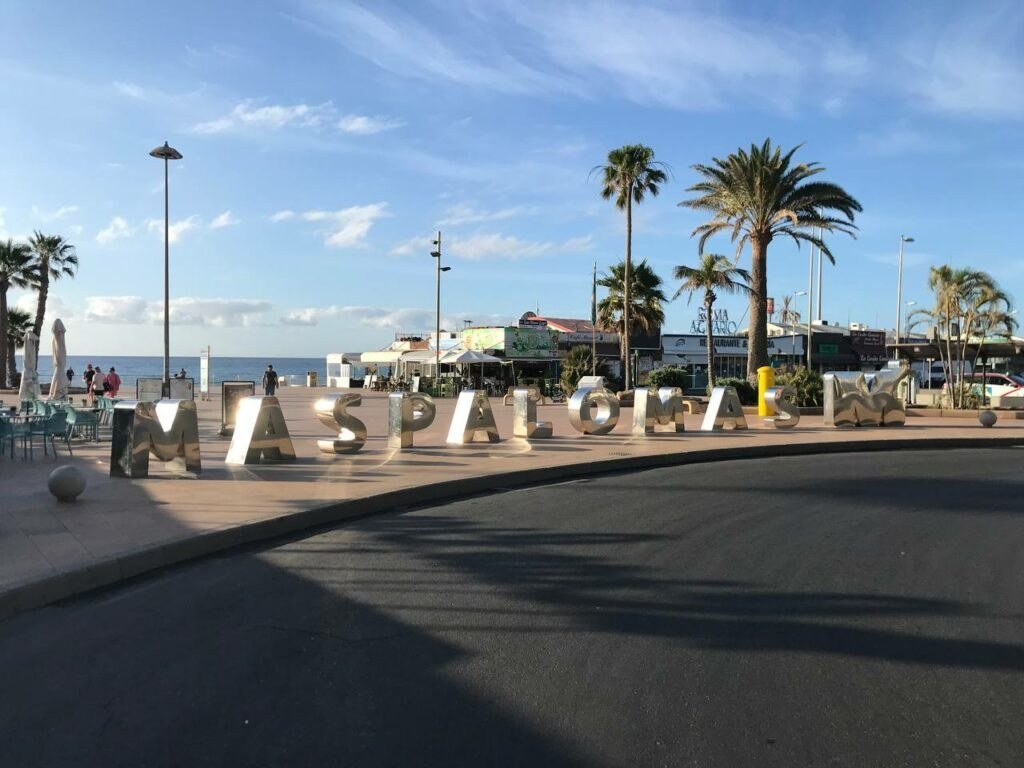
Maspalomas is a force. The tourist hub in the south of Gran Canaria, part of the municipality of San Bartolomé de Tirajana, has around 180,000 guest beds — about 70 percent of all the beds on the entire island. Together with Playa del Inglés and Mogán, the south accounts for over 80 percent of supply and demand. When tourism does well here, Gran Canaria does well. And at first glance it is doing splendidly.
The figures that look like success
Hotel occupancy in the south recently reached peaks of over 85, and in individual months as high as 91 percent — top figures by Spanish standards. Hotel revenue rose (in February by a good six percent to around €181 million). And the private sector is investing as rarely before: the island giant Lopesan is building a new five-star resort with 953 rooms across 160,000 square metres in Meloneras — one of the largest hotel projects the south has seen in years. Growth, it seems, everywhere.
The figure that gives pause
And yet there is one indicator that refuses to grow with the rest. A much-cited satisfaction index — measuring the perception of holidaymakers, drawn from review platforms such as TripAdvisor, Booking and Expedia by the analytics firm Mabrian — has been stuck for months at around 81 out of 100 points, with annual growth close to zero. In other words: despite record occupancy and record investment, what guests actually feel is stagnating. Such commercial indices should not be over-interpreted — the values vary slightly by source — but the direction is clear: more beds have not led to more satisfied guests.
Where the shoe really pinches: the tired middle
The most revealing finding is in the detail. Break satisfaction down by hotel category and a clear gap opens up: while five-star establishments reach almost 79 points, four-star hotels fall to around 68 and three-star ones to only about 65 points. It is the mid-range — the backbone of mass tourism — that is slipping. Many of these complexes date from the boom decades and are, in industry jargon, «obsolete»: structurally dated, technically outmoded, simply showing their age against newer competition. Guests notice — and rate accordingly.
Added to this is a shift in travel behaviour that hits the pure «sun-and-beach» holiday: stated interest in this classic product has fallen markedly, and a large share of tourists now express themselves as neutral about what is on offer. Also palpable is the decline in repeat guests — those loyal returnees who long formed the south's stable foundation.
The trickiest factor: Germany
For an area that relies heavily on German and British guests, a particularly awkward trend is added. Even the Canary Islands' tourism minister Jéssica de León openly admits «great uncertainty» in the markets and «dark clouds» over Germany — a country in its third year of recession that has already noticeably cut its air capacity to the islands for the coming winter. It is the same development we have described elsewhere as falling German booking figures: the most important source market is faltering at precisely the moment the south is pouring billions into concrete.
The big bet: Meloneras 2A
So what to do? The answer that politicians and major investors are banking on is renewal through new building. At its heart is the Meloneras 2A site, blocked in planning terms for more than two decades and released in 2025 by the San Bartolomé de Tirajana town hall. It enables a public-private investment of over €700 million; Lopesan alone may eventually build up to 1,800 rooms there. At the same time, more than 300,000 square metres of public land are to be created for schools, health and sports facilities and green spaces — an attempt to generate not just hotel capacity but quality of life.
The open question: more concrete or better beds?
Here opinions diverge. Supporters see the repositioning as the overdue modernisation of a mature destination — away from the tired mid-range, towards higher-quality, well-thought-out offerings. Critics, by contrast, ask whether even bigger mega hotels are the right answer to a problem that lies precisely not in a shortage of beds but in a lack of quality and authenticity. They point out that tourism now contributes over four billion euros in taxes — money that, by their reading, too rarely reaches residents as tangible improvement.
What remains
Maspalomas thus stands as an example of a question that troubles the whole of Canarian tourism: do you grow your way out of a quality crisis by building more — or better? The beds are full, that is true. But many of them have grown tired. Whether the south of Gran Canaria responds with smarter rather than merely bigger complexes will decide whether today's record occupancy becomes lasting success — or merely the calm before a structural storm.