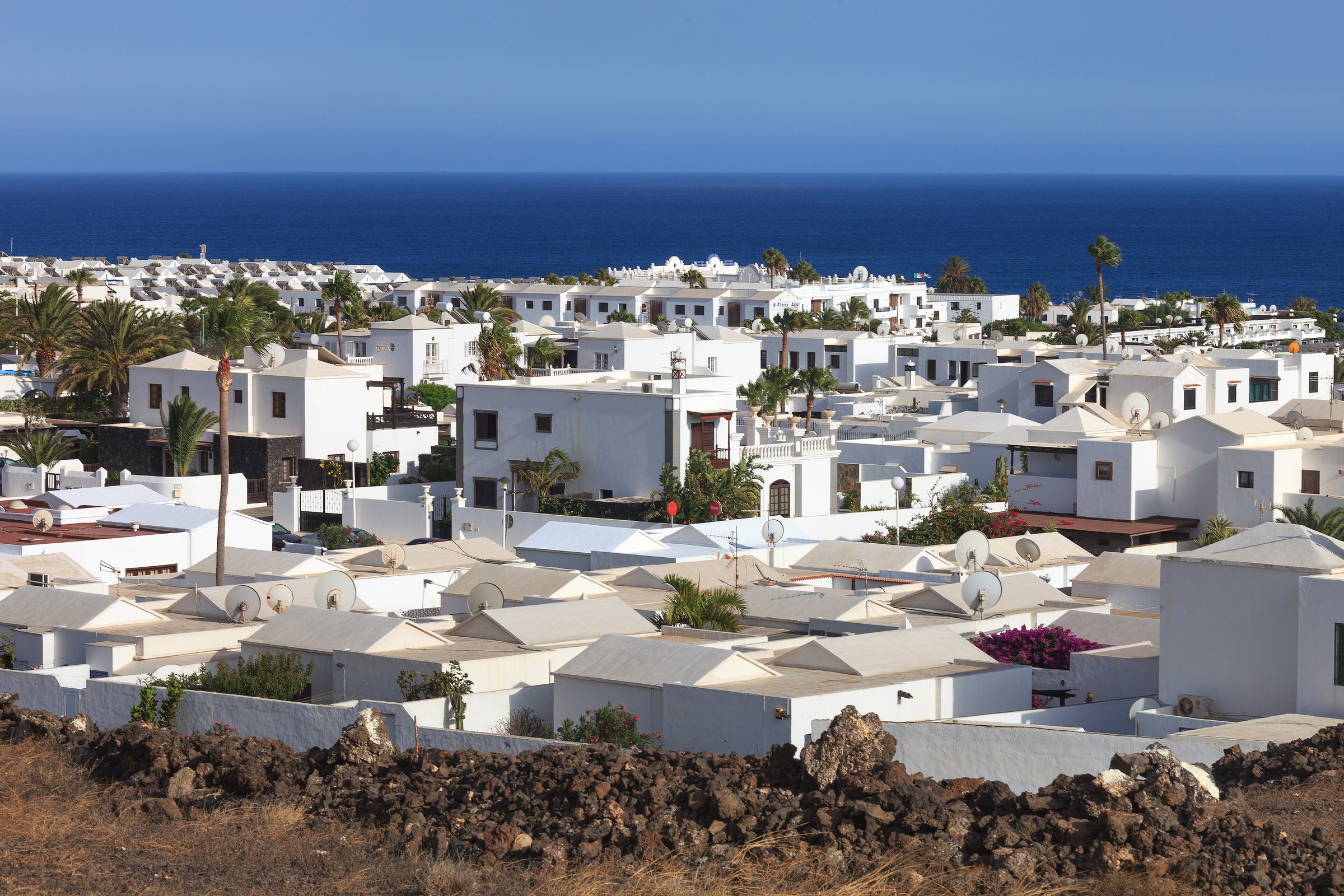
What can you do on the beach and in the water at Puerto del Carmen?
The municipality of Tías holds four Blue Flags for 2026, at Playa Grande, Matagorda, Los Pocillos and Playa Chica, according to a summary citing its town council. It matches headlines from RTVC and La Voz de Lanzarote, and says the flag rates water quality, safety, accessibility, services and environmental management.
RTVC reported on 5 May 2026 that 52 beaches in the Canary Islands have won the Blue Flag. Visitors should check at the beach access which beaches fly a flag during the season, as the information available lists no dates per beach from Tías.
Tourism portal spain.info credits the resort with “more than six kilometres of beaches with calm water”, while Wikipedia gives the Avenida de las Playas promenade as about 7 kilometres long. The best-known beaches are Playa Grande, Playa Chica and Playa de los Pocillos.
Wikipedia says Puerto del Carmen has many diving schools, with water at 19 degrees in winter and 23 in summer and visibility mostly above 25 to 30 metres. It also says Playa Chica has more than ten dive sites, reached from the shore or by boat; only each dive school can confirm prices and courses.
Tour operator Jet2holidays calls Playa Chica a small, lava-edged cove for diving and snorkelling, and Playa Grande the busiest beach, with showers, toilets, lifeguards and parasol hire. That is advertising copy, not an official statement, and so is its tip on the old harbour of Puerto Viejo, also called El Varadero, for eating and strolling.
Which sights near Puerto del Carmen are worth a day trip?
Bodegas El Grifo, a winery on the LZ-30 at kilometre 11 in San Bartolomé, runs a wine museum and was founded in 1775. It calls itself “one of the ten oldest wineries in Spain”, and a foundation stone found during the 1986 restoration confirmed the year, while the 20 to 25 minute drive from Puerto del Carmen is an unchecked estimate.
According to the winery's website, the museum is open Monday to Friday, with last entry at 17:15, and closed at weekends, though the page gives no year. Vinetur gives 10:00 to 18:00, which differs, so the winery's times are the ones to trust; its site names no admission price, and a third-party page lists 15 euros including two wines, unconfirmed.
The winery says the museum holds the original 1775 wine press of volcanic stone, historic machines and a Malvasía Volcánica from 1881. The visit is worth it mainly as an introduction to winemaking in La Geria for visitors from German-speaking countries, and the information available mentions no tours in German.
The Monumento al Campesino stands in Mozaga, in the municipality of San Bartolomé, and César Manrique created it to honour the island's farmers, says spain.info. It marks the geographic centre of Lanzarote and entry is free according to spain.info, but opening hours and details of the monument's restaurant are unconfirmed and should be checked before a visit.
The Fundación César Manrique has its seat at Calle Jorge Luis Borges 16 in Tahíche, in the municipality of Teguise. Spain.info and the foundation say the building is set into volcanic bubbles on a lava flow from the 1730s; the foundation also runs the Casa-Museo César Manrique in Haría, and opening hours and prices were not available.
Is the Museo Atlántico near Puerto del Carmen?
The Museo Atlántico lies 12 to 14 metres deep off Playa Blanca in the municipality of Yaiza, and it opened in 2016. Artist Jason deCaires Taylor made it, spain.info lists it with the sculpture group “Cruzando el Rubicón”, and the site has nothing to do with Puerto del Carmen.
Several German-language travel sites wrongly place the museum off Puerto del Carmen. Anyone setting out from there must plan a trip to the south of the island, to Playa Blanca, and no confirmed journey time or bus link is available.
The museum's current state is unconfirmed: an RTVC headline announces that Lanzarote will reopen the Museo Atlántico, while an Escapada Rural headline says its collection is under threat. No reopening date appears in the information available, so anyone wishing to visit should ask a diving school or the Cabildo (Lanzarote's island government) beforehand.
Bookings are made through diving centres, according to that information. Until the museum's operation is officially confirmed, it does not count as a safe recommendation.
How did Puerto del Carmen become a holiday resort?
Before the 16th century the area was called Tiñosa and served as an anchorage, later for the barrel trade, according to Wikipedia. It was declared a port of general interest in 1900 and lost that status in 1928, and in 1957 the fishing village took the name Puerto del Carmen, after Nuestra Señora del Carmen.
The Hotel Los Fariones is seen as the start of tourism. Wikipedia gives 1967 as the opening year and a German travel portal 1966, so the year is disputed and only the mid-1960s is documented.
A study by A. González Morales (University of Las Palmas de Gran Canaria, Papeles de Geografía 44, 2006) divides tourism development into phases: Belgian and French capital dominated before the 1970s, and German capital from 1973 to 1983. Mass tourism grew and concentrated in the municipality of Tías, Yaiza and Teguise followed until 1995, and sustainability principles then arrived, though their implementation stayed limited, the author says.
According to Wikipedia, guests come from Ireland, Britain, Germany, Scandinavia and mainland Spain, and Puerto del Carmen counts as the island's centre of mass tourism. That contrasts with the later, more tightly regulated resorts in Yaiza (Playa Blanca) and Teguise (Costa Teguise), and the information available does not document which quieter options exist there.
What do theme parks and excursions cost, and what is unconfirmed?
The Aqualava water park offers the “Splashtastic” ticket from 38 euros for adults in 2026, according to a listing on the booking platform Musement. It includes fast-track entry, a lunch menu with a drink and a locker, while a basic ticket starts at 27 euros on Musement and children aged 0 to 2 pay nothing, though these are platform prices, not the operator's figures.
Rancho Texas costs 30 euros for adults and 22 euros for children aged 3 to 12 in 2026. The zoo and theme park is open from 09:30 to 17:30.
According to Musement, the submarine tours start from Puerto Calero, with a free bus pick-up from Puerto del Carmen. No confirmed price exists, and there are also no official details on times, prices or distance for boat trips, dolphin tours and the coastal walk to Puerto Calero.
Entry to the Monumento al Campesino is free, says spain.info. For Bodegas El Grifo, the Fundación César Manrique and the Museo Atlántico, no price with a year is confirmed.
Which rules and dates should visitors to Puerto del Carmen know?
According to the tourism and beaches department of Tías, Lanzarote has been a UNESCO biosphere reserve since 7 October 1993. In its 2022 “Decálogo” (ten-point guide), the department asks visitors to follow guidelines in the spirit of the UNESCO Man and Biosphere programme.
The Ayuntamiento de Tías (town council) has a bylaw on public use of beaches and bathing areas, whose PDF is dated 2020. Which bans and fines it contains has not been established, so until it is checked, heed the beach signs and the lifeguards' advice.
According to Wikipedia, the Ironman Lanzarote takes place every May, with the swim at Playa Grande and start and finish in Puerto del Carmen. Wikipedia also names a carnival parade in February and a triathlon in June, but exact dates for 2027 are not available.
The fishermen's festival in honour of the Virgen del Carmen falls in the first weeks of August, with processions of decorated boats, according to spain.info. Other sources say July, so the accounts conflict, and the Tías summary's claim that Puerto del Carmen marks 60 years as an international destination in 2026 is unconfirmed beyond that source; the official events calendar is the binding guide.