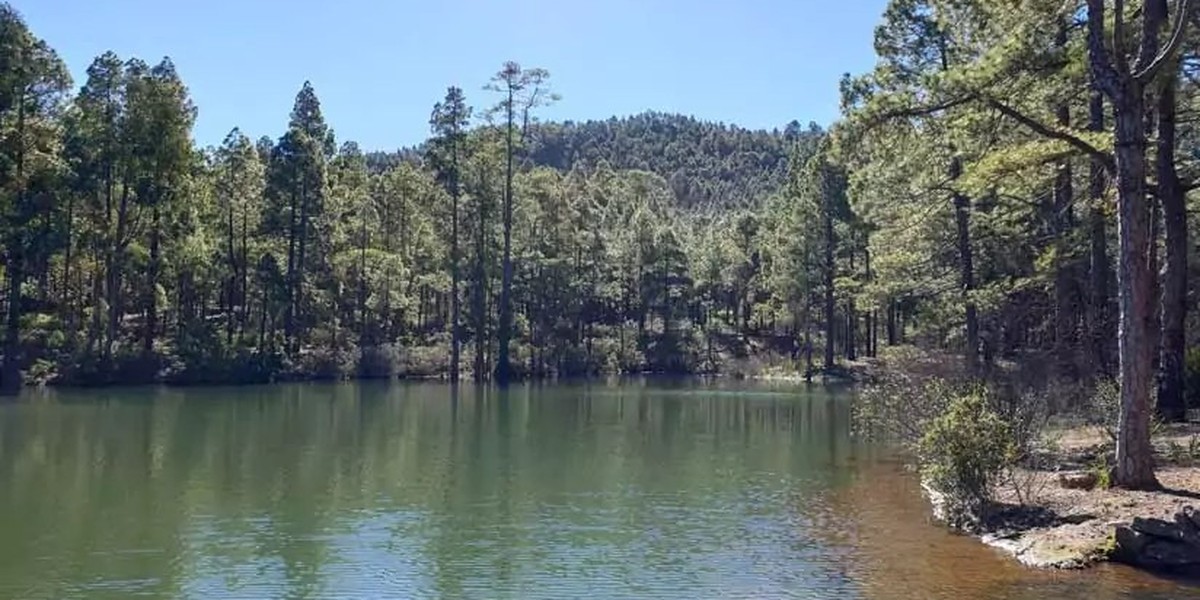
Twenty minutes from Artenara
Drive up the winding GC-216 from Artenara and after about twenty minutes you arrive in another world. Over 1,200 metres up, the scent of resin, the calls of woodpeckers, a carpet of needles underfoot: the Pinar de Tamadaba. Some 2,000 hectares of pine forest, set within a 7,500-hectare natural park that runs from the summits down to the sea cliffs and forms part of the UNESCO Biosphere Reserve.
It is one of the healthiest pine forests in the Canaries. And one with an unusual history.
The tree that resprouts from its trunk
The star of this forest is an endemic: the Canary pine. It grows wild nowhere else in the world. And it has an ability that makes it almost unique among pines — it survives fire.
Other conifers die when their crown burns. The Canary pine does not. After a fire it loses every needle, stands black and apparently dead — and then sprouts again straight from the charred trunk. Three adaptations make this possible: an exceptionally thick bark that can reach 18 centimetres, among the thickest in the entire Pinus genus. Dormant buds beneath that bark — epicormic buds — which are activated in an emergency. And stored carbohydrate reserves, from which the tree feeds the new growth.
The forest scientist José Climent has studied these mechanisms. His explanation for how the trait evolved is as convincing as it is unsettling: the island's rugged topography, with its deep ravines, acts like a chimney system during fires. Without the capacity to resprout, Climent argues, even the tallest trees would eventually perish.
What the fire of 2007 showed
Gran Canaria has seen how well this works. In the summer of 2007 a severe wildfire devastated around 18,000 hectares of the island. Two years later the pine forest was green again. After five years it looked as though it had never burned.
But a clarification is worth making here, one that tends to get lost in the enthusiasm. The individual tree resprouts quickly — specialists cite around four months. The forest as an ecosystem needs considerably longer: roughly ten years to truly regenerate. And the word «resistant» is misleading. The Canary pine survives fires of moderate intensity. In extreme fires it too can die.
Why this matters right now
This summer has reminded the islands how serious the situation is. During the heatwave that ended only this week, a wildfire warning was in force on Gran Canaria; on Tenerife the Cabildo extended its extraordinary prevention measures — no open fires, no barbecues, a smoking ban on hiking trails. The Canary pine is adapted to fire. But adaptation is not invulnerability, and more frequent, hotter fires change the equation.
The uncomfortable side: a forest that stands too dense
And then there is a debate that rarely appears in guidebooks. The Canary pine today covers more than 77,000 hectares of the Canaries — more than any other vegetation type, around 60 percent of the forested area. Yet this preponderance is not the work of nature alone.
By the middle of the twentieth century, Gran Canaria and Tenerife had centuries of over-exploitation behind them: deforestation, charcoal burning, intensive grazing. The Franco regime then launched large reforestation campaigns — partly with the idea of building a timber industry. In many places that policy stalled halfway.
Specialists now point out that Tenerife's pine stands are in places five times denser than their natural state. Stands that are too dense mean more fuel, competing trees, less undergrowth. The forest of Tamadaba was likewise reforested and regenerated during the twentieth century. That it is considered healthy today is a good sign — but it is a reminder that a pine forest in the Canaries is always also a shaped piece of landscape.
The forest of the Canaries, for centuries
Hardly any plant was used so intensively by the islanders. The indigenous inhabitants ate the pine nuts. From the resin-saturated heartwood, the tea, Canarians obtained an almost indestructible timber for beams, balconies, wine presses and ships; burning splinters served as torches. Bark became fishermen's floats, resin became pitch for caulking boats.
The tree itself is a living fossil whose ancestors reach back to the Jurassic. Relatives are found in the Mediterranean and, remarkably, in the Himalayas.
Practical matters for a visit
Tamadaba is no hidden gem, even if it is sometimes called one — it is among the most popular natural destinations for the people of Gran Canaria. Access is via Artenara (GC-216) or from the coast via Agaete and La Aldea de San Nicolás (GC-200).
At the heart of the pine forest, at around 1,200 metres, lies the camping and barbecue zone of Llanos de La Mimbre, with room for some 400 people; staying overnight and camping are permitted only with prior authorisation from the environment department of the Cabildo de Gran Canaria. Trails start from there, including the climb to the Pico de la Bandera and the classic Ruta de San Pedro, around 20 kilometres, with its views over Agaete.
The park is also regarded as Gran Canaria's foremost sport-climbing area: around 400 routes across 16 sectors on grey basalt walls. Climbing requires permission from the park administration — the management plan (PRUG) governs what may take place inside.
And with luck you may spot, high in the canopy, the blue chaffinch of Gran Canaria, the pinzón azul: a rare bird that could not exist without this forest.
Good to know: rules in the park
Camping and overnight stays at Llanos de La Mimbre are possible only with prior authorisation from the environment department of the Cabildo de Gran Canaria. Climbing requires separate permission from the park administration. When a wildfire warning is in force, additional bans on fires and smoking apply — if in doubt, check the current status with the Cabildo before setting off.