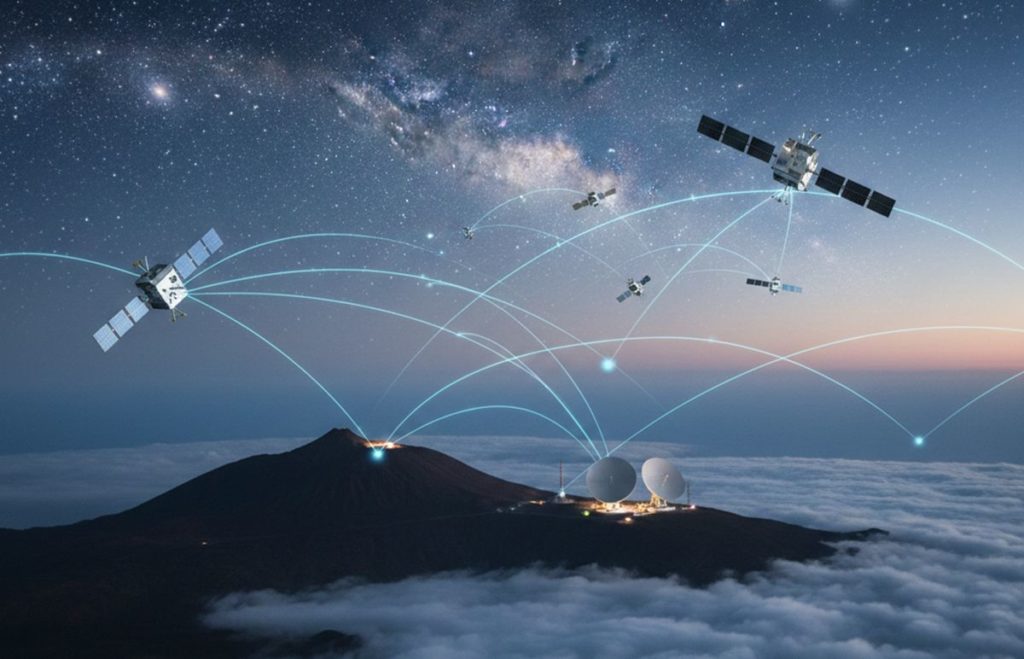
It sounds like a headline from a different part of the world: an island known mostly for beaches, Mount Teide and package holidays wants to turn itself into an "Atlantic space hub". That is exactly what the president of Tenerife's island government (Cabildo), Rosa Dávila, announced in late January with the "Tenerife Space Horizon" programme — by its own account the most ambitious space strategy the Canaries have ever seen.
The numbers in circulation: around €79 million of investment over the next five years, at least 500 skilled jobs, and the goal that the space sector should deliver 1% of Tenerife's economic output within ten years. That 1% roughly equates to an economic volume in the order of several hundred million euros a year — so the "€400 million" figure doing the rounds is not a pledged investment but the arithmetic translation of this GDP target.
What it's really about: away from a single sector
Behind the space vocabulary lies a hard-headed economic motive. Dávila said so herself at the launch: the aim is to "reduce our dependence on traditional sectors such as tourism" and move to a model that "creates skilled employment". Translated: Tenerife's economy hangs on a single sector — and well-educated young people leave the island because there are too few suitable jobs for them here. The promise is to "offer young people a future without having to leave".
This touches a nerve, and right now especially: in April, the Canaries recorded their first fall in foreign tourists since the pandemic. The debate over an "exhausted tourism model" has been running for two years. Looking for a second economic pillar is therefore not a luxury but a serious question.
This isn't a leap into the void — there is a foundation
What separates the strategy from pure political theatre: groundwork already exists, and it is real. Tenerife is home to the Instituto de Astrofísica de Canarias (IAC), a world-recognised research centre, along with the Teide Observatory, the "Teide" and "Anaga" supercomputers and the D-ALiX data centre.
Above all, the island already has something to show in space. In December 2023, ALISIO-1, the first Canarian satellite, was launched — developed by the IAC's IACTEC-Espacio division. On board was the DRAGO infrared camera, one of the most compact of its kind in the world. The earlier models have already done practical work: they monitored the 2021 La Palma volcanic eruption, water conditions in drought-hit regions and forest fires. This is where the project's most concrete value lies.
Eight eyes in the sky — for what?
The core of Tenerife Space Horizon is a constellation of eight Earth-observation satellites to be controlled from the island for the first time. Each satellite is to carry cameras for different light spectra, including the improved DRAGO-3 camera.
The practical point for the Canaries is obvious: an "eye in the sky" of its own, looking over the islands daily or several times a day — to respond quickly to forest fires, volcanic activity and other natural disasters, whose frequency is rising with climate change. For an island group that lives with fires every summer and with the aftermath of the 2021 La Palma eruption, this is not an abstract prestige project but potentially a disaster-protection tool. Add a "teleport" and a satellite ground station for communications and data processing, plus a link to the European Space Agency's ESA BIC Canarias business incubator.
Where scepticism is warranted
As promising as the foundation is, the round numbers deserve caution. The sector currently counts around 200 jobs on the islands; the targeted 500 are a tripling that has yet to be achieved. The 1%-of-GDP goal is explicitly set over ten years — a horizon spanning several political terms. Promises that reach so far into the future are easy to announce and hard to hold anyone to.
On the islands there are also critical voices asking whether €79 million of public money is well spent on satellites while the pinch is felt elsewhere — housing, health, roads. That scepticism is legitimate and part of the picture. The honest assessment: the technological foundation (IAC, ALISIO-1, DRAGO) is real and internationally recognised. Whether it becomes an economic engine with hundreds of jobs or an expensive niche project will be decided in the coming years by delivery — not by the press conference.
- Practical: better satellite Earth-observation can genuinely help with fire and disaster protection — a concrete benefit beyond prestige.
- Economic: if even some of the skilled jobs materialise, it would be a rare chance for young professionals to stay on the islands.
- Symbolic: it is the clearest attempt yet to broaden the Canarian economy beyond sun and sand.
- The yardstick: whether the bet pays off will show in satellites launched and contracts signed — not in announcements.
Frequently asked questions
- Is Tenerife really investing €400 million?
- No. The pledged investment is around €79 million over five years. The "€400 million" is the arithmetic translation of the goal that the sector should deliver 1% of Tenerife's economic output within ten years — a target figure, not a sum being spent.
- What does it bring ordinary islanders?
- Most concretely: better satellite Earth-observation for protection against forest fires and volcanic activity. In the medium term, the hope of skilled jobs so young professionals don't have to leave.
- Is this just a politician's promise?
- Partly. The technological foundation is real (the IAC, the ALISIO-1 satellite, the DRAGO cameras). The economic targets — 500 jobs, 1% of GDP — are long-term announcements whose delivery remains to be seen.
- Why Tenerife?
- The island has the IAC, a world-famous astrophysics institute, the Teide Observatory, powerful supercomputers and, with ALISIO-1, existing experience in orbit. The strategy builds on this ecosystem.
- What does it have to do with tourism?
- Everything. The stated aim is diversification — reducing dependence on a single sector. After the first tourism decline since the pandemic, the search for a second pillar is especially topical.
Read on
- Tenerife: La Oreja de Van Gogh in Adeje on 24 OctoberTenerife · 19 October
- Tenerife: ES-Alert phone test on 22 October, not emergencyTenerife · 19 October
- Mogán: deadline added late — objections to the tourism plan until 2 DecemberGran Canaria · 2 October
- Canary Islands end tourism moratorium fight, trading building rights for €500 millionCanary Islands · 21 August
- Puerto de la Cruz: Michelin star, but closed for refitsTenerife · 17 October
- All events on Tenerife →