Two projects, one island
If you arrive on Gran Canaria today, you travel by hire car, taxi or one of the Global bus lines. From the airport to Maspalomas takes 20–25 minutes via the GC-1 motorway, or about 25 minutes on the line 60 express bus. It works. And yet everyone is talking about two transit projects that have been in the pipeline for over a decade.
The first is the Tren de Gran Canaria: a railway from the Santa Catalina district in the capital along the east coast all the way to Meloneras in the south, 58 kilometres with eleven stations. The second is the MetroGuagua: not a train, not a tram, but a Bus Rapid Transit (BRT) system on dedicated lanes through Las Palmas. The two are intended to complement each other — a fast island line and a high-capacity urban bus connecting the harbour with the south of the city.
The Tren — the slow dream
The Tren was first announced in 2004. The Canary Islands government formally approved the plans in 2009, with an opening year of 2015. Today, in 2026, not a single sleeper has been laid. Cost estimates have drifted from 1.5 to 1.65 billion euros in the meantime. 85 percent was supposed to come from the European Regional Development Fund, the rest from Spain and the Canary Islands. There is no binding funding commitment for the full build.
The plan is for a hybrid of commuter and high-speed rail: ten five-car units carrying 500 passengers each, top speed 160 km/h, later expanded to 13 units. Stations are planned in Santa Catalina, San Telmo, by the hospital, in Telde, at the airport, in Vecindario, Playa del Inglés and Meloneras. Through Las Palmas the line runs underground — the San Telmo station is meant to sit at «menos tres», three storeys below street level, as Teodoro Sosa, vice-president of the Cabildo, told Canarias7.
Until Brussels makes a concrete commitment on EU funding, the construction is not financed. The earliest a first section could run is the early 2030s — and even that is optimistic.
MetroGuagua — the capital's construction site
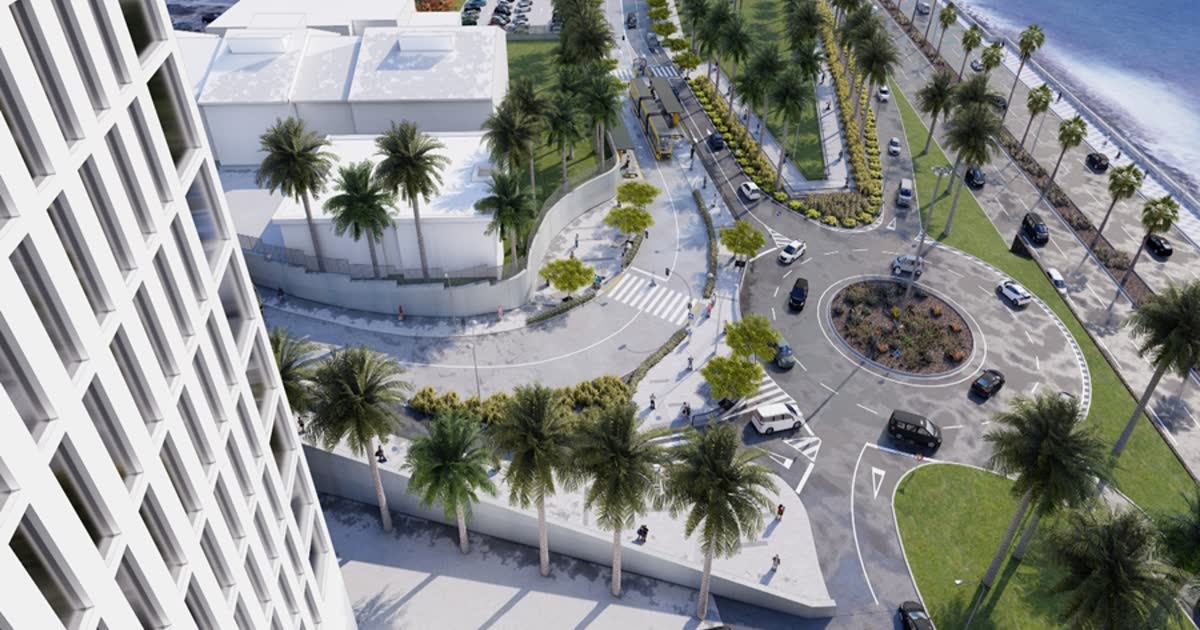
The MetroGuagua is more tangible. Construction has been under way since 2017. 11.7 kilometres on a dedicated alignment through Las Palmas, from La Isleta in the harbour district north to Hoya de la Plata in the south of the city. Planned frequency: every 4 to 5 minutes. Capacity per vehicle: 200 passengers. The advantage over a tram: no rails, no overhead wire, lower investment costs and shorter build time. In theory.
In practice: six years after construction began, several sections are still missing. Tramo 8 between Eduardo Benot and the Manuel Becerra terminal has been complete since early 2025. But the Hoya de la Plata station and the Vegueta junction remain open — the latter requires an extension of the coastal platform, since the GC-1 motorway needs to be relocated. The balance sheet from 25 April 2026: 43 million euros built, another 139 million required to finish the project.
The construction shapes the city. In Santa Catalina a road towards the Nicolás Estévanez motorway access has been closed for years. Only on 29 April 2026 did the Ayuntamiento decide to restore the connection at a cost of 200,000 euros — even while construction continues. Anyone who has visited the harbour district knows the barriers around Parque Doramas and the temporary detours along the León y Castillo corridor.
The subsidy row
In early May 2026, the Ministry of Public Works in Madrid demanded the return of a one-million-euro subsidy from 2023 — the Las Palmas Ayuntamiento had failed to spend the funds within the planned period. A technical issue, but politically charged: the city council and the island government have been quarrelling for months over who is responsible for the delays.
Deputy mayor Pedro Quevedo accused Coalición Canaria on 25 April of having «gambled away» 50 million euros of public funds by withdrawing from the MetroGuagua project. The CC opposition counters that the money is «the money of all taxpayers» and would be wasted on a poorly planned project. The party-political lines are clearly drawn — the open question is who will provide the next 139 million euros.
For travellers today — what works
As long as the two projects are not finished, the existing transit network remains the reality. From Las Palmas airport to Maspalomas: Global line 66 in 25–35 minutes, line 60 as the express, hire car via the GC-1 motorway in 20–25 minutes, taxi roughly 35 euros. Within Las Palmas: Guaguas Municipales line 12 runs the same corridor as the future MetroGuagua — at normal city-bus frequency in normal traffic.
The construction zones are visible to tourists, but rarely interfere with their stay. If you are staying in the harbour district around Parque Santa Catalina, expect minor detours — signage is consistent. In Vegueta, the old town with the cathedral and the market, the construction has not arrived; everything runs as usual there.
Looking ahead
The MetroGuagua can be finished — if the additional 139 million euros are raised. That is a political question, not a technical one. Realistically, partial sections might enter service in 2027–2028, with full completion later. The Tren is in a different position: without an EU funding commitment, no concrete will be poured. If you are travelling to Maspalomas in 2026, you should not factor the Tren into your plans — not even for 2030.
For travellers this means: the existing bus and hire-car system remains the island's lifeline. It works. The island does not depend on the Tren to be accessible — but the steady promise of a 25-minute trip from the capital to the south would change the character of tourism on Gran Canaria. So far, it remains a promise.
Frequently asked questions
- When will the Tren run in Gran Canaria?
- Early 2030s at the earliest. Construction has not started, the funding is not in place. Earlier plans named 2026 as the opening year — that is no longer realistic.
- What is the MetroGuagua?
- A bus rapid transit system (BRT) in Las Palmas with dedicated lanes, signal priority and 200-passenger vehicles. 11.7 km long, from La Isleta to Hoya de la Plata. Construction has been ongoing since 2017 and is not yet complete.
- How do I get from the airport to Maspalomas today?
- Global bus 66 or 60 (express) in 25–35 minutes. Hire car via the GC-1 motorway in 20–25 minutes. Taxi roughly 35 euros. There is no Tren yet.
- Are the construction works in Las Palmas a problem for tourists?
- In specific spots, yes. Santa Catalina has had a road towards the motorway closed for years — set to reopen soon. Other districts along the line 12 corridor see occasional detours.
- How much does the Tren cost?
- Estimated 1.49 to 1.65 billion euros for 58 kilometres of track and 11 stations. 85% was meant to come from EU regional funds, the remainder from Spain and the Canary Islands government. A funding commitment for the full build does not yet exist.