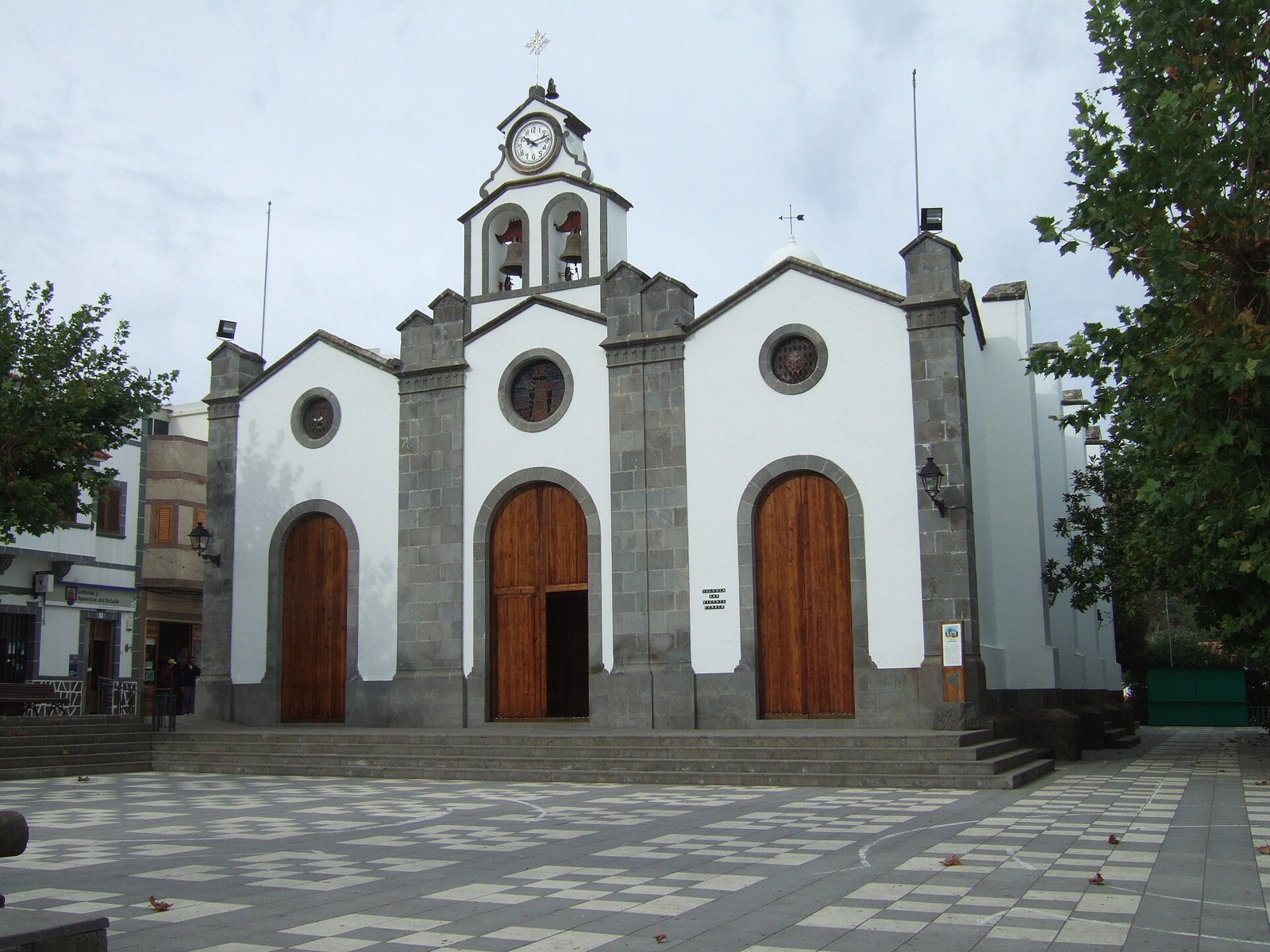
What happens for the first time on 26 September
This year's new item comes on the opening day: the first Feria Regional de Folclore, on the Plaza Municipal. What is printed: 10:00 the craft fair, then a master class in traditional dance with Ayla Rodríguez Hernández from Fuerteventura; 12:00 firecrackers and the raising of the flag with the A.F. Abenechara; 14:00 verseadores; 16:30 traditional Canarian games; 18:30 the whistling workshop. At 20:30 the 12th Premios Manzana de Oro go to the association "Juntos por Ell@s", and at 21:00 comes the Baile de Taifas.
Silbo, verseadores, Baile de Taifas — what they are
Verseadores are improvising poets: they sing ten-line stanzas, the décima, in turn over a fixed accompaniment. A Baile de Taifas is not a dance but a format — the Cultura Tradicional de Gran Canaria foundation describes it as "a traditional way, shaped by circumstances, of holding a musical gathering": the furniture goes against the wall and couples dance in shifts.
With silbo, precision matters. UNESCO inscribed the Silbo Gomero on its intangible heritage list in 2009: a whistled form of Spanish in which two distinct whistles replace the five vowels and four more the consonants. UNESCO records that the whistled language has vanished from the other Canary Islands and that on La Gomera it has been taught in school since 1999. The "Taller de Silbo Canario" therefore passes it on — it is not a local tradition.
The romería on 3 October — the town hall itself says the 4th
A romería is a pilgrimage in the shape of a village festival: the hamlets walk up to the church in traditional dress and lay the produce of their fields at the patron saint's feet, accompanied by carretas, wooden carts on which music is played and food handed out. According to the town hall the custom dates from 1974, when young people from Zumacal came before the Virgin with loaves and apples.
The programme puts the romería on Saturday 3 October at 18:30, then the verbena with the Orquesta Furia Joven at 23:30 and fireworks at midnight. Here the town hall contradicts itself: its release of 18 September names 4 October, and lists performers who do not appear in the programme. The civil and religious sections both say 3 October; for 4 October it prints the solemn mass at 12:00 with a procession.
Why apples: 1858, 800 tonnes, seven cider presses
The name misleads: "Valleseco" means dry valley. The parish priest of San Vicente Ferrer writes in the programme's greeting that the village shines green "after the abundant winter rains". The apple arrived, according to the municipality's tourism site, around 1858, when the mayor of the day had fruit trees planted on waste ground; the variety that took hold was the Reineta del Canadá.
That is what the sidra is made from. The daily Canarias7 reported on 26 November 2023 that Valleseco produces some 800 tonnes of apples and 46,000 litres of cider a year, and that only about five per cent of the harvest goes to the press. On 18 September the town hall counted seven lagares, five of them travelling from 24 to 27 September to the Salón Internacional de las Sidras de Gala in Asturias. The festival has carried the title Fiesta de Interés Turístico Regional since 2011.
What is printed — and what is nowhere
The programme contains exactly three figures aimed at the public: 3 euros for the fabada asturiana on 4 October in aid of the association "Juntos por Ell@s"; a ticket link to tureservaonline.es for "Entre Versos y Arena" on 9 October; and valledryfest.es for the Valledry Fest on 17 October. For everything else — the Los Salvapantallas concert, the children's party, the apple and cider stall — there is neither a price nor any note that it is free.
On parking the town hall gives one figure, only for 27 September: four signposted areas at the Área Recreativa de La Laguna with room for around 1,200 vehicles. As of 19 September it had announced no road closures for the romería and no special buses. The cover does not quite fit either: it reads "Del 26 de Sep. al 17 de Oct.", but the first printed item falls on 25 September and the last on 18 October.