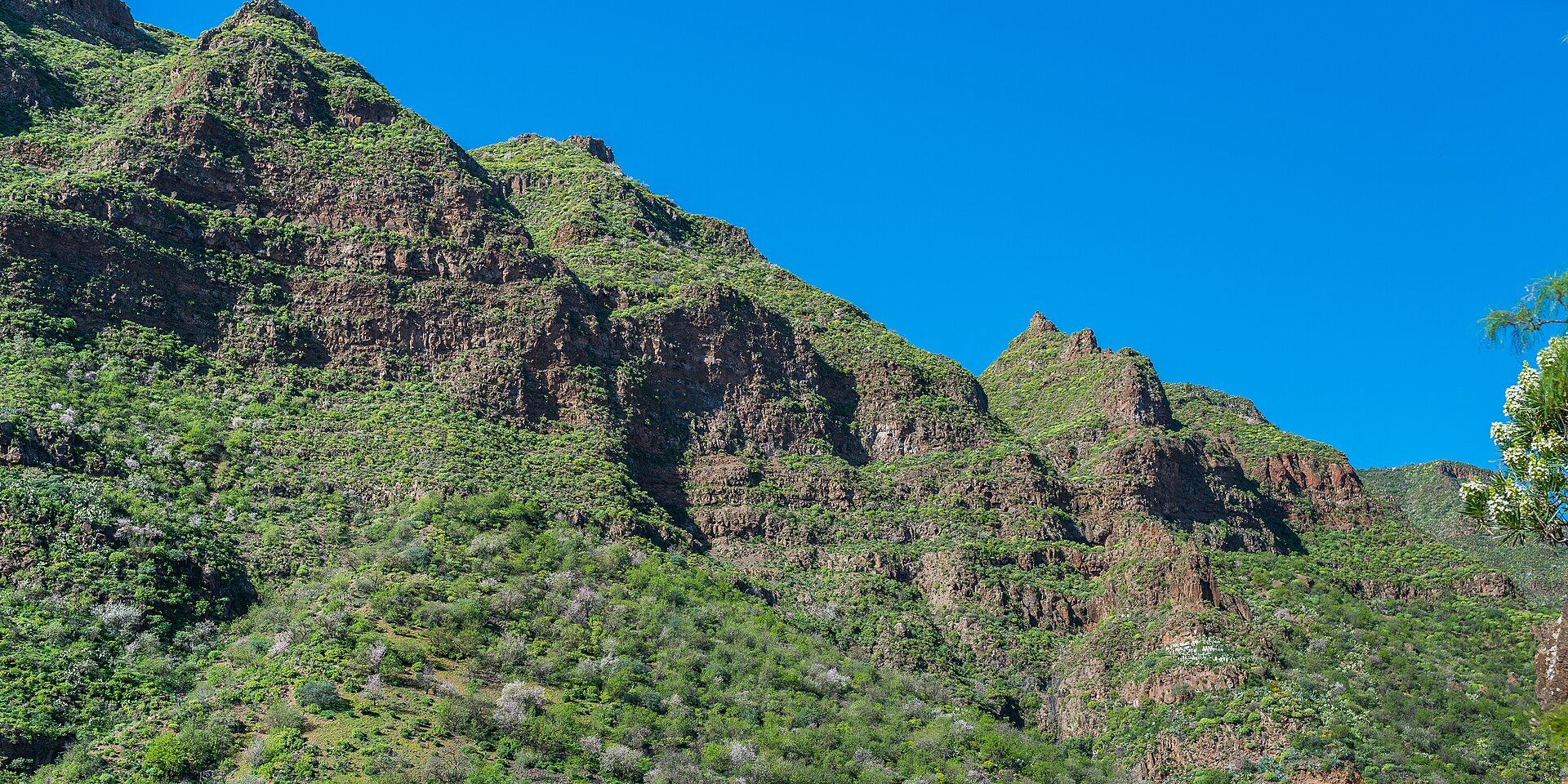
You drive in from the hot, bright south — and suddenly it turns green. The Barranco de Guayadeque is one of the largest ravines in the Canaries, a deep cut between the municipalities of Agüimes and Ingenio, with palms, almond trees and prickly pears growing on its slopes. From above it looks like a vein of life in a dry landscape.
But the remarkable thing is in the walls themselves. Over the centuries people here did not build houses — they dug caves, and some still live in them today. Guayadeque is less a sightseeing stop than an inhabited piece of the past.
Caves where people still live today
Two small settlements shape the valley. Cueva Bermeja, named after the reddish rock, is the first hamlet; higher up lies Montaña de las Tierras, also called "Los Marteles", where you can visit traditional cave dwellings. The houses are no stage set: they are hollowed-out living spaces, often cool and comfortably warm in winter, into which only doors and windows have been set from outside.
The heritage of the ancient Canarians
Long before the Spanish, the island's original inhabitants lived here. The walls of the ravine hold hundreds of caves: homes, but also granaries and burial caves. Guayadeque is regarded as one of Gran Canaria's most important archaeological zones and was protected as a Cultural Asset of Interest in 1991; the excavations continue, and in 2020 untouched areas were discovered.
Many of the most important finds — mummies and everyday objects among them — can be seen today at the Museo Canario in Las Palmas. Visit Guayadeque and then go to the museum, and you'll understand the valley in a whole new way.
Eating in the rock — and a chapel in the cliff
Guayadeque is also a place to enjoy. Several restaurants are dug straight into the rock: you sit in the cool stone while the sun blazes outside, eating Canarian home cooking — grilled meat, papas arrugadas, a robust wine. It's one of the most atmospheric ways to have lunch on the island.
Also cut into the mountain is the little Ermita de San Juan Bautista, a chapel in the cliff. It shows how naturally life here is woven into the stone — from the family home to the house of God.
Nature, protection and the visit
Since 2000 the ravine has been a Natural Monument. It is home to endemic species found only on Gran Canaria, including the island's giant lizard and rare plants. A visitor centre at the mouth of the valley explains its geology, history and nature — a good first stop.
Frequently asked questions
- Where is the Barranco de Guayadeque?
- In the southeast of Gran Canaria, between the municipalities of Agüimes and Ingenio; you reach it from there.
- Do people really still live in caves there?
- Yes. In settlements such as Cueva Bermeja and Montaña de las Tierras, cave houses are still lived in today; some can be visited.
- Can you eat there?
- Yes, in several restaurants dug straight into the rock — serving Canarian cuisine.
- What's the story with the ancient Canarians?
- Guayadeque was settled before the Spanish conquest; hundreds of caves served as homes, granaries and graves. Many finds are at the Museo Canario in Las Palmas.
- How do you get there?
- Best by car from Agüimes or Ingenio; a stop at the visitor centre is a good way to start.
Read on
- Gran Canaria weather 13 October: wet north, dry southGran Canaria · 13 October
- Gran Canaria this weekend, 16–18 October: Miralta, Walking FestivalGran Canaria · 12 October
- 165 beds per 100 residents: seven Canary municipalities have more tourist beds than peopleCanary Islands · 25 September
- Maspalomas Winter Pride: 2–8 November 2026Gran Canaria · 12 October
- Maspalomas forum 25–26 Nov: cooking, science and AIGran Canaria · 12 October
- All events on Gran Canaria →
As of 11.07.2026. Details based on Wikipedia and Turismo de Gran Canaria. Opening hours of restaurants, the visitor centre and paths may change and are given without guarantee; archaeological and inhabited areas are to be respected.