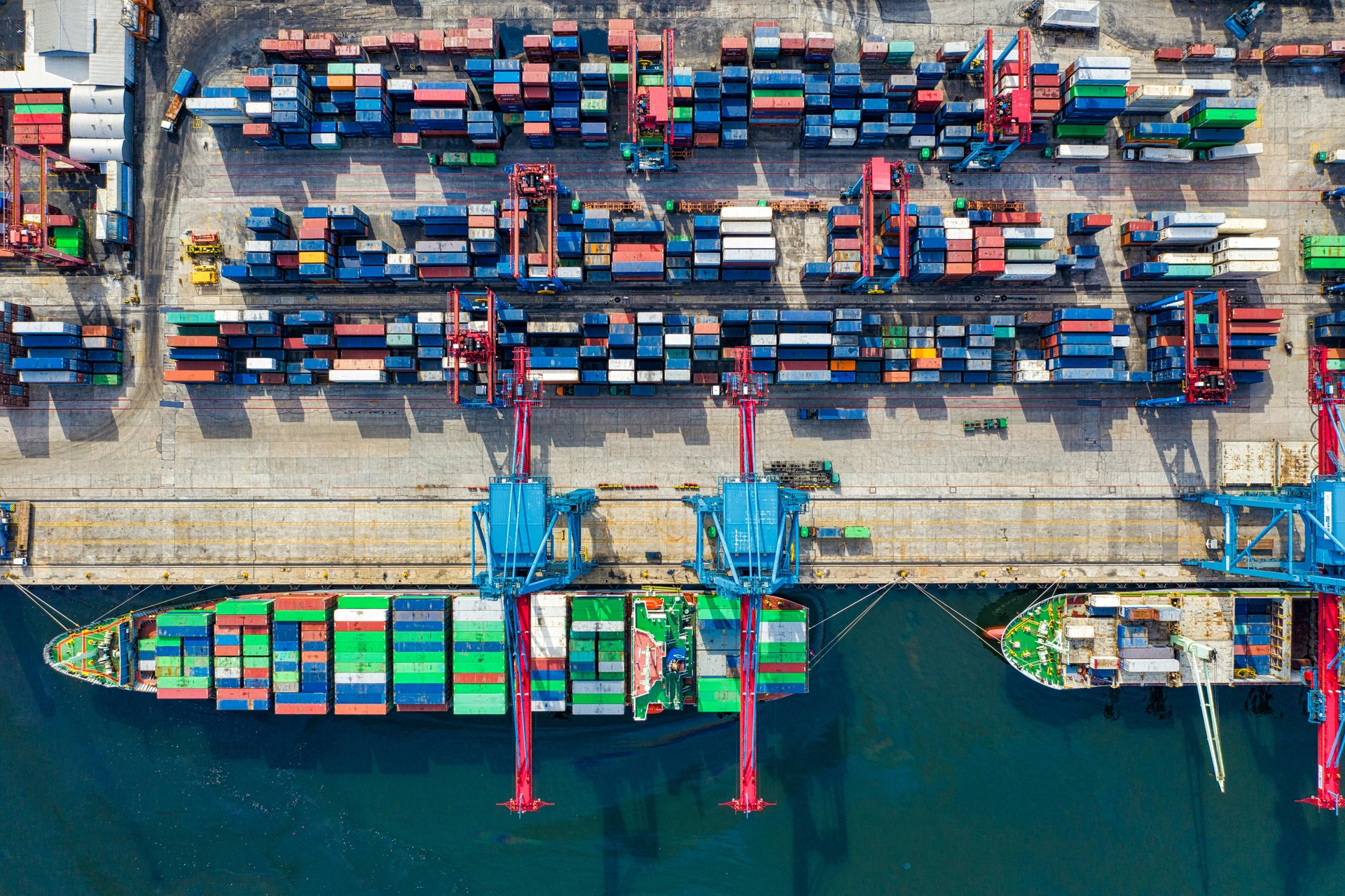
The contradiction
2026 was supposed to be the year of the Port of Las Palmas. Ever since the Iranian strike on Saudi Arabia's Samref refinery in March escalated tensions in the Persian Gulf, more and more shipping lines have been diverting onto the Atlantic route — along the West African coast, past the Canary Islands. More ships, more fuel demand. Brent rose by USD 12.66 per barrel in a single trading day in March.
The port's first-quarter statistics show this almost everywhere: total traffic up 4.5 percent, cruise passengers up 23.6 percent, even frozen fish up 58.9 percent. It is, in the words of port president Beatriz Calzada on 14 May, «another historic quarter».
Except for one line in the table. In bunkering — the sale of fuel to passing ships — the figures collapse. In March 2026, Las Palmas sold 15 percent less than a year earlier — almost 40,000 tonnes less.
Cepsa, or why the 40,000 tonnes are no coincidence
Las Palmas was for years the biggest bunker port in Spain. In 2018 it was only 9,000 tonnes behind Algeciras for the national lead. In early 2026 it is still in the top tier, but no longer the uncontested leader. The reason has a name: Cepsa.
The company — now branded Moeve, ultimately owned by Abu Dhabi sovereign-wealth fund Mubadala — began on 1 January 2026 to systematically shift part of its bunker activity to Santa Cruz de Tenerife. The stated reason: «commercial strategy». Specifically: in Las Palmas, Cepsa competes with three other operators (Peninsula Petroleum, Oryx, Minerva). In Tenerife it has the market to itself.
The result: Tenerife delivered 238,696 tonnes of fuel in the quarter — up 44.6 percent. A few years ago, these were marginal volumes. Las Palmas is losing exactly what Tenerife is gaining.
The paradox: the Cepsa shift has nothing to do with the Hormuz conflict. It is a pure market decision. Just as shipowners worldwide are turning to the Atlantic route, the islands' most important bunker brand is rearranging its business internally.
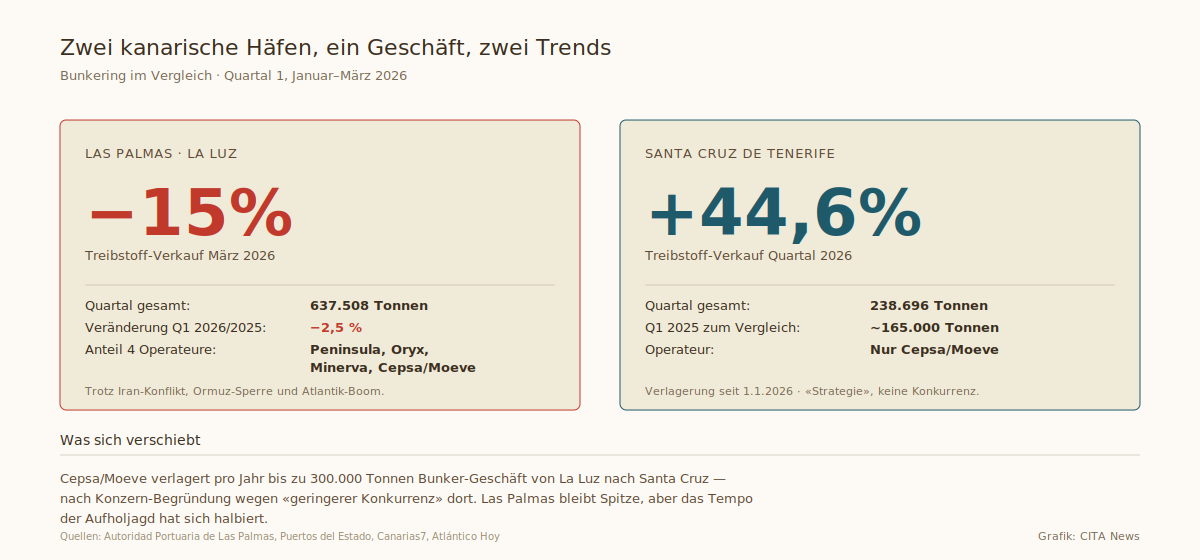
Two ports, two trends. Graphic: CITA News.
What the port itself says
Beatriz Calzada, president of the Autoridad Portuaria de Las Palmas, told the management board on 14 May: «The forecasts we have are for absolute occupancy, with continuous rotation in transit.» The port is at 100 percent capacity, she said; on some days ships wait «12 miles out for a window to open».
The board also extended the cooperation agreement with the fuel logistics operator Petrologis Canarias on 14 May — granting a discount on the activity fee in exchange for environmental improvements. Bunkering, in other words, remains politically defined as a strategic activity. In 2022 the board even formally labelled the business «estratégico», in order to keep the four operators in place.
What it means for the islands
Bunkering is not just any business. It brings hundreds of ship calls each year — in Las Palmas alone, more than 12,500 in 2021. Around one third of those, according to port statistics, come solely to refuel. These ships buy fuel, sometimes supplies; their crews go ashore for a few hours. It is the quiet, invisible base industry of the islands — less visible than tourism, but economically closer to the core.
The shift towards Tenerife is not necessarily bad from a Canarian perspective. Both ports are in the same region; both pay taxes into the same Cabildo system. From the perspective of the city of Las Palmas — its roughly 1,500 port-dependent jobs and its concession revenues — it is a different story.
Two structural factors complicate the picture. First, Peninsula Petroleum has only been fully in the market since 2021 — a new competitor expected to fill the Cepsa gap in the long term. Second, the port set itself a target in 2025 of three million tonnes of bunkering per year. The 637,508 tonnes of Q1 2026 imply an annual run-rate of around 2.55 million. Las Palmas is some way off the three-million target — and Cepsa has just halved the speed of the catch-up.
Frequently asked questions
- What is bunkering?
- The sale of fuel to ships — usually at anchor or alongside a pier. The Canary Islands sit geographically between Europe, West Africa and the Americas, which is why Las Palmas has for decades been one of the most important bunker ports in the Atlantic.
- Why isn't Las Palmas benefiting from the Iran conflict?
- It is benefiting in total traffic (+4.5%), but not in bunkering. Cepsa is systematically shifting business to Tenerife from January 2026 — a corporate decision independent of the conflict. The market would normally favour Las Palmas; internal Cepsa strategy does not.
- Does Tenerife now get the whole business?
- No. Tenerife has only one operator (Cepsa). Las Palmas has four. The Cepsa shift could partially reverse once Peninsula Petroleum reaches full scale. The Canary Islands as a whole remain one of the biggest bunker hubs in the Atlantic.
- What do the authorities say?
- Port president Beatriz Calzada speaks of a «historic quarter» and full occupancy. The official report does not hide the bunkering decline but highlights growing transhipment volumes from Opcsa as compensating.
- What role does the Hondius dispute around Granadilla play?
- Direct: none — bunkering goes through La Luz, not Granadilla. Indirectly, both stories show the same trend: Tenerife is taking on functions historically reserved for Las Palmas.