The 2024 stowaway
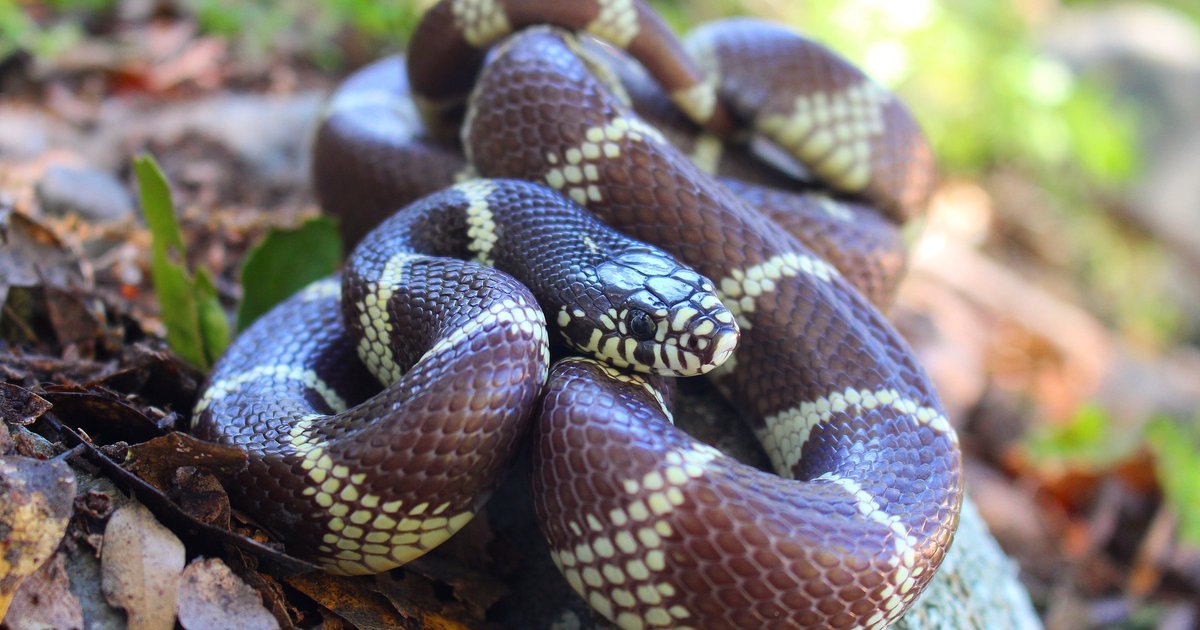
It was a normal summer day when somewhere between Gáldar and Agaete a driver parked his car and noticed that something was rustling in the underside. A California kingsnake. Black and white banded, perhaps a metre long, entirely unharmed by the journey. She had travelled twenty kilometres without the driver having noticed.
What is remarkable about this snake is not just that she does not belong here. It is that in her entire lifetime in the wild she normally does not travel further than five hundred metres. That is a figure from the research that Ramón Gallo, biologist and head of the Stop Culebra Real project, has gathered in Gran Canaria. A snake of this species is not built for migrations. She knows her hill, her crevice, her stone.
What she does not know is asphalt roads and moving vehicles. The car is her launchpad. Forty kilometres in half an hour — a distance that would biologically take her two generations.
Why a Californian snake ended up here
Lampropeltis californiae should really live in the dry regions between California and northern Mexico. She is non-venomous, harmless to humans, and that was exactly what made her a popular pet snake in the nineties. At reptile fairs she was cheap. On Gran Canaria, as the reconstructed story goes, someone kept her privately from the mid-nineties onwards. Probably several people. Probably they did not stick to safety precautions.
In 1998 someone found the first specimen in the wild — in the municipality of Telde in the east of the island. By 2007 there was no going back: science confirmed that the species had established itself. She bred, she survived the winter, she found everything she needed. On Gran Canaria there are no natural predators of this snake. The birds she would know from California are missing. The mammals that would eat her are missing. The island was a pantry without a lock on the door.
Today the main distribution area is in Telde, Valsequillo and Santa Brígida. Secondary areas range from Montaña La Data in San Bartolomé de Tirajana to the valley of Agaete and on to Guiniguada in Las Palmas. And that is the problem.
What she eats — and what disappears as a result
In every invaded area on Gran Canaria, scientists at CSIC measure the same figures. The giant lizard Gallotia stehlini — an endemic reptile found nowhere else in the world — disappears to 99 per cent. The skink Chalcides sexlineatus, also endemic, declines by over 80 per cent. The Boettger gecko, an excellent mosquito hunter, halves its population.
The snake eats all of it. She is an efficient hunter, fits into every rock crevice and needs no prey that can fight back. When the native reptiles are wiped out, she moves on to introduced mice and rats. But by then the island ecosystem is already broken.
The Gran Canaria giant lizard plays a key role in dispersing plant seeds. Skinks and geckos regulate insects. When they disappear, vegetation changes, certain pests proliferate, and a web that has developed over millions of years falls apart. The snake notices none of it.
The dogs: Mamba, Russel, Goku, Dubai, Google
The idea of using dogs against snakes came up in 2023. A sniffer dog can detect the scent of Lampropeltis from ten metres away — and it is a scent the snake cannot shed. She gives it off more intensely when she feels threatened, that is, in the very moment when she would most like to hide.
It started with a dog named Mamba. Then came Russel. Then Goku and Dubai, and then Google. The trainer, whose name the project does not publicly disclose, has taught them to mark at the underside of a vehicle when they smell something. Three of the five dogs work in delimited areas where reports of snake sightings have come in. Dubai is specialised in open terrain, where the snake is calm and gives off less scent.
Since Sunday this team patrols the Puerto de Las Nieves in Agaete, the harbour from which fast ferries leave for Tenerife and La Palma. Over a million passengers departed from here in 2024. The port lies right next to an area where the snake is abundant. If a snake finds her way into a car driving onto the ferry here, the next island is compromised. As a reminder: in 2025 the first California kingsnake was caught on Tenerife. In La Laguna, under a paper recycling bin. One.
The dogs are accompanied by two handlers and the trainer. They are joined by officers of the Grupos de Medio Ambiente (GRUMA) and Transporte (GRUTE) of the Canarian Police, who carry out random vehicle inspections in the port area.
May 2026 could break every record
The spring statistics are clear. More than 760 California kingsnakes were caught on Gran Canaria in the first four months of 2026. In the first days of May alone, 150 came on top. «If the trend continues, this May will be the month with the highest number of captures of all time», Ramón Gallo tells COPE Canarias. «It is very humid. The snakes feel extremely comfortable.»
The paradox: more captures do not mean fewer snakes — they mean more active snakes on the surface. The species spends most of her life underground. Captures are only the tip of an iceberg. And from Gallo's perspective they are nowhere near enough. Complete eradication is «not feasible» in the short term, the project concedes. What researchers are currently planning are reservoir zones where the giant lizard can grow up protected from the snake. Island ecologists would go to places the snake has not reached yet and build barriers.
What residents and tourists can do
Seeing a snake is not a drama. Not reporting it, however, is. Anyone spotting a California kingsnake — black and white banded, or more rarely cream and brown — should call the number 608 098 296, make a note of the location and time, and try to keep an eye on the animal. Touching it is not necessary and not recommended. The snake does not bite venomously, but she bites.
Anyone driving away from the valley of Agaete or from Telde, Valsequillo, Santa Brígida can invest five minutes and take a look under the vehicle. Tyres, axles, wheel arches. The snake seeks warmth and darkness. Anyone waiting in the harbour of Las Nieves when the dog comes by: simply stay still. The animals work calmly and quickly.
And anyone wondering why the Canaries make such a big deal of a Californian snake — the answer is the giant lizard. She is one of the oldest creatures of the archipelago, a relic from the time when these islands rose out of the Atlantic. If she dies on Gran Canaria, she dies on the entire planet.
Frequently asked questions
- Is the snake dangerous to humans?
- No. Lampropeltis californiae is not venomous. She only bites when cornered. The wound is superficial and heals without complications.
- How do I recognise her?
- She is 80 to 120 centimetres long, has a slim head and a typical band pattern — either black with white bands or cream with dark brown bands.
- What do I do if I see one?
- Call 608 098 296 or 112. Note the location and time. Watch the snake if possible, but do not touch. Even if the animal is already dead, report it — the data help map the spread.
- Why not simply use poison?
- Because poison would also kill the endemic reptiles we want to protect. Selective traps are in development, but currently they still catch lizards too.
- What penalties apply for illegally transporting a snake?
- Between 3,100 and 200,000 euros. The California kingsnake is on the Spanish catalogue of invasive species — possession, transport, trade and exchange are strictly prohibited.