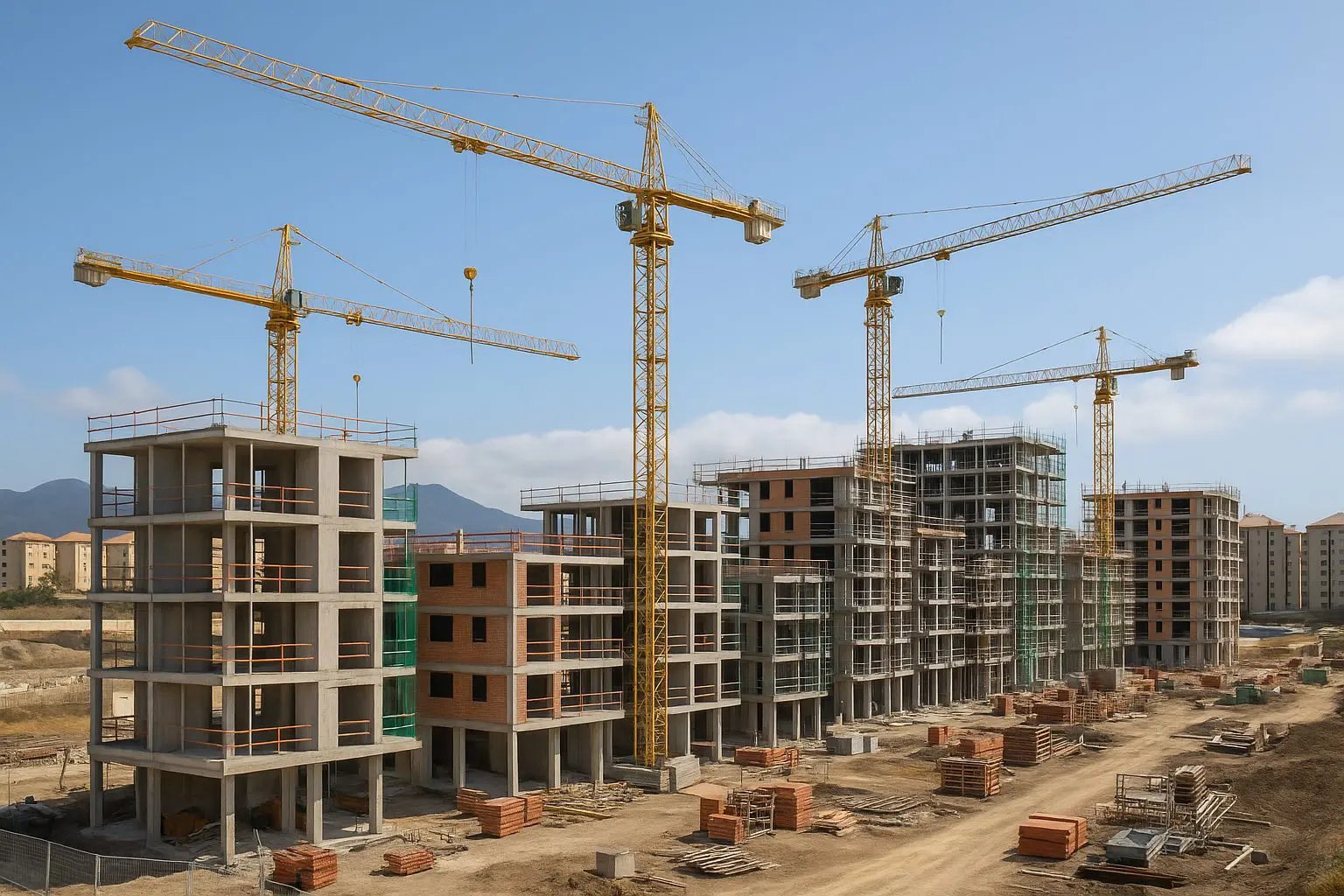
Anyone following the news from the islands these days might think housing policy had enjoyed a spring. Within a few weeks, several islands reported progress: subsidised loans for new social housing, a revived ghost development, a new tax against empty homes. After years in which the housing crisis was mostly a subject of complaint, this sounds like a fresh start. But it pays to look closely — because the push carries a contradiction within it.
What is being built and subsidised
On Gran Canaria, the state lending institute ICO has granted a €11.5m loan for 88 subsidised rental homes (VPO) in the south of the island, in Santa Lucía de Tirajana. Together with a €2.5m grant from the Canarian housing institute ICAVI, public funding adds up to €14m — of a total cost of €16.6m. Building has been under way since 2025, with the homes due to be ready in early 2028. Notably, the developer is a private company. So this is not a pure social-housing initiative but a public-private model — the state making viable a project that would not pay off for a private builder alone.
On Tenerife, a different story is drawing attention: in Granadilla de Abona, 277 homes are coming back to life that had lain idle as a building shell since the 2008 property crash. After around two years of completion work, they now reach the market as affordable rentals — financed through a model that channels private investors into housing via tax breaks (the Canarian investment reserve, RIC). A symbol of the burst building boom thus becomes affordable housing.
Finally, on Lanzarote, the Arrecife town council approved 290 new homes in the Los Geranios district. These, however, are private — not to be confused with the 201 public social homes already under construction in the same district, part of a plan for around 700 public homes on the island.
The paradox: a full market, empty homes
And here is the catch. While new homes go up, a substantial part of the existing stock sits empty. This shows most clearly in La Laguna on Tenerife: according to a study by the city's university, 5,123 of the city's 74,091 homes are empty — almost seven percent, determined from water-consumption data. Three in four of these empty homes are concentrated in just three districts.
This is exactly where the latest instrument comes in: in early June, La Laguna's council resolved to introduce a surcharge on the property tax (IBI) for permanently empty homes — between 50 and 150 percent more. Spain's 2023 housing law allows this. The idea: make emptiness expensive, so owners rent out or sell. A note of caution on the timeline, though — what was approved at first was only a «roadmap» within three months. The council had already passed a similar resolution in 2024, which then fizzled out. An expression of intent does not become a payable tax overnight.
The contradiction is no Canarian curiosity but part of a nationwide debate. The Bank of Spain attributes soaring prices chiefly to a supply shortfall — too little is being built. Other experts counter: in 2021 around 3.8 million homes stood empty in Spain, some 14 percent of the stock, far above the five percent considered healthy. The problem, they argue, is not only a shortage but also a question of distribution — housing exists, but does not reach where it is needed.
Why it is stuck nonetheless
Piece the individual reports together and the real bottlenecks emerge. First, land and bureaucracy: the shortage of building-ready land and years-long permit procedures make projects slow and costly — the reason even subsidised homes like those on Gran Canaria will not be finished until 2028. Second, competition from holiday lets: in the sought-after coastal areas, short-term tourist rentals displace permanent housing, an issue currently heating up the islands. Third, time: many of the announced homes are still under construction or only at the planning stage; relief therefore comes years from now at the earliest.
There is also a delicate point within the public stock itself. The islands have around 4,500 social homes, about 1,000 of them in La Laguna. A residents' collective accuses the public company responsible of charging low-income families rents that are at times too high — and even the property tax — although a Supreme Court ruling is said to prohibit the latter for such families. Housing policy, after all, is not only a question of new building but also of dealing fairly with what already exists.
The reckoning
The housing push is real: money is flowing, homes are going up, and with the empty-homes tax a hitherto barely used tool is at least being tackled. After years of inaction, that is a turn. But the numbers call for sobriety. As long as thousands of homes sit empty, building land stays scarce and holiday lets compete for the same square metres, the crisis persists. The real task is not just to build more — but to ensure that both existing and new housing actually reaches the people who live on the islands.
Frequently asked questions
- Are lots of new homes being built in the Canaries right now?
- Several projects are running: 88 subsidised rental homes on Gran Canaria, 277 in Granadilla (Tenerife), 201 public plus 290 private on Lanzarote. But many are still under construction or in planning and will only be ready in the coming years.
- What is the empty-homes tax in La Laguna?
- A planned surcharge on the property tax (IBI) of 50 to 150 percent for permanently empty homes, allowed by the 2023 housing law. In early June 2026 only a roadmap was approved; a similar move in 2024 had fizzled out.
- How many homes are empty?
- In La Laguna alone, 5,123 of 74,091 (almost 7%), according to a university study based on water-consumption data. Across Spain in 2021 it was around 3.8 million, some 14 percent of the stock.
- Why doesn't new building solve the crisis at once?
- Because of scarce land, lengthy permit procedures and competition from holiday lets. Many projects will also only be finished in 2028. And part of the problem is distribution, not just shortage.
- How do I get a subsidised home?
- Through the Canarian housing institute ICAVI and the municipalities, tied to income limits and usually via a waiting list or allocation process.
Read on
- Canary Islands holiday lets: 90% of homes for residentsCanary Islands · 12 October
- 75 percent protected housing: Mogán's new general plan locks in around 3,000 subsidised homesGran Canaria · 26 September
- When the hotel group builds homes: what lies behind Lopesan's 326-home plan for Gran CanariaGran Canaria · 26 June
- Canary Islands: Police warn of WhatsApp dance vote scamCanary Islands · 22 October
- Binter Canarias: Routes, Baggage and Resident DiscountCanary Islands · 21 October
- All events on the Canary Islands →
As of 08.06.2026. Sources include Canarias7, Diario de Avisos, eldiario.es, El Economista, Gobierno de Canarias, the Instituto de Crédito Oficial (ICO), the Instituto Canario de la Vivienda (ICAVI), and a housing study by the Universidad de La Laguna. The empty-homes tax in La Laguna is at the resolution and planning stage. Figures and timelines may change.