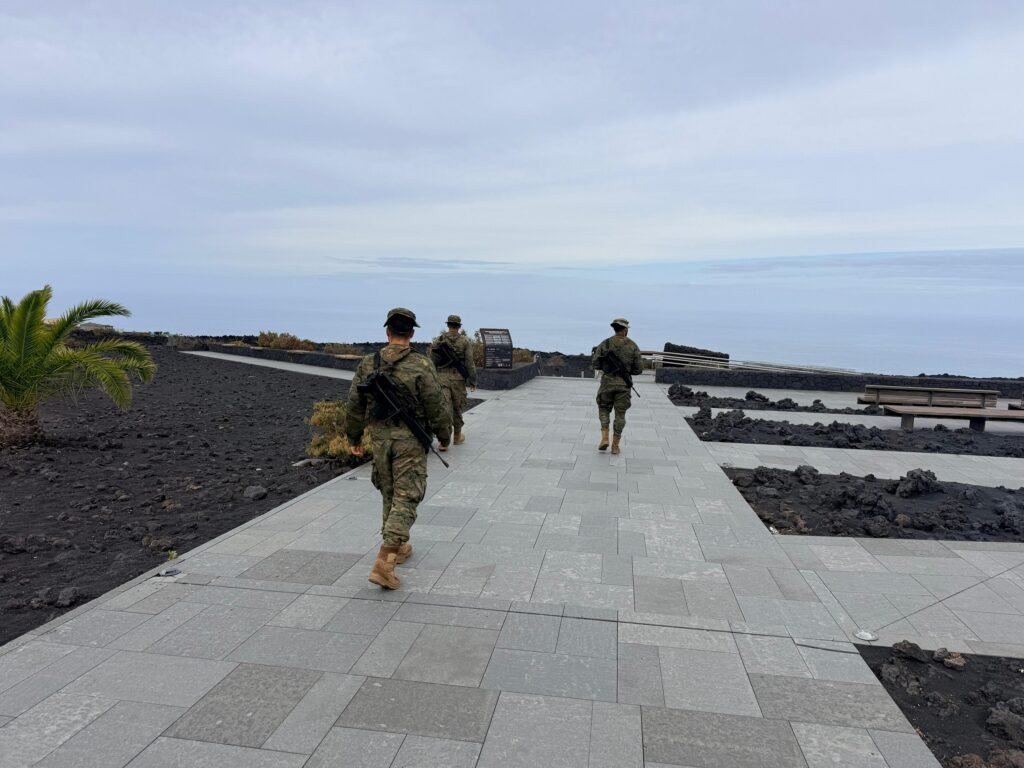
It is an image one does not associate first with the Canaries: soldiers in camouflage, a military transport on the runway, a send-off from senior officers — and at the destination no exercise in island sunshine, but the protection of airspace on NATO's eastern external border. On Monday, 8 June 2026, the first rotation of what is called Contingent IX of the Spanish Army's air-defence unit took off from Gando air base on Gran Canaria, bound for Latvia.
Who is leaving — and where to
On board, according to the Mando de Canarias, the regional military command, were «around a hundred» soldiers, the majority from the islands themselves. They were seen off on the runway by the commander of the No. 94 Anti-Aircraft Artillery Regiment (RAAA 94), the unit providing the contingent. Their posting is Latvia, a Baltic state with a shared border with Russia — and thus part of the eastern flank that has been at the centre of NATO defence planning since Russia's attack on Ukraine.
The mission: «Persistent Effort»
The deployment runs under the name «Persistent Effort», a NATO operation to secure Latvian airspace. On its eastern external border the alliance maintains eight multinational battle groups, including in Estonia, Latvia, Lithuania and Poland, led respectively by nations such as the United Kingdom, Canada, Germany and the United States. Spain takes part within the enhanced Forward Presence (eFP) and currently has around 500 soldiers stationed in Latvia, most from a brigade based in Córdoba. The Canarian air-defence unit now joins them.
What the soldiers bring: the NASAMS system
The core of the deployment is a ground-based air-defence system called NASAMS. It fires AIM-120 AMRAAM missiles, so-called «fire-and-forget» weapons that need no further guidance after launch. Their range is effectively seven to ten, at most around 25 kilometres; the accompanying Sentinel radar detects targets up to 75 kilometres away. The system can be integrated into NATO's integrated air-defence network and can counter aircraft, helicopters and missiles. It protects, in military jargon, «points of vital importance» — airports, command centres, critical infrastructure.
Why this is no sensation, but routine
Here some context is worth it, because the phrasing «Spain moves its military away from the Canaries» implies a drama that does not do the matter justice. In fact this is a rotating mission: units relieve one another at fixed intervals, and for the Canarian regiment this is already the fifth deployment in the Baltic region, alternating between Latvia and neighbouring Estonia. No island defence is being «withdrawn»; rather, a routine contribution to collective defence is being made — as many NATO states make in turn. That a special unit stationed on Gran Canaria regularly takes on this task says more about its capabilities than about any supposed weakening of the islands.
The wider context
For the Canaries, a military presence is nothing new: the Mando de Canarias is an autonomous regional command of the Spanish armed forces, and deployments from here to NATO's eastern flank have become a fixed rhythm. The departure from Gando comes during a week of brisk alliance activity in northern Europe, with several large exercises in the Baltic and Scandinavian theatre. The message the defence ministry and the regional command want to send is correspondingly sober: reliability towards allies, shared security, presence at the border of alliance territory.
In the end one contrast sticks in the memory: as the summer season begins on Gran Canaria, around a hundred island soldiers take up position on the coldest border of European security. No drama, but duty — yet one that shows that even Spain's southernmost region is firmly anchored in NATO's north.