Near-total partial lunar eclipse over the Canaries on 28 August
In the early morning of 28 August 2026 there is a partial lunar eclipse that comes close to being total: the Earth's shadow covers the Moon almost completely. According to Spain's Instituto Geográfico Nacional (IGN), the eclipse reaches a magnitude of about 0.93 — a value near totality.
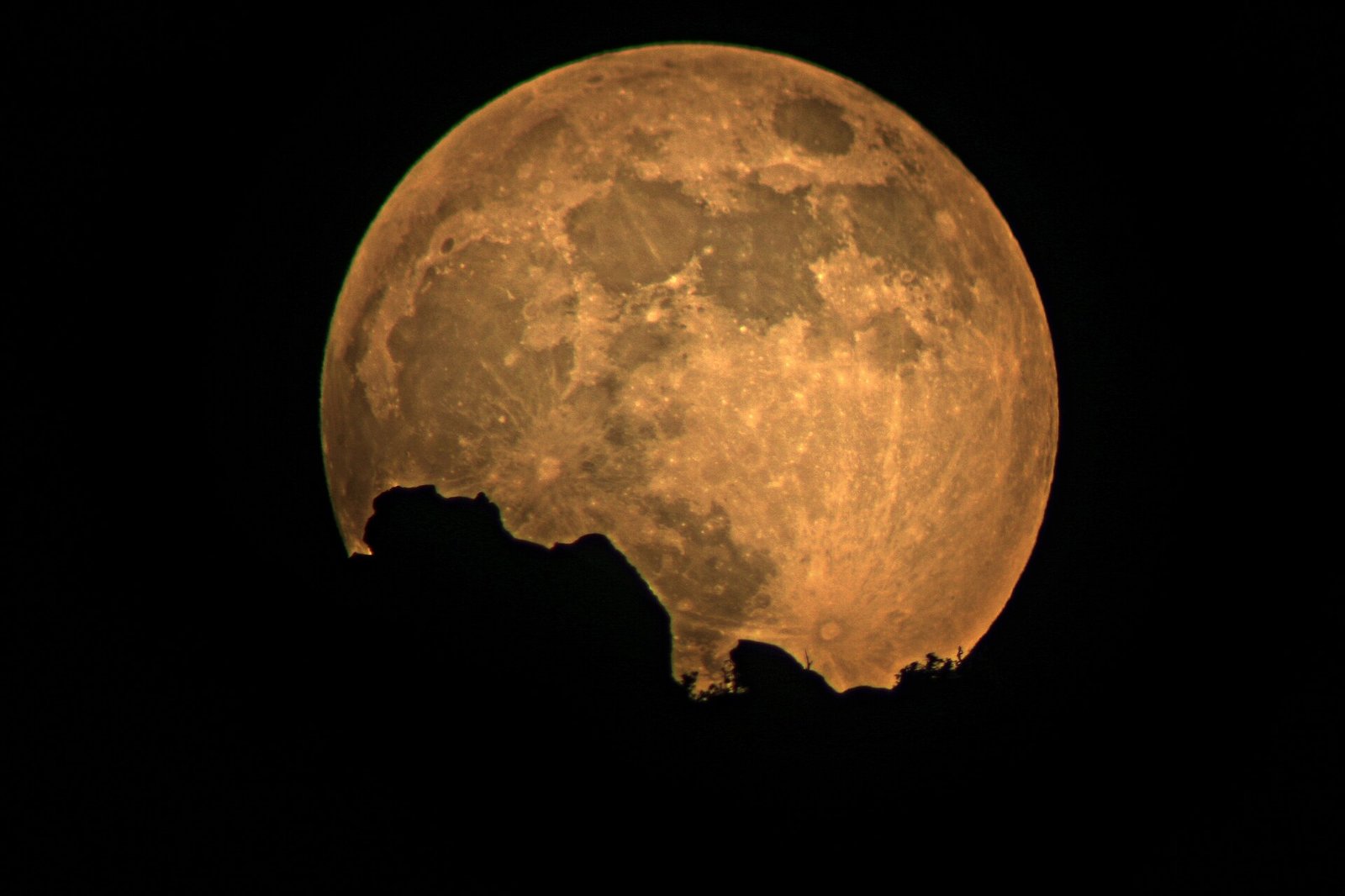
Photo: NPS Photo, Public domain (Symbolbild).
The Canary Islands are among the favoured places to watch: early risers can follow the event before sunrise and moonset. In Juncalillo (Gáldar, Gran Canaria) a public observation is organised for the night of 28-29 August. The times are based on the IGN, relayed by diariodeavisos.
What happens during the night
According to the data published by the IGN and relayed by diariodeavisos (Canary Islands local time, WEST/UTC+0), the penumbral phase begins at 02:23. The visible part, in which the dark umbra slides across the Moon, starts at 03:33. Maximum eclipse comes at 05:12, when the Moon is almost entirely covered.
The partial phase ends at 06:52 and the penumbral phase, in calculated terms, at 09:01. In the Canary Islands the Moon stays above the horizon until the end of the partial phase — according to the archipelago, the only region of Spain where the event can be seen in full up to that point, before the Moon sets.
Why the Canaries are favoured
Because the decisive phases fall in the hours before dawn, and the Moon is then still in the western sky over the Canary Islands, the islands offer especially good conditions, according to the reports. Maximum eclipse at 05:12 falls in the deep of the night, long before first light.
The key is to look west: that is where the Moon travels before it sets. A clear, low horizon without mountains or buildings, and a spot as dark as possible away from street lighting, improve the chances of a good view.
What a lunar eclipse is
A lunar eclipse occurs when the Earth, Sun and Moon are aligned so that the Moon passes into the Earth's shadow. In a partial eclipse only part of the umbra crosses the lunar disc; in this near-total version, with a magnitude of about 0.93, the Moon is almost entirely covered.
The shaded part of the Moon often looks reddish or coppery. That is because the Earth's atmosphere bends part of the sunlight and directs the red portion into the shadow — the same effect that turns sunrises and sunsets red.
Safe to watch with the naked eye
Unlike a solar eclipse, a lunar eclipse can be watched safely with the naked eye. No protective glasses and no special equipment are needed. The IGN states explicitly that observation with the naked eye is completely safe.
Binoculars or a small telescope can enrich the view, but they are not required. It is enough to find the Moon in the western sky and watch, unhurried, as it dips into the Earth's shadow.
Public observation in Juncalillo
In Juncalillo, a village in the municipality of Gáldar in the north of Gran Canaria, a public observation is planned for the night of 28-29 August. According to eldiario.es, the Asociación Astronómica y Educativa de Canarias Henrietta Swan Leavitt and the Poesía Viva Atlántica initiative are inviting people to take part, among others in collaboration with the Ayuntamiento de Gáldar.
The site was chosen, according to the reports, for its darkness away from light pollution and for its connection to the sacred mountains of Gran Canaria, a UNESCO World Heritage designation. A talk and a guided observation through telescopes are planned; places are limited and registration is required.
Dress warmly, give your eyes a few minutes to adjust to the dark, and note the Canary Islands times; binoculars are a plus but not a must.
This is a partial, though near-total, eclipse: the Moon is not fully darkened, and a thin bright edge may remain visible. Cloud cover can limit the view.
Key facts
- Partial, near-total lunar eclipse in the early morning of 28 August 2026 (IGN)
- Magnitude about 0.93 — the Moon is almost entirely covered
- Canary times (WEST/UTC+0): penumbra from 02:23, partial phase from 03:33, maximum 05:12, end of partial phase 06:52, penumbra ends 09:01 (IGN, via diariodeavisos)
- In the Canary Islands the Moon stays above the horizon until the end of the partial phase
- Safe to watch with the naked eye; no protective equipment needed
- Public observation in Juncalillo (Gáldar, Gran Canaria) on the night of 28-29 August (according to eldiario.es)
FAQ
- When is the lunar eclipse?
- In the early morning of 28 August 2026. According to IGN data (Canary time), the partial phase begins at 03:33, maximum is at 05:12, and the partial phase ends at 06:52.
- Is it a total eclipse?
- No. It is a partial eclipse, but near-total: with a magnitude of about 0.93 the Moon is almost entirely covered by the Earth's shadow, according to the IGN.
- Can it be seen from the Canary Islands?
- Yes. The Moon is still above the western horizon during the decisive phases. According to the reports, the Canaries are the only region of Spain where the eclipse is fully visible up to the end of the partial phase.
- Do I need protective glasses?
- No. Unlike a solar eclipse, watching with the naked eye is completely safe; no protective equipment is needed.
- Where is there a shared observation?
- In Juncalillo (Gáldar, Gran Canaria) a public observation is organised for the night of 28-29 August. Places are limited, according to eldiario.es, and registration is required.
Read on
- Gran Canaria: Cheapest fuel on 13 October in Las PalmasGran Canaria · 13 October
- Gran Canaria weather 13 October: wet north, dry southGran Canaria · 13 October
- Solar eclipse on 12 August: why the Canaries miss the best of it — and still get a dream sunsetCanary Islands · 20 June
- Canaries: Plenilunio ends with over three million effectCanary Islands · 5 October
- Maspalomas Winter Pride: 2–8 November 2026Gran Canaria · 12 October
- All events on Gran Canaria →