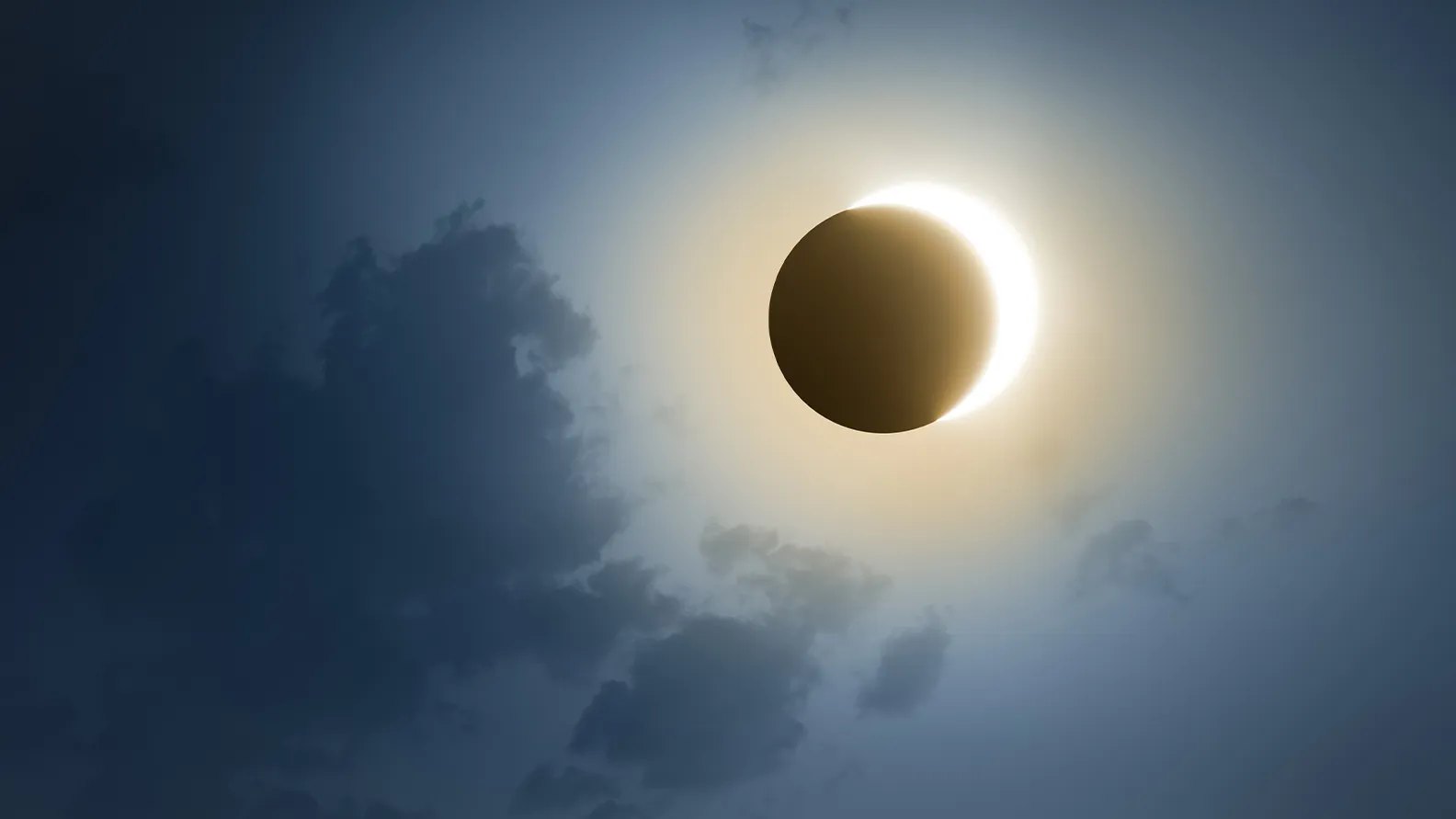
Let's clear up the misunderstanding currently haunting many headlines. Yes, on 12 August a total solar eclipse crosses Spain — the first fully visible from the Spanish mainland in over a hundred years. The zone of totality, where the Moon completely covers the Sun, runs right across the peninsula: from Galicia via Oviedo, León, Bilbao and Zaragoza to València and the Balearics. There it will go almost dark for a short while.
The Canaries, however, lie south of that zone. Here the Moon does not cover the Sun entirely, but "only" by about 70 percent. The full disc becomes a glowing, narrow arc — a "golden crescent", as the Canary Islands astrophysics institute IAC calls it.
Why it's still a special evening
Before disappointment sets in: a Sun covered by 70 percent is a rare and beautiful sight — and on the Canaries there's a stroke of luck on top. The eclipse almost exactly coincides with sunset. So the bitten-into Sun sits low and large over the western sea horizon, set in the warm colours of dusk. Experts expect one of the most striking summer sunsets in a long time.
But this very position has a catch you need to know: because the Sun sits so low, on some eastern and central-eastern slopes — such as central and eastern Tenerife and the eastern side of La Palma and El Hierro — the Sun has already set by the peak of the eclipse. There you won't see the maximum at all.
First things first: eye protection
A partial eclipse is no licence to look at the Sun — quite the opposite. As long as even part of the solar disc is visible, looking directly can permanently damage the retina, often without any pain at the time. Looking with the naked eye, through sunglasses, a smartphone, binoculars or a telescope without a special filter is dangerous.