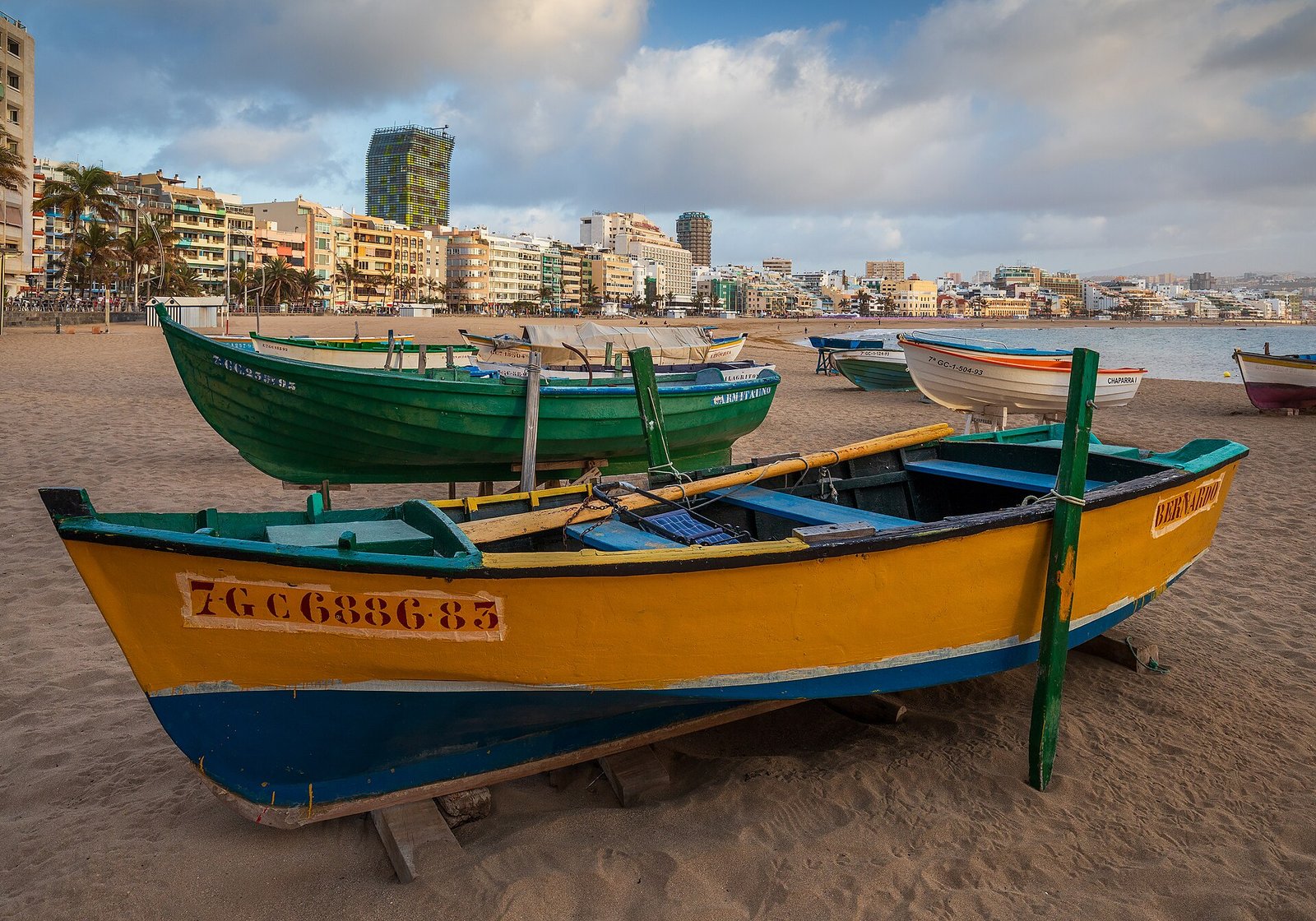
La Isleta is no postcard backdrop but a living fishermen's quarter: a peninsula of brightly painted houses, steep lanes and the smell of salt and fresh fish, right next to the vast Puerto de La Luz. Here, where Las Palmas de Gran Canaria has always faced the sea, the Virgen del Carmen is honoured every July — the patron saint of sailors and fishermen.
For La Isleta, the Fiestas del Carmen are the semana grande, the big week of the year. It is a party by neighbours for neighbours, not a programme laid on for visitors — and that is exactly what makes it special. Turn up with a little respect and you are warmly welcome. Here is what happens and how to be part of it.
The fishermen's quarter and its Virgin
La Isleta grew up as the home of fishermen, dockworkers and sailors, and that heritage still shapes the neighbourhood today. All along the Spanish coast the Virgen del Carmen is seen as the protector of those who go to sea, so it is no surprise that her feast is kept here with such devotion. For generations, La Isleta families walked their sons down to the boats and the harbour; the Virgin was the one they turned to in storm and worry.
That is why the fiesta is both religious and folk celebration in one. Around the church and central streets such as Calle Benartemi, the quarter turns for weeks into a stage of music, stalls and encounters. In 2026 the programme runs from around 6 July into early August, with the packed big week in the middle of the month.
The sea procession — the big moment
The most moving moment is the procesión marítima. In 2026 it falls on 19 July, the Día del Marino, the day of the seafarers. The image of the Virgen del Carmen is carried from her church, through the lanes to the harbour, and lifted onto a decorated boat. Escorted by a whole flotilla of fishing boats and yachts, she sails out to sea — horns, firecrackers and the applause of thousands on the quay going with her.
For the fishing families this is no spectacle but a promise: protection for everyone who will head out onto the water in the year ahead. Stand on the shore and you quickly sense that the emotion here is real, not staged.
La Aurora, the romería and the carpets
A dense programme surrounds the procession. In the days before 16 July, the Rosarios de la Aurora wind through the streets at daybreak: the faithful sing the rosary while the neighbourhood still sleeps — hence the name la Aurora, the dawn. On 16 July, the actual feast of the Virgen del Carmen, come the solemn Procesión de la Aurora and a high mass.
Two days later, on 18 July, the Romería-Ofrenda is held: a costumed procession in which people bring food as an offering — in 2026 the donations go to Cáritas. On the eve of the feast, neighbours decorate the streets with intricate carpets of salt and natural materials (the Ruta de las Alfombras). Add concerts, folk dance and evenings full of Canarian music.
How to join in as a guest
The best news first: everything is free and open. You need no ticket, just curiosity and a little respect. Come on foot or by guagua (the local bus), because parking in La Isleta is scarce and on festival days almost impossible. Wear comfortable shoes for the steep lanes, bring water and allow plenty of time — on procession days everything moves slowly.
And remember: the procession is first of all an act of faith. Photos are welcome, but pause for a moment as the Virgin passes, the way the locals do. After that the evening belongs to the party — the stalls serve fresh fish, papas and cold beer, and the music does not stop in a hurry.
Common questions
- When is the sea procession in 2026?
- On 19 July, the Día del Marino. The big week runs in mid-July, and the whole fiesta from around 6 July into early August.
- Where does the fiesta take place?
- In the La Isleta quarter next to the Puerto de La Luz in Las Palmas de Gran Canaria, around the church and Calle Benartemi.
- Does it cost anything?
- No. The processions, romería and concerts are public and free.
- What is la Aurora?
- The Rosarios de la Aurora, sung rosaries that wind through the streets at dawn — culminating in the Procesión de la Aurora on 16 July.
- How do I get there?
- Best by guagua or on foot; parking is tight and streets are closed on festival days.
Read on
- Las Palmas: Gran Cabalgata parade on 20 FebruaryGran Canaria · 14 October
- Vecindario: San Rafael 2026 fiestas with Braulio, GofionesGran Canaria · 14 October
- Triana Is Losing Shops and Buzz: Concern for the Historic Heart of Las Palmas de Gran CanariaGran Canaria · 12 August
- This weekend on Gran Canaria, 17–19 July 2026: Soul Festival, Fiestas del Carmen and the club nightGran Canaria · 17 July
- Maspalomas Winter Pride: 2–8 November 2026Gran Canaria · 12 October
- All events on Gran Canaria →
Details as of July 2026, per the official programme of the Las Palmas de Gran Canaria town hall. Dates, times and routes may change.