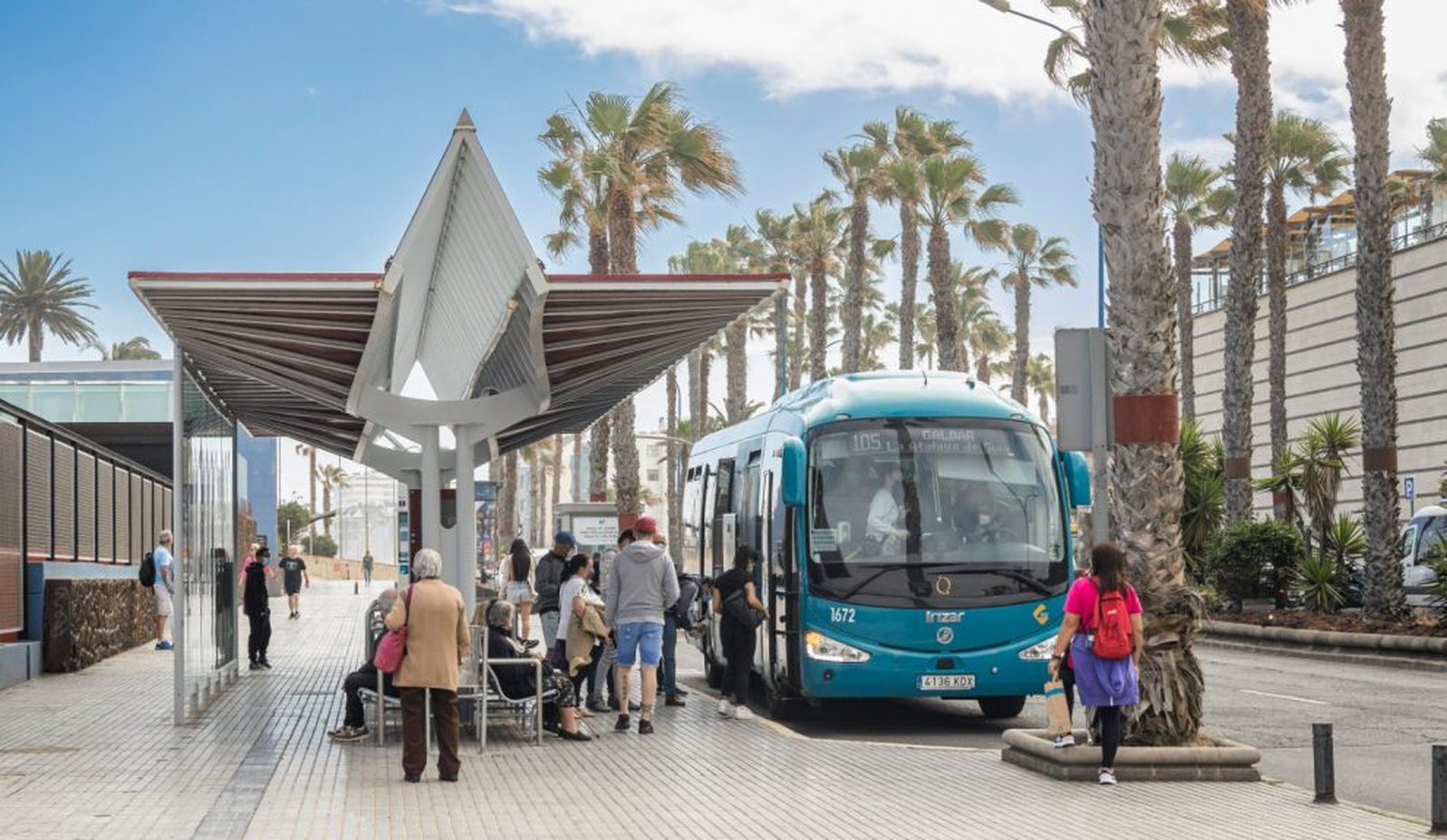
Two Bus Colours, One System: Global vs Guaguas
Before you board anything, remember one thing — it saves a lot of confusion: Gran Canaria has two bus companies, and they come in different colours.
The blue Global buses (in Spanish "guaguas", say gwa-gwas) are the intercity buses. They connect the whole island — airport, south, capital, mountain villages. If you're going from A to B across country, it's almost always Global.
The yellow Guaguas Municipales run only within the capital, Las Palmas. Perfect for city travel there, but they don't go beyond it.
The one catch: tickets are not valid across companies. A Global ticket won't work on the yellow city bus and vice versa. Sounds fiddly, but you'll learn it fast — and for most holidaymakers Global is what matters.
Airport to Your Hotel: Bus, Taxi or Transfer?
You land at Gran Canaria Airport (LPA) on the east coast — almost exactly between the two big destinations: the capital in the north, the beaches in the south. Here's how to move on:
North to Las Palmas: take Line 60. It runs about twice an hour, costs around €2.30–2.95 depending on the stop (San Telmo or Santa Catalina) and takes about 30 minutes.
South to Maspalomas/Playa del Inglés: take Line 66. Roughly hourly; depending on your stop you'll pay about €2.75–4.05.
Travelling with luggage and family? Then the taxi is more comfortable. Airport to Maspalomas (about 38 km) is roughly €45, to Las Palmas a bit less. Pre-booked private transfers cost similar and wait with a name sign.
Across the Island: the Blue Global Bus
The backbone for anyone seeing the island without a rental car is the blue Global buses. The network is huge — over a hundred lines, thousands of stops, many routes running late into the night.
The star for visitors is Line 30, the express between Maspalomas and Las Palmas. It takes just over 70 minutes, runs roughly every 20 minutes at peak, and links the island's two worlds — beach and city — cheaply and simply.
How it works: board at the front, tell the driver your destination (or tap your card), pay, done. The hubs are San Telmo and Santa Catalina stations in Las Palmas, plus the Estación de Maspalomas (San Fernando) in the south. From there you get connections everywhere.
City Transport in Las Palmas: Guaguas & MetroGuagua
Once you're in the capital, the yellow Guaguas Municipales take over. They run all across Las Palmas — from the old town of Vegueta and the Triana shopping street to the city beach Las Canteras.
New and smart is the MetroGuagua: a high-frequency rapid-bus line with its own lane, crossing the city south to north — basically a tram on wheels. For longer journeys within the city, the fastest option.
Same rule here: city ticket by cash or card on board. If you're staying longer, the city travel card works out cheaper.
The TransGC Card: Your Best Money-Saving Trick
If you plan more than a couple of journeys, the TransGC card (formerly TenMÁS) almost always pays off. It's a rechargeable plastic card you simply tap against the reader on board.
The clever bit: you get a bonus of up to around 40% on the credit you top up — so you travel noticeably cheaper than with single tickets. And no more digging for change every time.
Where to get it? At the San Telmo and Santa Catalina bus stations in Las Palmas, plus some kiosks and newsagents. For shorter stays there's also a ten-trip card for a few euros. And one card works fine for two people — just tap twice.
Taxi: When It's Really Worth It
Taxis are plentiful, safe and not as pricey as many fear — especially with two or four people.
The meter applies: base fare around €2.95, then about €0.80 per kilometre (a bit more at night and on Sundays). For fixed routes like airport–Maspalomas there are often flat fares (around €45). Tipping isn't expected; round up if you like.
A friendly note: make sure the driver resets the meter to zero at the start. For short hops — hotel to the beach, dinner in the evening — the taxi is often the most relaxed option.
Car Hire: Freedom for the North and the Mountains
If you want the green north, the mountain villages and hidden coves, there's barely a way around a rental car. The island is small, the roads are good — but the centre is mountainous.
A few things that make the trip smoother: take a car with a bit of engine power, the hairpins into the interior will thank you. The speed limits are 50 in towns, 90 on secondary roads, 120 on the motorway — and speed cameras are around, especially at the edges of villages. Fuel is cheap (the Canaries have low fuel taxes), parking is easy in the resorts and tight in Las Palmas.
Important for island-hopping: most rental companies don't allow you to take the car on the ferry to another island — some do, but ask first or it gets expensive.
Island-Hopping: the Ferry to Tenerife
Gran Canaria is only the start — the neighbouring islands are within easy reach by ferry. The prettiest crossing starts at the charming harbour of Puerto de las Nieves near Agaete in the north-west: the fast ferry gets you to Tenerife (Santa Cruz) in about an hour and a half. Ferries also leave from the port of Las Palmas.
For a day trip or a long weekend on the next island it's ideal — walk on board, no flight-baggage hassle. Best to book tickets online in advance.
For more on the loveliest corners, see our other guides — for example where to stay or which hikes are worth it.
Frequently asked questions
- Do I need a car on Gran Canaria?
- Not for a pure beach holiday in the south or a city break in Las Palmas — the buses (Global blue, Guaguas yellow) cover that well. For the green north and the mountains a rental car is a clear advantage.
- How do I get from the airport to my hotel?
- To Las Palmas on Line 60 (~€2.30–2.95), to Maspalomas on Line 66 (~€2.75–4.05). With luggage the taxi is more comfortable (airport–Maspalomas ~€45).
- What's the difference between Global and Guaguas?
- Global (blue) runs intercity and across the whole island; Guaguas Municipales (yellow) only within Las Palmas. Tickets are not valid across the two.
- Is the TransGC card worth it?
- Almost always if you make more than a couple of journeys: you get up to around 40% bonus on your credit. Available at the San Telmo and Santa Catalina stations.
- How fast is the bus from Maspalomas to Las Palmas?
- On the express Line 30 about 70 minutes, roughly every 20 minutes at peak times.
- Can I take the rental car on the ferry?
- Usually not — most rental companies forbid taking the car to other islands. Some allow it; best to ask first.
- How expensive are taxis?
- Base fare around €2.95, then about €0.80/km; a bit more at night and on Sundays. Make sure the meter is reset.
- How do I get to Tenerife?
- By fast ferry from Agaete (Puerto de las Nieves) in about 1.5 hours, or from the port of Las Palmas.