An island without a cemetery
La Graciosa was settled late: according to Historia de Teguise, permanent houses only appeared after 1852, when Rafael Cappa Maqueda applied to open a fish-salting works. Around 1900 some 100 people lived there, 160 by 1910. Everything else was missing: no church, no school, no cemetery.
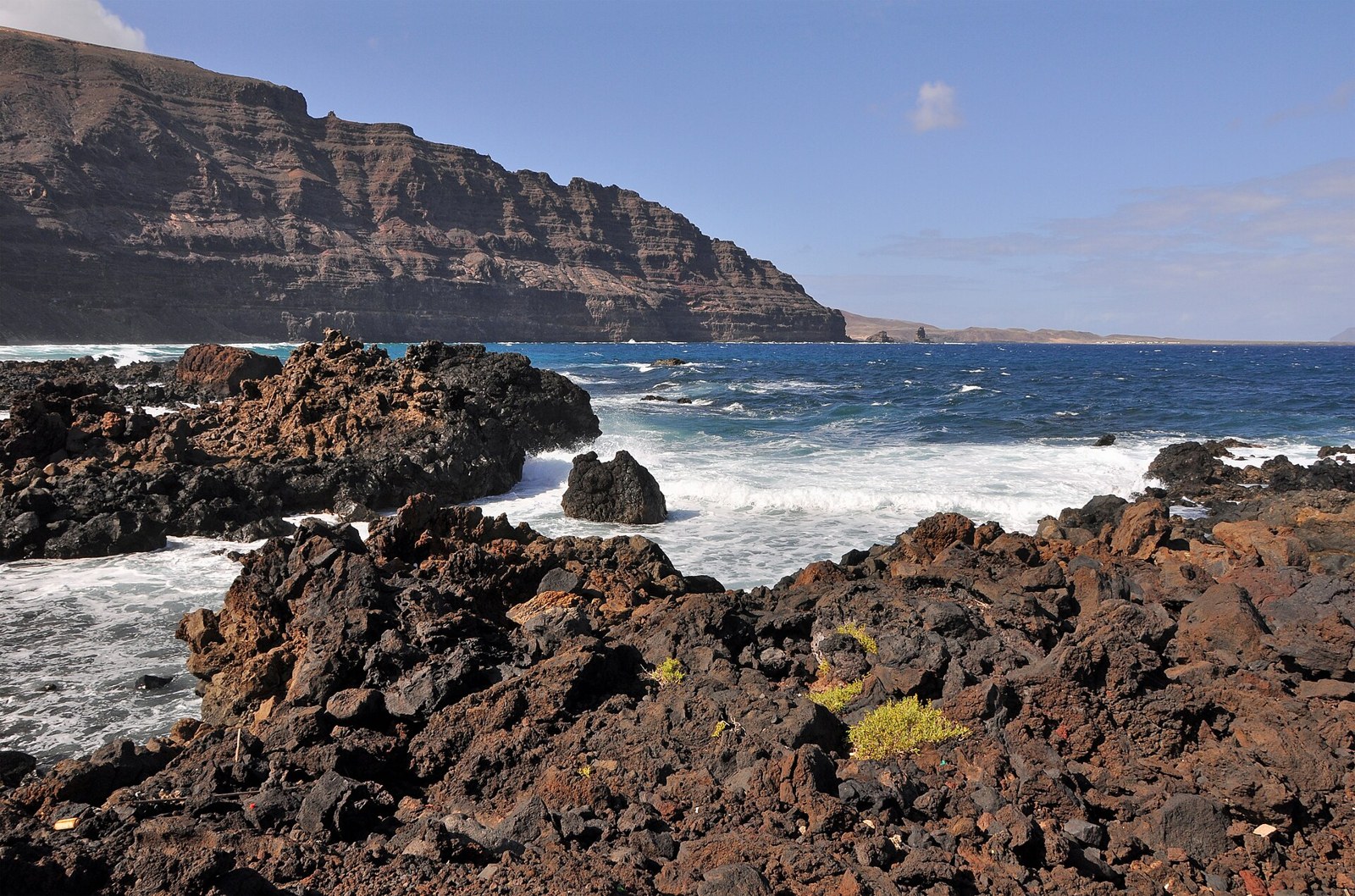
Historia de Haría quotes an account from the Diario de Las Palmas of 28 June 1966: the coffin was improvised from old wood, usually from broken-up boats, then came the crossing of El Río and the climb up the cliff to Haría. The strait is about two kilometres wide at its narrowest; the Risco de Famara behind it is a wall several hundred metres high. Generations of gracioseras took the same route to sell their fish on Lanzarote.
23 September 1945
The exact day comes from La Voz de Lanzarote. Emilio Hernández Domínguez writes there that on this date the first mass was celebrated in the new church at Caleta de Sebo, by Juan Alonso Vega, magistral of the cathedral of Las Palmas. For the date and the priest's name, that is the only source we could find.
Independently of it, the Canary education department's CanariWiki and the Memoria de Lanzarote photographic archive both date the Iglesia de Nuestra Señora del Carmen to 1945. It has a single nave and a thoroughly maritime interior: an altarpiece shaped like a ship, a pulpit in the form of a ship's wheel, an altar resting on an iron anchor. Its patroness is the Virgen del Carmen, known on the island as the Virgen del Mar.
25,000 pesetas — and where they came from
The church was not a one-off. Alongside a photograph from 1945, Memoria de Lanzarote lists four works with their costs: cemetery 12,000 pesetas (1943), church 25,000 pesetas (1944), landing stage 13,000 pesetas (1944), cistern 5,000 pesetas. Converting to euros does not help: nominally about 150 euros for the church, which says nothing about 1944 purchasing power.
The money came through the Mando Económico de Canarias, a military administration set up in 1941 which, according to Memoria de Lanzarote, had raised around 32.8 million pesetas for infrastructure by 1946. The driving figure was Francisco García Escámez, captain general of the Canaries; Historia de Teguise credits him with La Graciosa's church, school, cemetery and small quay. That an authoritarian regime staged this as a favour is part of the story.
Electricity only in 1985, water in the early 1990s
How long the road still was afterwards was summed up by Saúl García in the Diario de Lanzarote on 12 April 2024: in 1943 three cisterns in Caleta del Sebo and one in Pedro Barba; in 1977 a desalination plant producing 75 cubic metres a day, run by generators that supplied twelve hours of power daily; in 1985 the submarine cable that brought uninterrupted electric light for the first time; in the early 1990s a submarine pipeline connecting the island to Lanzarote's water supply.
So forty years lie between that first mass and permanent electricity. The telephone arrived in between: in 1987 Telefónica opened an exchange with 300 lines, according to the archive project Historia de la Graciosa.
Today: eighth island, 718 inhabitants
On 1 January 2022 ISTAC counted 718 inhabitants on La Graciosa. There is no official figure for 1 January 2026: the official counts run only to 2025 for municipalities, and only the breakdown by settlement, which ends in 2022, lists La Graciosa separately.
On 26 June 2018 the Spanish Senate unanimously recognised La Graciosa as the eighth inhabited Canary Island. Administratively nothing changed: the island still belongs to the municipality of Teguise and has no island council of its own; since 30 June 2026 the Lanzarote body has at least been called the Cabildo Insular de Lanzarote y La Graciosa. On water, the next step is due: under the EU project ICONIC, trial operation of a solar-powered seawater desalination plant begins in 2026.