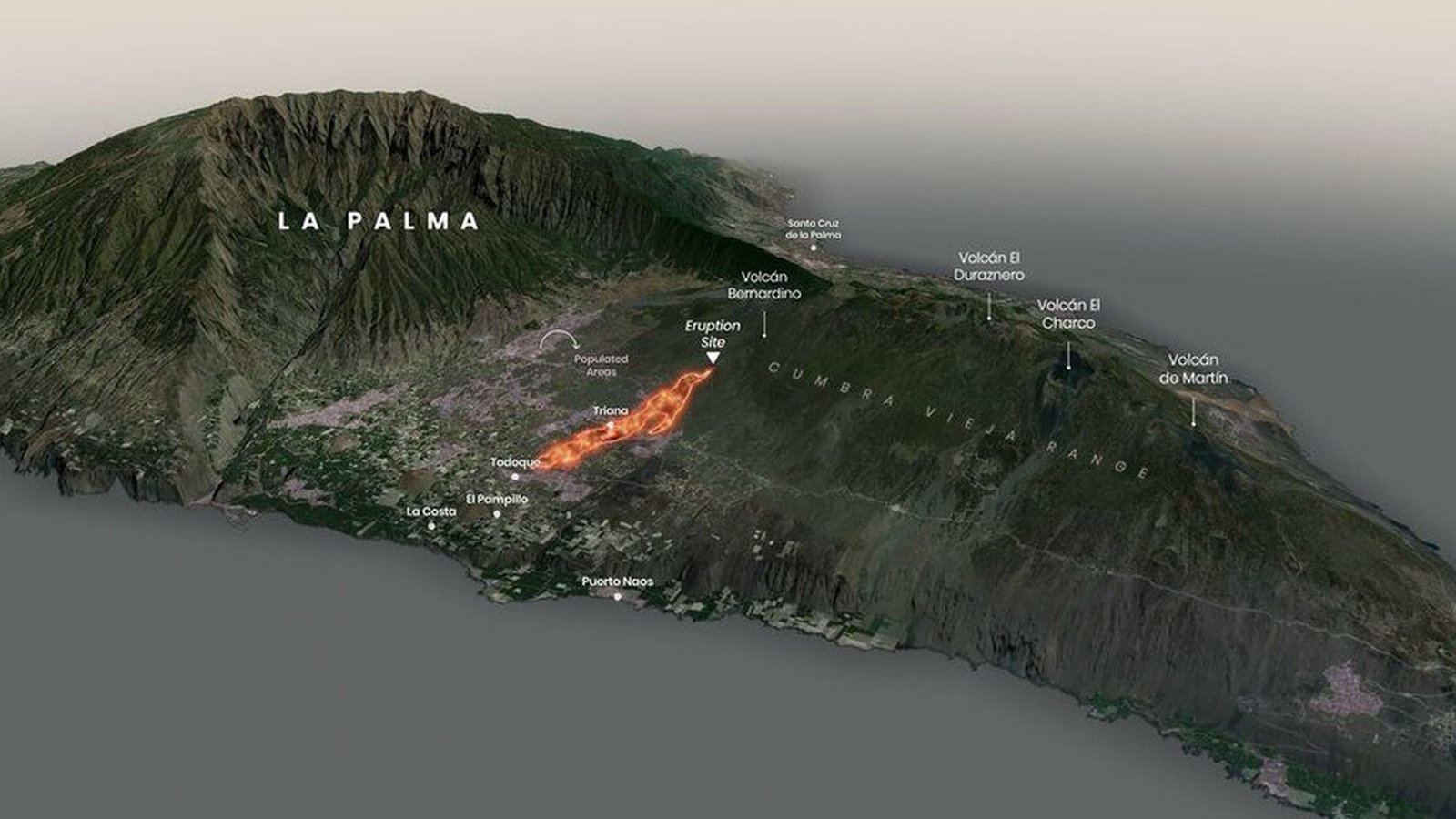
The destruction: 1,676 buildings, of which around 1,345 homes; over 200 million cubic metres of lava; around 7,000 people evacuated
Finished public new builds: very few so far — the only ones handed over early were 46 homes in Tazacorte, while the eruption was still ongoing
Under construction/acquisition: around 399 properties, plus 42 refurbished; over 160 social homes via the ICAVI across several municipalities
Still provisional: dozens of families still live in containers and wooden modules
Aid funds: around 340 million euros mobilised, over 250 million not yet distributed
Sources: eldiario.es/Canarias Ahora (EFE), El Apurón, IGN/INVOLCAN, Plataforma de Afectados
To grasp the scale: the Tajogaite was no ordinary natural event. For 85 days, from 19 September to 13 December 2021, the volcano on the Cumbre Vieja put out over 200 million cubic metres of lava. It was the longest recorded eruption in the island's history. In the end 1,676 buildings were destroyed, around 1,345 of them homes; entire districts such as Todoque vanished under the lava; and about 7,000 people had to leave their homes. The material damage ran into the hundreds of millions.
Where reconstruction stands today
Five years on, the picture is mixed. On one side, movement is visible: according to official figures, around 399 properties are in various phases of construction or acquisition, 42 homes have been refurbished, and the Canary housing institute ICAVI is advancing over 160 social homes in municipalities such as Puntallana, Tazacorte, Tijarafe and Breña Baja. The first of the housing modules set up as an emergency measure have been dismantled, because their occupants found more stable accommodation.
On the other side stands the sobering situation of many of those affected. The special commissioner for reconstruction has acknowledged that the only public homes handed over in the first years were 46 units in Tazacorte — handed over while the volcano was still active. Several stock-takes conclude that, of the loudly announced new housing projects, barely any had been completed by 2026. Dozens of families still live in container settlements and wooden modules that were meant as a stopgap and have become, for many, a lasting form of housing.
The point of contention: the undelivered aid
The biggest point of conflict is the aid money. According to official figures, the central and Canary governments together have mobilised around 340 million euros. Yet over 250 million of that has, according to several sources, not yet reached those affected. The Plataforma de Afectados and the Tierra Bonita platform criticise the reconstruction as too slow; their charge is that a large share of the homes built so far have come from the victims' own initiative, not from public programmes. Cita.news reports this criticism without judging it — the official bodies, for their part, point to ongoing building projects and a plan for around 700 homes.
Frequently asked questions
- When was the eruption?
- From 19 September to 13 December 2021, 85 days in total. It was the longest recorded eruption on La Palma.
- How many homes were destroyed?
- Around 1,345 homes out of 1,676 buildings destroyed in total. About 7,000 people were evacuated.
- Are people back in their homes?
- Many are, but far from all. Dozens of families still live, five years on, in provisional containers and wooden modules. Finished public new builds are so far very few.
- Why can't people fully return to Puerto Naos?
- Carbon dioxide is still seeping from the ground there, in places at dangerous concentrations. The levels are continuously monitored.
- Can you visit La Palma?
- Yes. The island is safe, tourism has recovered, and a visit directly supports the economic recovery.
Read on
- The science breathes easier, the affected still wait: La Palma four years after the volcanoLa Palma · 6 June
- Gran Canaria volcano: last eruption 2,000 years agoGran Canaria · 29 October
- Cabin baggage fees: claiming back five years of chargesCanary Islands · 12 September
- La Palma hospital: 30 discharged patients still in bedsLa Palma · 7 November
- La Palma saxophone festival: 9 to 14 November 2026La Palma · 6 November
- All events on La Palma →
As of 24/06/2026. Sources include eldiario.es/Canarias Ahora (EFE), El Apurón, IGN, INVOLCAN and statements from victims' associations (Plataforma de Afectados, Tierra Bonita). Reconstruction figures reflect the cited publications and may change; the current official figures are what count. Map: illustration.