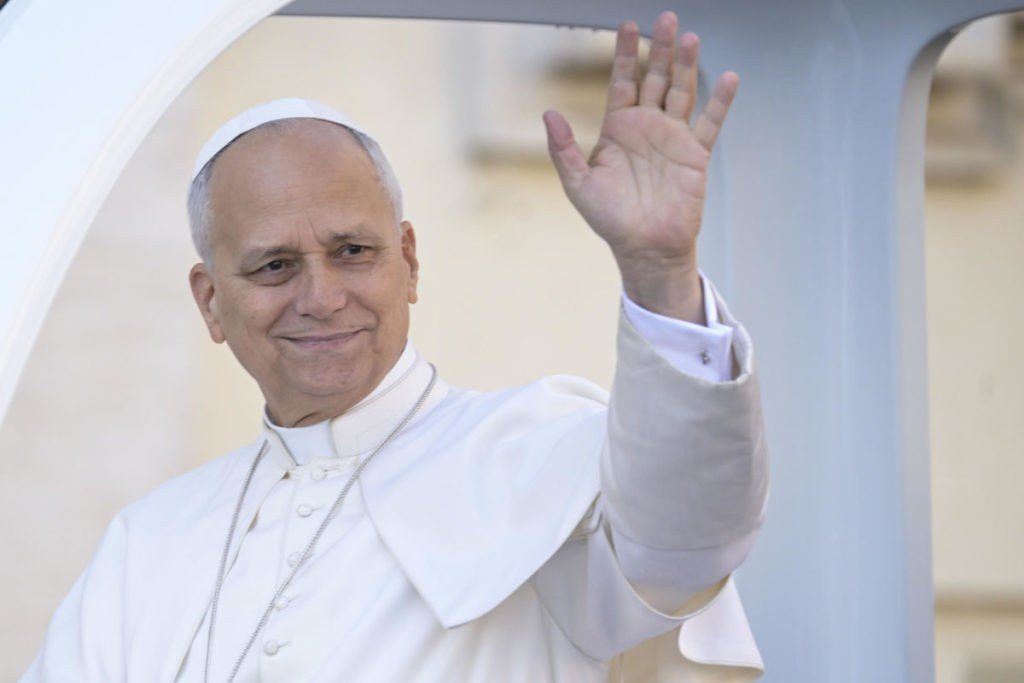
There are those journeys that never happened — and yet make history. Pope Leo XIV's visit to the Canaries is one of them. For it was not originally his trip. The islands were on the itinerary of his predecessor Francis, who died on 21 April 2025 before he could visit them. Leo XIV — the first US-born pope, born Robert Prevost in Chicago and, after years as a missionary, also a Peruvian citizen — is now carrying out that plan. Making migration the centre of this leg was Francis's concern; Leo carries it forward.
A compass that travels from Africa to Rome
Perhaps the most moving detail is a small, unremarkable object. The president of the Cabildo (island council) of Gran Canaria, Antonio Morales, is presenting the Pope with a compass from a cayuco — one of those wooden fishing boats in which people brave the dangerous Atlantic route. The device was made in China, used by people who set out from Senegal, and reached the quay of Arguineguín. «While pateras and cayucos mostly use handheld GPS devices, compasses are more reliable — a symbol of rescue and safety», Morales explains. Now this object, which survived half the Atlantic, will be carried into the Vatican by «an American and mathematician pope», as Morales puts it with a smile.
There is also a cross, made using the technique of the «cuchillo canario», the traditional Canarian knife — craftsmanship as an expression of island identity.
A rosary from the village's last carpenter
The municipality of Mogán has come up with something too: a handmade rosary from the wood of avocado trees and Canary pine («tea de pino»). It was made by Doramas Hernández, known in the town as the «last traditional carpenter». A gift that smells of home.
The story that explains the gift
Why Arguineguín? The small harbour in the south of Gran Canaria carries a bitter nickname: «muelle de la vergüenza», the quay of shame. During the migration crisis of 2020, thousands of people were stranded here in undignified conditions; the newspaper EL PAÍS called the place «an example of how not to do things». That is precisely why the Pope wants to see it — not to hide it, but to make it visible. One of the finest stories here is that of Mamadou Koulibali, a young Malian: two years ago he himself arrived by boat in Arguineguín. Today he is helping to refurbish the very quay that once took him in.
A golf cart for the care homes
Not everything is heavy and symbolic — some of it is simply charming. For the short distances the Pope uses, alongside the armoured Mercedes popemobile, three electric vehicles, among them a golf cart in which he rolls through Calle Viana in historic La Laguna to greet residents of care homes in person. The popemobile itself, an armoured Mercedes G-Class, is a small technical curiosity: capable of up to 235 km/h, around 400 horsepower, costing some €400,000 — and above all fully glazed. The design goes back to the assassination attempt on John Paul II in 1981, after which the Vatican switched to armoured, bulletproof vehicles.
Fabric with «dignity, flow and symbolic power»
Behind the scenes, the wardrobe is also being considered. On this trip the Pope is dressed by the Italian vestment designer Filippo Sorcinelli, who describes his philosophy thus: «A fabric destined for the Pope must have dignity, flow and symbolic power.» And on Tenerife the island's patroness receives him in fitting style: Jaime Estévez, who has watched over the garments of the Virgin of Candelaria for nearly 40 years, chose a «simple yet elegant» outfit for the occasion.
From a chocolate bar to a treasure hunt
And then there are the details that show how much an entire archipelago is set in motion. The airline Binter laid on special flights and is distributing over 121,500 specially made commemorative chocolates to its passengers. At the schools — closed on the visit days — the youngest pupils prepared for the «man from the Vatican» with treasure hunts and puzzles. Those of a historical bent recall, meanwhile, that as early as 1934 a future pope touched the islands: Cardinal Eugenio Pacelli, the later Pius XII, stopped in Teror back then. And over it all lies a deployment that the authorities call the «largest and most complex security operation in Canarian history» — more than 1,250 officers.
What it is ultimately about
It is these small things — a compass, a rosary, a golf cart — that make a state visit human. They tell of an island searching for its place between tradition and tragedy, between hospitality and the harsh reality of the Atlantic route. The Pope comes for a day. The stories he takes with him remain.