Tenerife's autumn 2026 pilgrimage festivals: every date from September to November, and how to join in
Ox-carts, traditional dress, folk music and a cup of wine handed to you by someone you have never met: between September and November there is a romería somewhere on Tenerife almost every weekend. The newspaper El Día published a calendar of these festivals on 7 September 2026 — we have checked it, added to it, and filled in what date lists usually leave out: what actually happens at one of these, and what you should know before you go.
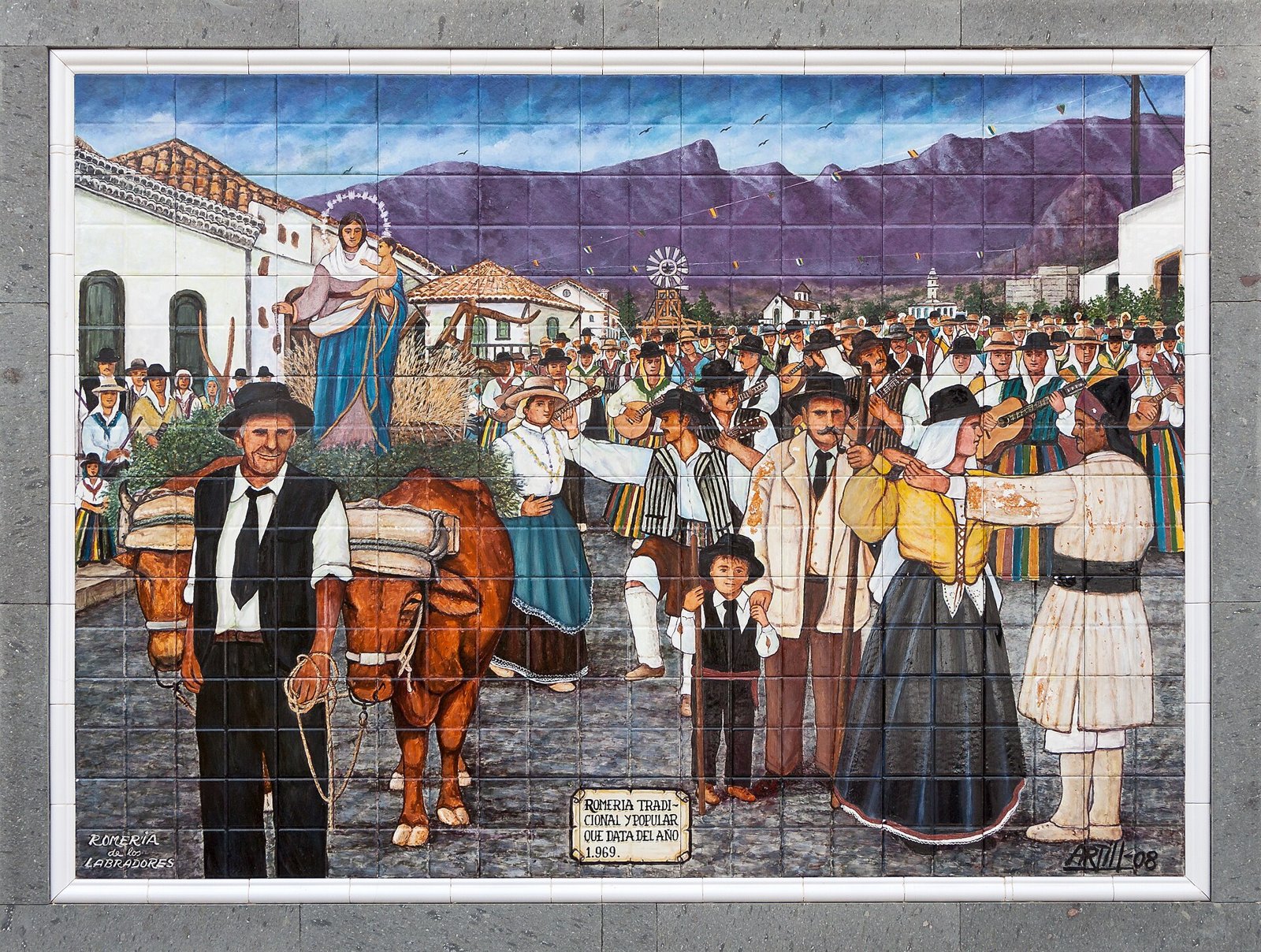
Photo: H. Zell, CC BY-SA 3.0 (Symbolbild).
This guide is written for people who have just moved to the island as much as for those who have been here for decades. A romería is not a ticketed event with a stage schedule. It is a pilgrimage that turns into a village party. You can simply turn up. You just want to know how.
The dates: September and October 2026
The dates below come from the fiesta and romería calendar El Día published on 7 September 2026, with individual entries corroborated by local media and listings sites. We give start times only where a source actually states one.
September 2026
- Saturday 12 September — Bajada de San Carlos, Güímar. Date per El Día; we found no official municipal programme.
- Saturday 12 September — Baile de Magos de Las Galletas, Arona, at the Parque Urbano Paulino Suances Romín. According to local outlet El Digital Sur, table bookings ran at the Centro Cívico in Las Galletas until 20:00 on 11 September, and traditional Canarian dress is required to take part.
- Sunday 13 September — Romería de Benijos, La Orotava.
- Saturday 19 September — Bajada de la Virgen de Abona, Arico.
- Saturday 19 September — romería in San Juan de la Rambla, reported by El Digital Sur as the 31st romería in honour of San José. Registration for traditional carts ran from 1 to 14 September, with carts available to hire for 200 euros; information via the town hall (922 360 003, ext. 2116) or [email protected].
- Saturday 19 September — Bajada de Los Roques, Fasnia.
- Sunday 20 September — Romería Barquera de El Médano, Granadilla de Abona, in honour of Nuestra Señora de las Mercedes de Roja.
- Sunday 20 September — Subida de la Virgen de Abona, Arico (the return journey after Saturday's bajada).
- Saturday 26 September — Romería de San Miguel, San Miguel de Abona.
- Sunday 27 September — Paseo Romero de Chanajiga, Los Realejos.
October 2026
- 2 October — Baile de Magos de Geneto, La Laguna.
- 3 October — Romería de Valle Tabares, La Laguna.
- 4 October — Romería de Geneto, La Laguna.
- 9 October — Baile de Magos de Barranco Las Lajas, Tacoronte.
- 10 October — Paseo Romero de Barranco Las Lajas, Tacoronte.
- 18 October — Romería de La Vega, Icod de los Vinos.
- 18 October — romería in Adeje.
- 23 October — Baile de Taifa de Araya, Candelaria.
And so the season does not end abruptly: for November the same calendar lists the Baile de Magos of Igueste de Candelaria (6 November), the Baile de Magos de San Diego in La Laguna (7 November), the Paseo Romero de Lomo de Montijo in Güímar (15 November) and the San Andrés festivities in the north of the island on 29 and 30 November.
What a romería actually is
If you have never been to one, you probably picture a street party. That is only half of it. A romería is, at root, a pilgrimage: a procession in honour of a village's patron saint, through which rural communities gave thanks for the harvest and asked for protection. That religious core is still there — usually a mass, and the saint's image carried at the head of the whole procession.
Wrapped around it is everything visitors notice first: ox-drawn carts (carretas) decorated with produce, branches and flowers; people in the traje de mago or traje de maga, the Canarian country dress; and parrandas, groups of musicians with timple, guitar and drum who sing the procession along its route.
The part that most surprises newcomers: food and drink are handed out from the carts, to everyone. Wine, cheese, meat, stews, papas arrugadas go to whoever is standing at the roadside, and you do not need to know a soul. It is a neighbourly gesture, not catering. In the evening the day often rolls into a baile de magos, a night of dancing in traditional dress with long communal tables and food that goes on late.
The highlights — and what makes each one different
Not all romerías are alike. Several of the autumn dates have a very distinct character.
Romería Barquera de El Médano (20 September, Granadilla de Abona). The most unusual of the season: this pilgrimage does not stay on land. After the procession through the village, the image of Nuestra Señora de las Mercedes de Roja is taken aboard a boat and carried across the bay, escorted by other vessels — a romería and a sea procession in one, against the Atlantic backdrop of El Médano.
Bajada and Subida de la Virgen de Abona (19 and 20 September, Arico). A two-part date, very typical of Canarian fiesta logic: the image goes down on Saturday and back up on Sunday. To see both, plan two days.
The romería in San Juan de la Rambla (19 September). The 31st edition in honour of San José, with open registration for traditional carts according to El Digital Sur — a good reminder that these are not spectator events but festivals the village families make themselves.
October in La Laguna and Tacoronte. Geneto, Valle Tabares, Barranco Las Lajas: smaller, rural romerías in the districts above the towns. Fewer crowds, and closer to what these festivals originally were.
On Fiesta de Interés Turístico status: we found no source confirming such a declaration for any of the autumn dates listed here. Confirmed declarations on Tenerife apply to other festivals — the Romería de San Benito Abad in La Laguna and the Romería de San Roque in Garachico are reported as Fiesta de Interés Turístico Nacional, while the Bajada de la Virgen del Socorro in Güímar holds regional status. All three fall earlier in the year.
Practical advice for going
Arrive early. This is the single most useful rule. Guides to Tenerife's romerías suggest that if the procession starts at 12:00, you should already be looking for a parking space by 10:00. Village centres close to traffic and the route fills up fast.
Take the guagua if you can. For the big festivals the island bus operator TITSA regularly lays on special services. For the Romería de San Roque in Garachico on 16 August 2026, El Día reported that TITSA reinforced line 363 with 23,000 extra seats, running from 09:30 to 23:00, with a special stop at the car park by the football pitch replacing the usual town-centre stops. Around 20,000 extra seats were reported for Candelaria and for the Fiestas del Socorro. For smaller romerías, however, a special service is not guaranteed — check titsa.com or the town hall first.
What to wear. There is no charge and normally no dress code for spectators. Turning up in the traje de mago is welcome, and for some bailes de magos it is a condition of taking part, as in Las Galletas. Otherwise: comfortable, sturdy shoes (cobbles, slopes, hours on your feet), sun protection, a hat and water.
Food. Yes, it is handed out from the carts — but do not count on it for a meal. Bringing your own basket with bread, cheese and drinks is entirely normal and part of the picture.
With children. The daytime part — the procession, the carts, the music — is thoroughly family-friendly. Once the evening baile starts it gets louder, more crowded and distinctly more adult. That is a good moment to leave.
Accessibility. Official information is rare. What works in practice: pick a wide, shaded stretch of the route with easy access and get there in good time, rather than pushing through the crowd later. Allow for road closures in the surrounding area.
And remember it is also an act of worship. At the mass, in front of the image and as the procession passes, restraint and respect are expected. Do not block the route, do not cut through the ranks, and give the carts and the oxen room.
How to check the details yourself — and what is still open
Romería programmes are often finalised only days in advance. Times shift, routes change, and bad weather or wildfire risk can move or cancel an event. So for every date in this article the rule is the same: check again before you set off.
The most reliable places are the websites of the relevant municipalities (arona.org, losrealejos.es and granadilladeabona.org among them) and their official social media accounts, where fiesta committees usually post the programme first. Add to that the town hall's Concejalía de Fiestas by phone, titsa.com for transport, and local listings sites such as La Agenda.
One thing stayed open in our research: start times. For most of the autumn dates above, no publicly accessible source stated a time or a route as we went to press. So we do not state one — better no time than a wrong one. The Bajada de San Carlos in Güímar on 12 September we could likewise only verify through the El Día calendar, not through a municipal programme; if you plan to go, ask the town hall first.
Second-best tip: small cash, a bottle of water, and a light bag for everything that gets pressed into your hands along the way.
Key facts
- Window: 12 September to 23 October 2026 — at least 18 dates across Tenerife, per the calendar published by El Día on 7 September 2026.
- Cost: free. Romerías and bailes de magos are public events; some bailes require a table booking in advance.
- Busiest weekend: 19–20 September — Arico, San Juan de la Rambla, Fasnia and El Médano.
- Most distinctive: the Romería Barquera de El Médano (20 September) carries the Virgin across the bay by boat.
- Transport: TITSA added 23,000 seats on line 363 for the Garachico romería in 2026, according to El Día — a measure of the crowds the biggest dates draw.
- Recognition: San Benito Abad (La Laguna) and San Roque (Garachico) are reported as Fiesta de Interés Turístico Nacional; the Bajada del Socorro in Güímar holds regional status.
FAQ
- Do I have to pay to attend?
- No. Romerías and bailes de magos are public festivals with no entry charge. Some bailes do require you to book a table in advance — in Las Galletas, bookings ran until 11 September at the Centro Cívico, according to El Digital Sur.
- Do I need Canarian traditional dress?
- Not as a spectator. To walk in the procession, or to take part in some bailes de magos, yes: for Las Galletas local reporting says traditional dress is compulsory. Guests in traje de mago are welcome everywhere.
- Is it suitable for children?
- The daytime part very much so — ox-carts, music and costumes go down well. The evening baile, with loud music and alcohol, is more of an adult affair.
- How do I get there without driving?
- By TITSA bus. For major dates the operator lays on special services and extra departures, sometimes with relocated stops. That does not happen automatically for smaller romerías, so check titsa.com beforehand.
- When is the exact programme published?
- Often only a few days ahead. The municipality's website and the official channels of the town hall or fiesta committee are the most reliable source for times and routes.
Read on
- Tenerife: Playa Jardín reopens after contaminationTenerife · 23 October
- Tenerife: Arbistar moved 881 Bitcoin on crash dayTenerife · 23 October
- Tenerife: Tropicalia turns 10 with 11 acts on 2 stagesTenerife · 23 October
- TF-1 night roadworks from 25 October on 18.6 kmTenerife · 23 October
- Los Cristianos restaurants: 4 checked, mains from €7Tenerife · 23 October
- All events on Tenerife →