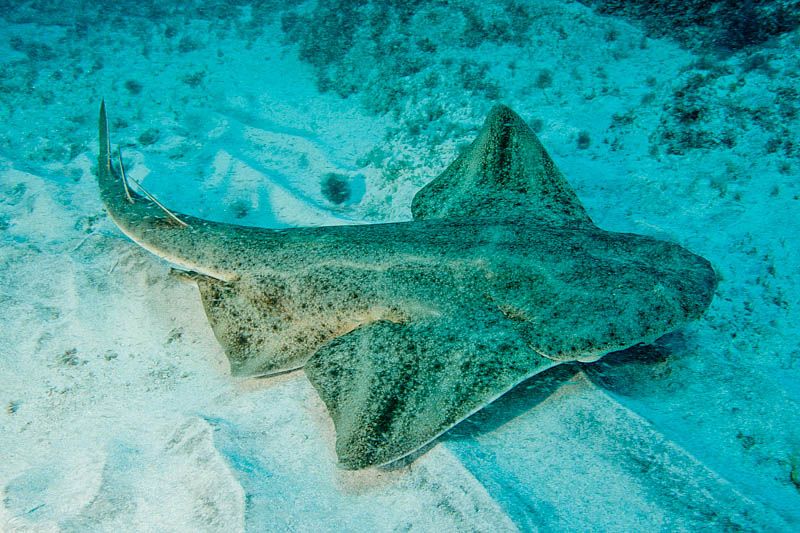
Sunday afternoon, just after four, on Playa Honda beach — a spot on the east coast of Lanzarote, right next to the airport. A young woman from Lanzarote is standing in the shallow water at the shoreline. Suddenly a sharp jolt, then a bite to her leg. She kicks repeatedly until she frees herself. What she hadn't seen: directly in front of her feet, completely buried in the sand, lay a young angel shark — only its eyes were showing.
The woman had stepped on the animal. The shark reacted the way any wild animal reacts when you accidentally step on it: with a defensive bite. No attack. No hunting. A startle reaction.
What even is an angel shark?
The angel shark — «angelote» in Spanish, scientifically Squatina squatina — is a shark that looks nothing like the shark from the movies. It has a flat, broad body, large wing-like pectoral fins (hence «angel») and lives on the sandy seabed. It is not a fast open-water swimmer but an ambush predator: it half-buries itself in the sand, leaves only its eyes exposed, and waits motionless for hours until a fish swims past.
This camouflage is exactly what was the problem here. If you walk in shallow water, you don't see the animal — and in the worst case you step on it.
How dangerous is it to humans?
Short answer: practically not at all. There are no documented serious or fatal angel shark incidents in the Canary Islands or anywhere in Spain. The shark does not mistake humans for prey — a leg is far too big for that. The few known bites were all the same: someone accidentally stepped on an animal hidden in the sand, and the shark defended itself.
There was a similar case at Famara beach, where a larger juvenile bit a child bathing in shallow water — that child did need medical treatment. That, too, was not an attack but the same startle situation.
In other words: the angel shark is about as dangerous to humans as a bee. It only stings (or bites) if you crowd it — and never seeks contact on its own.
Why Lanzarote matters so much for this shark
Now comes the genuinely remarkable part. The angel shark was once widespread across the entire north-east Atlantic and the Mediterranean — from Scandinavia to West Africa. Today it has all but vanished. Overfishing, bottom trawling that ploughs up the seabed, pollution and climate change have collapsed the populations. The angel shark is now considered one of the most threatened shark species in the world — the second most critically endangered group of sharks overall.
And of all places, the Canary Islands — and Lanzarote in particular — are one of the last areas where the species still lives in stable numbers. The sandy, sheltered seabed around the island is a nursery for juvenile angel sharks. So what happened off Playa Honda is, paradoxically, a good sign: it shows that the animals are reproducing and that their young grow up right by the beaches.
The Canary Islands population is on the Spanish catalogue of species threatened with extinction. Research projects such as the Angel Shark Project regularly tag juveniles in Lanzarote and collect sighting reports to protect the species. Divers from all over the world come to Lanzarote precisely to see angel sharks — for many, it is the only water where they can still do so at all.
What to keep in mind at the beach
The likelihood of this happening to you is very low. But if you swim at Lanzarote's sandy beaches — especially Playa Honda, Famara or other shallow, sandy bays — a few simple rules:
- Shuffle through the shallows instead of stamping. If you slide your feet across the sand rather than stepping down, you startle hidden animals without treading on them. This technique is called the «stingray shuffle» — it works for all sand-dwelling sea creatures.
- Look where you step in the water. In shallow, clear water you can often see the eyes or outline of a buried animal if you look closely.
- If you see an angel shark: leave it alone. Don't touch it, don't disturb it. Observing from a distance is completely safe — and a real privilege, because it's only possible in a few places left in the world.
- If you are bitten: clean the wound, disinfect it, and get medical attention for deeper injuries. A juvenile's bite is usually superficial, but any animal bite should be kept clean to avoid infection.
A story with two sides
The Playa Honda incident lends itself well to a sensational headline — «Shark bites swimmer». But the real story is a different one: an extremely rare, critically endangered animal defended itself after a human accidentally stepped on it. And the actual point is that this animal still exists off Lanzarote's beaches at all — while it has vanished almost everywhere else in the world.
If you live on Lanzarote or holiday here, you share the water with one of the Atlantic's special animals. That's no reason for fear — but, with a little respect and care, quite a stroke of luck.
Frequently asked questions
- What is an angel shark?
- A flat, bottom-dwelling shark (Squatina squatina, Spanish «angelote») with large wing-like fins. It lives half-buried in the sand and hunts from ambush. Despite the name «shark», it is practically harmless to humans.
- Is the angel shark dangerous?
- No. There are no documented serious or fatal incidents in Spain. Bites only happen when someone accidentally steps on an animal hidden in the sand — a purely defensive reaction, not an attack.
- What happened at Playa Honda?
- On 1 June 2026, a young woman in shallow water accidentally stepped on a juvenile angel shark buried in the sand. The animal bit her leg in defence. She had to kick repeatedly to free herself but suffered no serious injuries. Playa Honda is on the east coast of Lanzarote, next to the airport.
- Why does the angel shark live precisely off Lanzarote?
- Lanzarote has the sandy, sheltered seabeds the species needs to live and raise its young. While the angel shark has vanished almost everywhere else through overfishing and bottom trawling, the Canary Islands — Lanzarote especially — are one of the last refuges worldwide.
- How can I protect myself at the beach?
- Slide your feet through the sand rather than stepping down firmly (the «stingray shuffle»). Look where you step in shallow, clear water. If you see an angel shark: observe from a distance, don't touch.
- Should I report an angel shark if I see one?
- Yes. The Angel Shark Project collects sighting reports to study and protect the species. Dive centres and local conservation groups in Lanzarote accept such reports.
- Is it allowed to catch or disturb angel sharks?
- No. The species is legally protected and listed in the Spanish catalogue of species threatened with extinction. Catching, disturbing or harming them is prohibited and punishable.
Read on
- Lanzarote bin strike: 80% minimum service, expect full binsLanzarote · 16 October
- Lanzarote: Ocean Lava Triathlon 24 October in Puerto del CarmenLanzarote · 15 October
- Lanzarote Local Market Returns to Playa Honda with Over 100 Canarian ProductsLanzarote · 6 August
- Lanzarote: MHT drag dinner show in Puerto del Carmen, €49Lanzarote · 15 October
- Lanzarote: Arrecife Marea Fest on 17 October, free entryLanzarote · 15 October
- All events on Lanzarote →