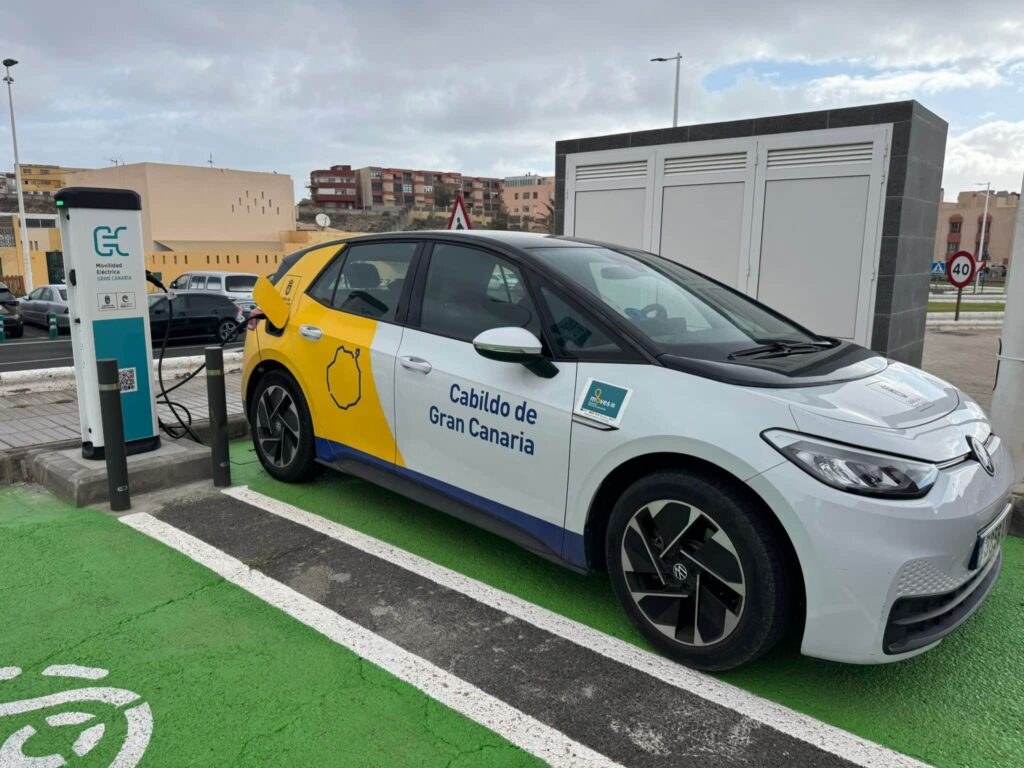
The transport transition is a particular issue in the Canaries: limited space, many short journeys, heavy dependence on imported fuel. No wonder the regional government is pushing the electrification of transport. Now the Department for Ecological Transition and Energy (Consejería de Transición Ecológica y Energía) under Mariano Zapata has launched a new round of funding for sustainable mobility in public transport, co-financed with EU money from the FEDER Canarias 2021–2027 programme.
But the figures running through the news tickers deserve a second look — for there, two different levels of funding are easily conflated.
Who is funded — and who is not
First things first, to clear up a common misunderstanding: this regional-government subsidy is not aimed at private individuals wanting to buy their own electric car. Those eligible are exclusively professionals in passenger transport: public and private companies, holders of a taxi licence, and VTC operators (chauffeur-driven hire cars) providing a public transport service. So it is about renewing fleets — buses, taxis, collective transport — not the private second car.
Zapata framed the goal thus: electric mobility should become «an accessible reality not only for citizens but also for the transport professionals who play a key role in decarbonising our cities».
The terms in detail
The subsidy is split into two lines. Line A supports the purchase of electric or zero-emission vehicles in classes M1, M2 and M3 — from the car-sized taxi saloon to the bus. A minimum investment is required, graduated by vehicle class: about €25,000 for an M1 vehicle, €35,000 for an M2 and €60,000 for an M3 bus.
Line B funds the associated charging infrastructure and alternative-fuel stations. Here up to €110,000 per beneficiary is possible; for municipalities and public companies the maximum rises to up to €300,000.
Where the «€30,000» comes from
And the much-quoted €30,000? That specific sum does not come from the regional-government subsidy but from a separate programme of the Cabildo of La Gomera. There the island council funds the purchase of zero-emission vehicles on a graduated scale: up to €10,000 for cars with at most eight seats — and up to €30,000 for vehicles with more than eight seats used in occasional transport («transporte discrecional»). The island of La Palma has also launched its own funding programme for electric and hybrid taxis. So anyone reading the figure €30,000 should know: it applies to large vehicles at island level, not blanket to every EV purchase.
And what about private individuals?
Anyone wishing to buy an electric car privately in the Canaries does not come away empty-handed — but is supported by other routes and to a markedly smaller extent. The key here is the Spain-wide Plan Auto+: it provides up to €4,500 in subsidy, plus €1,000 from the manufacturer, deducted directly at the dealer. Favoured above all are pure electric vehicles with a net price up to around €45,000, preferably of EU production.
IGIC instead of IVA: in the Canaries generally 7% rather than mainland Spanish VAT — lowers the final price directly
Home charging point (wallbox): no direct subsidy any more, but a 15% IRPF tax deduction on the installation cost (taxable base max. €4,000, i.e. up to €600 saved)
There is also a structural advantage of the archipelago: instead of VAT (IVA), the Canaries apply the lower IGIC of generally 7 percent, which reduces the final price of a vehicle directly. For the home wallbox, by contrast, there is no longer a direct subsidy, only a tax advantage: 15 percent of the installation cost can be deducted from income tax (IRPF), on a taxable base of at most €4,000 — up to €600 saved.
What remains
The new subsidy is a targeted building block of the Canarian transport transition — but one aimed above all at professionals: taxis, hire cars and transport firms electrifying their fleets. For them, a close look at the tender conditions can be worthwhile, not least because of the full advance payment. Private individuals, by contrast, should be aware that their funding routes lie elsewhere — in the state Plan Auto+ and the tax advantage. Anyone who does not confuse the two will find their way through the subsidy jungle much more easily.
Frequently asked questions
- As a private individual, do I get €30,000 for my EV?
- No. The €30,000 refers to large vehicles (more than eight seats) in the funding programme of the Cabildo of La Gomera. The regional-government subsidy is aimed at transport professionals (taxis, VTC, companies), not private car buyers.
- Who can apply for the Canary Islands government subsidy?
- Public and private companies, holders of a taxi licence and VTC operators (chauffeur-driven hire cars) providing a public transport service.
- How much is the subsidy for charging infrastructure?
- Up to €110,000 per beneficiary, and up to €300,000 for municipalities and public companies (Line B).
- How do you apply?
- Electronically, via the Canary Islands government's sede electrónica. Awards are first-come-first-served by order of complete applications, with 100% advance payment.
- What help is there for private EV buyers?
- The state Plan Auto+ (up to €4,500 plus a €1,000 manufacturer discount), the lower IGIC (usually 7%) instead of IVA, and a 15% IRPF tax deduction for the home wallbox (max. €600).
Read on
- Canaries: 211,400 homes empty as new rental scheme opensCanary Islands · 28 October
- Canary Islands doctors' strike extended to 10 NovemberCanary Islands · 28 October
- Canary Islands 16–18 October: fiestas, concerts, partiesCanary Islands · 16 October
- Canary Islands: strong calima to Wednesday, 30C in southCanary Islands · 26 October
- Canary Islands: Sunday power price falls just 1.82%Canary Islands · 25 October
- All events on the Canary Islands →
As of 13.06.2026. Sources include the Gobierno de Canarias (gobiernodecanarias.org, sede electrónica), Europa Press, Fedetax, gomeranoticias and RACE. This article is general service information and not legal or funding advice. Amounts, deadlines and conditions may change; the official tender documents of the respective body are decisive.