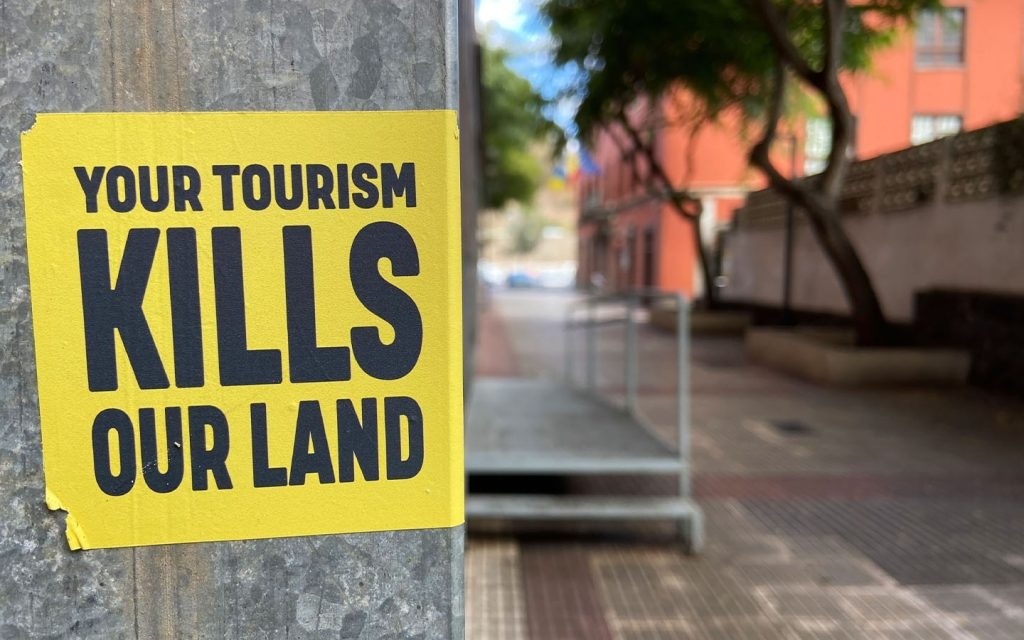
What Fodor's actually said
Imagine a magazine in New York City telling an entire destination: «Please take a year off.» Not for safety reasons. Not because the weather is bad. But because the locals are slowly suffocating under tourism.
That's exactly what Fodor's Travel — one of the oldest American travel publishers, founded in 1936 — did to the Canary Islands in November 2025. They appear on the «No List 2026». Alongside Antarctica, Mexico City, Mombasa and Montmartre.
The reasoning isn't from Florida or Manhattan. It comes from Tenerife. The Canary Islands environmental organisation ATAN told Fodor's: «We are losing our identity, our culture and, ultimately, our right to exist as a community.»
The numbers Fodor's cites
18.4 million tourists arrived in 2025. For 2.2 million residents. That's a ratio of 8.4 to 1. New York City manages 4.5 to 1. Paris 7 to 1. Mallorca 7.3 to 1. The Canary Islands sit just above — with significantly less infrastructure.
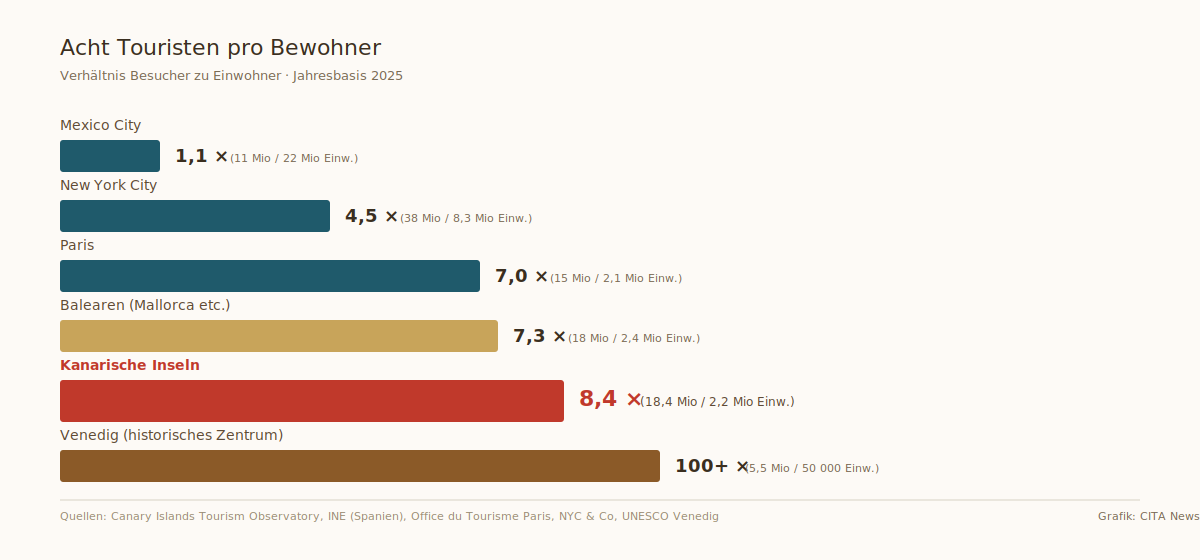
Eight tourists per Canarian — more than Paris, less than Venice. Graphic: CITA News.
Then the water figure. A France24 investigation, picked up by Fodor's: around 40 Olympic swimming pools of wastewater are released into the sea around the Canary Islands each day. That's about 100,000 cubic metres. A day. A good portion of it insufficiently treated.
The traffic figure: what was a 40-minute drive from northern to southern Tenerife ten years ago now usually takes over 90 minutes. Rental cars carry most of the traffic load. The housing figure in Las Palmas: rents up over 60 percent in ten years, average income up 11 percent.
How politicians replied
Tourism Minister Jéssica de León responded quickly. She called the list «bad news for the Canary Islands» and noted that «the situation experienced by one or two islands does not apply to the whole archipelago». The line from the Canary Islands government: Lanzarote and Tenerife have problems, but El Hierro, La Gomera and La Palma are different. Statistically, that's true. Politically, it's a deflection.
José María Mañaricua, president of the Las Palmas hotel federation (FEHT), pushed back against Fodor's with a realistic argument: the US market is anyway «complex» for the Canary Islands due to a lack of connectivity. Ironically, Air Transat announced the first direct flight Canada–Las Palmas in 50 years just two weeks before the Fodor's publication. The connectivity is coming — and now, of all moments, the US magazine warns.
Who's right?
Both. And that's the problem.
Fodor's research is clean. The numbers check out. ATAN is an established Canary Islands environmental organisation, not an ideological activist group. «Canarias tiene un límite» — the protest slogans of 2024 and 2025 are not an invention of an American magazine.
But a blanket warning against an archipelago of eight very different islands is also too crude. La Palma is recovering from the volcano, longs for visitors and is not overrun. El Hierro records around 30,000 annual overnight stays — some coffee shops in Berlin have more foot traffic.
What Fodor's list really does: it forces the Canary Islands' tourism policy to face the question of whether the growth model of the last two decades can still carry on. So far there are few answers.
What this means for European tourists
You'll still be able to fly to Tenerife or Gran Canaria despite Fodor's. There's no travel ban, no restriction, no signpost at the airport telling you to turn around. But if in the summer of 2026 you experience peak traffic on the TF-1 or GC-1, the night-time water gurgle in your hotel and the «Tourist Go Home» poster at the bus stop — you'll know what Fodor's meant.
Maybe you'll book differently then. A smaller island. A longer stay in a guesthouse instead of several short hotel stops. Skipping the rental car for city visits. It would help the island — and probably you too.
Frequently asked questions
- Is travel to the Canary Islands now banned?
- No. Fodor's «No List» is not a government travel warning system. It is an editorial recommendation to readers asking them to take a year off so the islands can recover.
- What is Fodor's and why do people listen to it?
- Fodor's Travel is one of the oldest US travel publishers, founded in 1936. The online platform reaches several million readers monthly. The «No List» is published annually. Last year Barcelona and Venice were on it.
- Which Canary Islands are less affected?
- La Gomera, La Palma, El Hierro and northern Fuerteventura don't have a comparable overtourism problem. Fodor's primarily refers to Tenerife and Lanzarote.
- Will anything change in policy?
- The Canary Islands government has announced a new holiday rental law. Parliament is debating a tourist tax. Concrete decisions are still pending.
- What can I do as a traveller?
- Avoid rental cars where possible, take the bus and guagua. Travel off-season (May, June, October). Choose local restaurants and guesthouses over all-inclusive complexes. Minimise water use in your hotel.