
What happened
On 17 April 2026, the supreme court of the Canary Islands ruled for the first time that the Plan Insular de Ordenación de Gran Canaria — known as the PIO — is void. Four weeks later, on 14 May, the same chamber published a second ruling. The claimant this time: Lopesan.
The PIO is not just any plan. Across 25,000 pages it determines where on Gran Canaria construction is permitted, where tourist zones lie, where nature reserves are protected. Without it, there is no secure legal foundation for construction projects. The Cabildo had approved it on 29 December 2022 after a process spanning nearly two decades.
Further actions against the same plan are pending at the TSJC. «More resolutions will follow in the coming days», the court has announced.
Why the court has struck down the plan
In simple terms: in 2022 the Cabildo adopted a plan that was being aligned with a law that had long since ceased to be in force in Spain. That law had been replaced in 2017.
The court sees this as a structural flaw: a plan built on outdated legislation must immediately be revised — so it was void from the outset.
Island president Antonio Morales has called the ruling «unjust, mistaken and superficial» and announced that the Cabildo will appeal to Spain's Supreme Court and, if necessary, the Constitutional Court. That can take years.
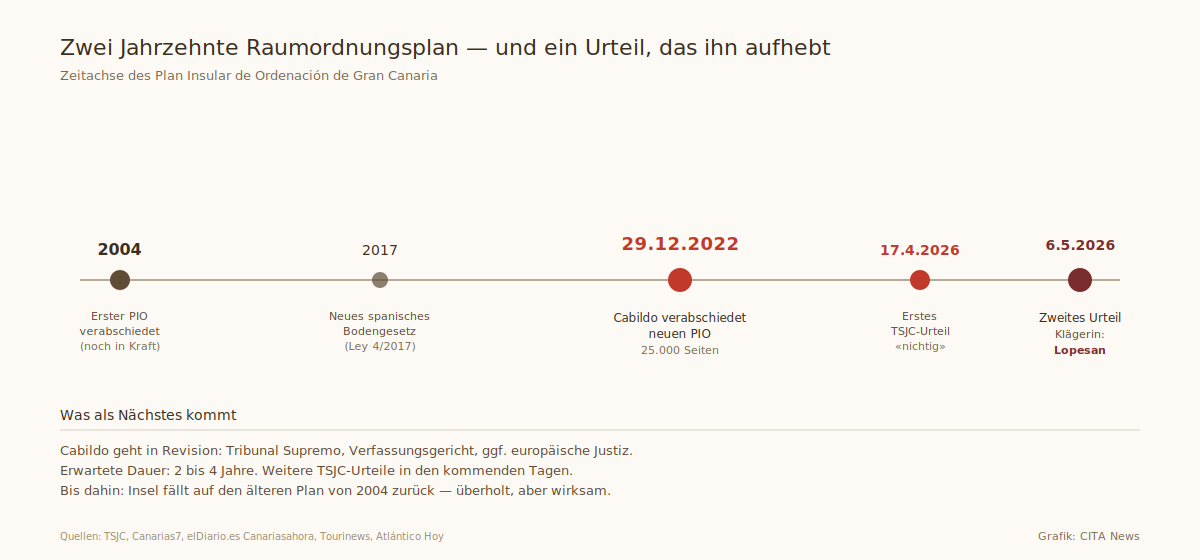
Two decades of plan, two rulings. Graphic: CITA News.
Lopesan, the claimant
It is not without irony that Lopesan is the one to have won one of these cases. The Meloneras-based group is one of the island's largest hotel operators — and is currently building, as we reported on Tuesday, the «Lopesan Meloneras Family» mega-resort with 953 rooms. Construction is under way there too. The PIO sits in the background there too.
Lopesan did not challenge the plan on principle, but over specific provisions that restricted expansion in its own tourist zones. Two smaller construction firms joined the action.
Politically, the situation is explosive. The opposition (PP) speaks of «a full-force judicial and political blow» to the Morales (Nueva Canarias) government. Morales counters that the court «directly attacks the social and economic development of the island».
What it actually means
As long as the ruling is not final, the PIO formally remains in force. That is the official line from the Cabildo. In practice, the situation is unclear.
Developers report increasing caution from banks: a hotel or housing licence built on the PIO as its legal foundation may end up with empty foundations once the court process concludes. Private buyers of new-build flats on Gran Canaria should expect delays.
For large projects like the Lopesan resort, little changes — they are secured by stand-alone permissions. Other projects, particularly in newer tourist zones, hang directly on the 2022 PIO.
A second consequence: as long as Gran Canaria has no legally final new plan, the island falls back on the older 2004 plan. What was not permitted then is still not permitted now — even if the 2022 PIO had included it.
Gran Canaria is heading into a long legal limbo. The Supreme Court will take years. Until then, the island will keep building — cautiously.
Frequently asked questions
- Is the PIO gone with immediate effect?
- No. As long as the Cabildo files an appeal, the plan formally remains in force. Developers and lawyers nevertheless recommend caution.
- As a private buyer of a new-build flat, do I have a problem?
- If your developer's permit was granted before 2022, probably not. For newer projects that hang directly on the 2022 PIO, delays are possible. When in doubt: ask your developer and notary directly.
- What happens to the planned Lopesan mega-resort in Meloneras?
- Lopesan is the claimant, not the defendant. The hotel project has its own permissions outside the 2022 PIO. No direct consequences are expected.
- How long until everything is settled?
- The Supreme Court usually takes two to four years. Further instances may extend this.
- What about the other islands?
- Tenerife and Fuerteventura are watching closely. A PIO collapse on Gran Canaria could spread legally to the other islands.