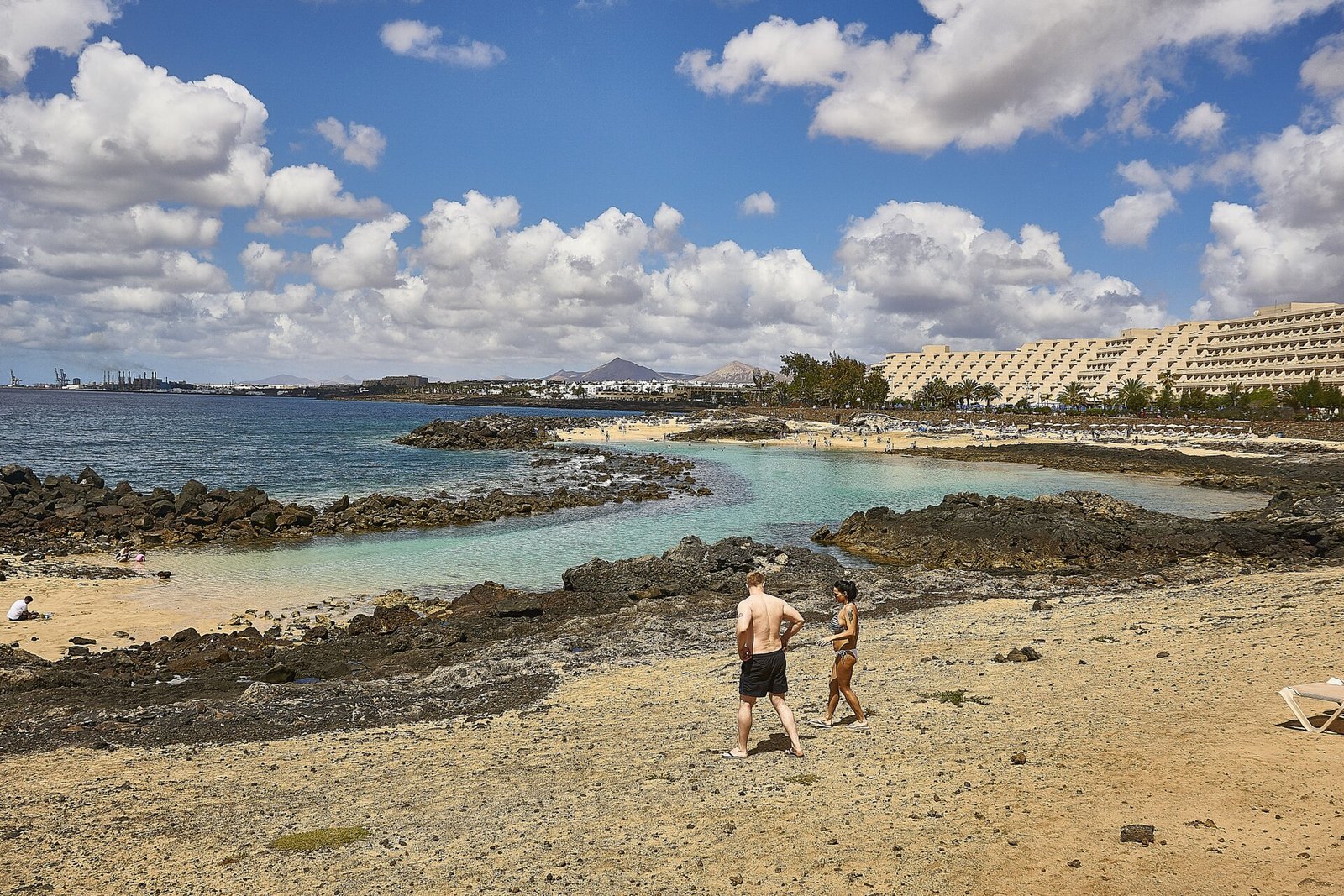
You’ve probably walked or driven past it along the coast of Costa Teguise and wondered what lies behind those discreet walls. La Mareta is not a hotel, nor is it a museum you can simply wander into. It’s a living, working official residence, steeped in royal history and Canarian artistic heritage, and it’s currently making headlines as the chosen summer refuge of Spanish Prime Minister Pedro Sánchez. For most of us, it remains a beautiful enigma, a place seen only in distant photographs. So, what’s actually in there? Let’s piece together the story of this remarkable coastal estate, from its royal origins to its modern-day, high-security role.
Nestled in the municipality of Teguise on Lanzarote’s northeast coast, La Mareta is a state-owned property under the care of Patrimonio Nacional, the agency that manages Spain’s crown-linked heritage. Its primary function today is institutional: it hosts the Spanish Royal Family, heads of state, and government leaders. It’s a tool of quiet diplomacy and, since a 2015 agreement, a stage for promoting Spain’s tourism interests. But its journey to becoming a Spanish state asset is a story that begins with a very different king.
A King’s Gift: From Jordan to Spain
The story of La Mareta starts in the late 1970s, when King Hussein of Jordan commissioned a private holiday retreat on Lanzarote. He chose the island’s most visionary artist, César Manrique, to design it. Manrique, the creative force who shaped Lanzarote’s unique aesthetic, created a complex that was in perfect harmony with its surroundings: low-rise, whitewashed, and integrated into the volcanic landscape. It was a private paradise for a monarch.
Then, in a grand gesture of friendship, King Hussein formally gave the property to King Juan Carlos I of Spain on 22 June 1989. But the story takes an interesting turn here. Less than a month later, on 18 July, Juan Carlos handed La Mareta over to Patrimonio Nacional. With this act, it ceased to be a purely private royal possession and became a state residence, serving the Crown and the Spanish government. From the early 1990s, the Spanish Royal Family began using it regularly, and it soon became a discreet venue for international diplomacy, hosting figures like German chancellors Helmut Kohl and Gerhard Schröder, Mikhail Gorbachev, and Václav Havel.
Inside the Estate: Manrique’s Coastal Vision
So, what did Manrique create? La Mareta is not a single grand palace but a sprawling, low-rise coastal estate. Official and media descriptions paint a picture of a complex designed for relaxed, private living. The estate covers around 30,900 square metres, with roughly 10,000 square metres of gardens that blend seamlessly with the native volcanic terrain.
Instead of a main palace building, the accommodation is spread across a series of bungalows or guest pavilions. Reports consistently mention around ten of these structures. The main one is said to have two bedrooms, its own private pool, and several terraces, acting as the central residence. Across the wider estate, you’ll find at least two more outdoor swimming pools, a tennis court, and a basketball court. One of the most enviable features, and one often cited, is the direct, private access to the sea from the grounds. While some media reports mention a library, dining room, and an interior lake feature, the exact internal layout remains a closely guarded secret, as no official detailed floor plans are ever released to the public.
A Fortress of Privacy: Security and Secrecy
Don’t expect to book a tour. La Mareta is emphatically closed to the public. For Lanzarote residents, it’s an emblematic but inaccessible landmark. A very rare exception was made in November 2018, when the residence opened its doors for a few hours as part of a local historical celebration, by special permission of the King. This was a one-off, pre-registered event, not a sign of things to come. For everyone else, any "visit" is limited to viewing the perimeter from a distance.
The reason for this secrecy is its function. When the Prime Minister or a foreign head of state is in residence, security is understandably intense. Patrimonio Nacional recently awarded a one-year security contract worth over €266,000 specifically for guarding the complex. During Pedro Sánchez’s stays, media reports describe a deployment of around 30 Guardia Civil officers from Madrid, supplementing his regular detail. Maritime security is also tightened, with the Captaincy of Las Palmas imposing temporary exclusion zones for boats off the Teguise coast. It becomes one of the most secure spots in the country.
The Prime Minister’s Summer Refuge
This brings us to why La Mareta is so often in the news. Prime Minister Pedro Sánchez has made it his habitual holiday retreat, choosing Lanzarote for breaks in summer, at Easter, and at Christmas. His arrivals are a now-familiar ritual: an Air Force jet lands at César Manrique airport, followed by a motorcade transfer to the residence under heavy escort. His stays can be lengthy; one report noted a 33-day summer break, which generated local discussion about the security disruptions in the area.
Each year, as August arrives, Spanish and international media run features on "the palace where Sánchez holidays," recounting its Jordanian origins, Manrique’s design, and its secluded luxury. This annual spotlight, combined with the estate’s natural secrecy, has cemented its image as a mysterious coastal state residence—a place we all know from the outside, but whose inner life remains a fascinating secret.
Common questions
- Can the public visit La Mareta?
- No, it is a closed official residence. There are no regular visiting hours, and entry is strictly prohibited, with only a single, rare public opening having occurred in 2018.
- Who designed La Mareta?
- The complex was designed by the iconic Lanzarote-born artist and architect César Manrique in the late 1970s, reflecting his signature style of integrating architecture with the volcanic landscape.
- Who owns La Mareta now?
- It is owned by the Spanish state and managed by Patrimonio Nacional, the agency responsible for properties linked to the Spanish Crown.
- Why was it in the news recently?
- It regularly makes headlines as the chosen summer holiday residence of Spanish Prime Minister Pedro Sánchez, whose annual arrival involves a significant security operation.
- What facilities are inside the complex?
- Based on reports, the estate features multiple bungalows, at least two or three swimming pools, tennis and basketball courts, extensive gardens, and direct private access to the sea.
Read on
- Haría: Rob Mazurek, Cueva de los Verdes, 6 NovemberLanzarote · 2 November
- Tías: Ruralia Ecoencuentro and Saramago readings in NovemberLanzarote · 1 November
- Lanzarote: Araceli Bravo sings in Femés on 7 NovemberLanzarote · 31 October
- Lanzarote sights: Timanfaya €30, prices and times 2026Lanzarote · 1 November
- Lanzarote car hire: rules, costs and Timanfaya 2026Lanzarote · 1 November
- All events on Lanzarote →
Stand 3 August 2026. This article is based on verified public sources and official information. Interior details not officially published are treated as indicative.