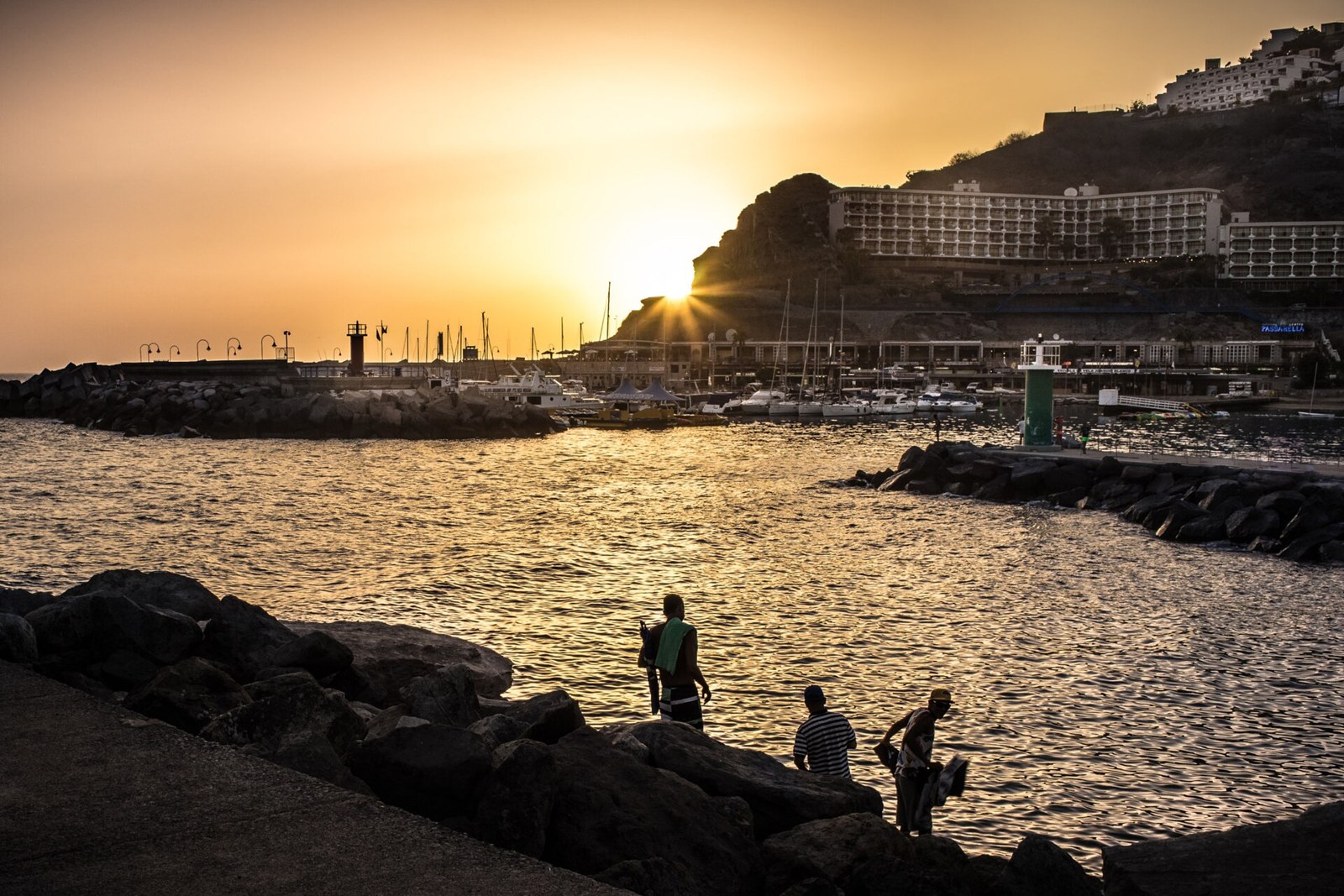
One of 16, and the only Canary one
The INE tables list 107 resorts. The August 2026 value for Villaviciosa in Asturias is withheld as confidential, so 106 can be compared. In 16 of them the room rate came in below the same month a year earlier. The sharpest falls are in Andalusia: Arcos de la Frontera down 19.6 per cent, Ronda down 13.1. Madrid is in the group too, down 6.6 per cent, and Mogán follows at minus 4.3 — no other Canary resort appears. By room rate, Mogán ranks 51st of 106.
What Mogán covers, and what it does not
For the INE a tourist point is a whole municipality. Mogán takes in Arguineguín and Patalavaca, Tauro, Taurito and Playa del Cura, and above all Puerto Rico with Playa de Amadores and the purpose-built fishing village of Puerto de Mogán. It does not take in Maspalomas, Playa del Inglés, San Agustín or Meloneras: those lie in San Bartolomé de Tirajana, which the INE counts separately — and which rose, to 169.90 euros ADR (up 2.7 per cent) and 150.48 euros RevPAR. Two neighbours twenty minutes apart by car, moving in opposite directions: "the south of Gran Canaria" is not a single market.
The ten Canary resorts compared
Ten of the 107 resorts are in the Canaries, and nine of them got dearer. All values: INE, table 46298, August 2026, provisional.
| Resort | Island | ADR August 2026 | Year on year |
|---|---|---|---|
| Yaiza | Lanzarote | €203.25 | +8.0% |
| Adeje | Tenerife | €192.75 | +9.8% |
| San Bartolomé de Tirajana | Gran Canaria | €169.90 | +2.7% |
| Tías | Lanzarote | €169.23 | +7.0% |
| Pájara | Fuerteventura | €158.29 | +8.3% |
| Teguise | Lanzarote | €157.29 | +5.3% |
| Arona | Tenerife | €135.95 | +8.6% |
| Mogán | Gran Canaria | €124.68 | −4.3% |
| Puerto de la Cruz | Tenerife | €110.86 | +19.5% |
| Santa Cruz de Tenerife | Tenerife | €96.79 | +4.9% |
More beds, the same guests
The cause is not missing demand: Gran Canaria airport reports 1,334,497 passengers in August, 3.1 per cent more than a year earlier. But supply grew as well — 71,129 bed places in 173 open establishments, against 69,821 in 166 a year before. Bed occupancy fell all the same, from 84.27 to 83.78 per cent, and at weekends from 85.63 to 83.58. In the INE zone "south of Gran Canaria", which with 63,570 places holds most of the island's supply, places grew by 2.3 per cent while occupancy slipped from 87.48 to 86.04 per cent. More beds against the same demand means less pricing power. The INE publishes no separate capacity figure for the municipality of Mogán.
Gran Canaria against the other islands
Of the four big holiday islands, Gran Canaria is the only one where an available room earned less in August than a year earlier: 132.95 euros against 133.44. Tenerife reached 137.22 euros (up 8.4 per cent), Lanzarote 155.35 (up 4.5), Fuerteventura 130.58 (up 9.9). The picture is not complete, though: on La Gomera RevPAR fell 8.9 per cent to 75.16 euros, and on La Palma the room rate eased by 0.4 per cent while RevPAR rose 6.9 per cent on much better occupancy. For the Canaries as a whole the INE gives 158.40 euros ADR — fifth of the 19 territories at that level, Ceuta and Melilla included — and 135.86 euros RevPAR, fourth behind the Balearics, the Basque Country and Andalusia.
What it means for holidaymakers and for staff
For travellers, the south-west of Gran Canaria is the one part of the Canaries where a hotel room cost less on average than last year. For the people who live off it, the same figure is bad news: a good six euros less came in per available room. No assessment of the Mogán figures has been published as of 23 September — not by the hoteliers' association FEHT, nor by the Cabildo de Gran Canaria, nor by Mogán town hall. In general terms, FEHT president José María Mañaricúa warned back in July, speaking to Tourinews: "Si subimos los ingresos, pero los costes suben más, somos menos rentables" — if revenue rises but costs rise faster, profitability falls. That was not a response to this data. And Mogán's own tourist levy of 15 cents per person per night is far too small to explain a fall of 5.65 euros a room.