What exists today
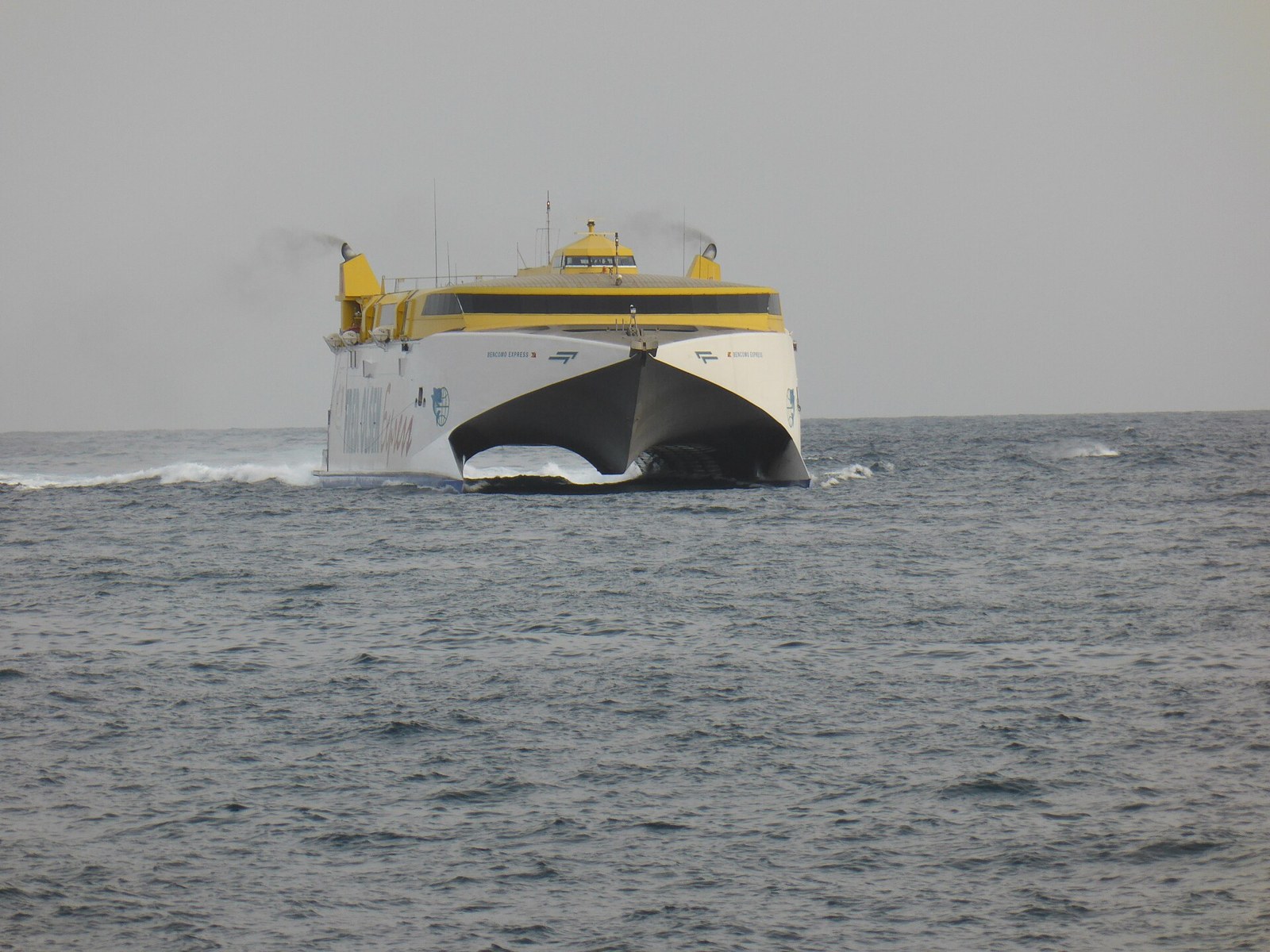
Two operators serve the western islands: Fred. Olsen Express and Baleària Canarias, successor to Naviera Armas and Trasmediterránea. Both networks radiate from Tenerife. For La Gomera, La Palma and El Hierro, Fred. Olsen lists only ports on Tenerife and Gran Canaria; at Baleària, La Estaca hangs off Tenerife alone. There is one exception: La Gomera and La Palma are joined by a through ticket with no change of ship — except that the ship calls at Los Cristianos on the way. To El Hierro not even that exists, and there is no direct air link either.
What an OSP is — and what became of it
An obligación de servicio público sets a route's minimum frequencies, capacity and maximum fares; the operator can be compensated for them. Under Law 12/2007 on Canary maritime transport the regional government is responsible: article 16 gives it the task of designating the lines that meet basic needs, article 19 lets the consejería put them out to tender. That happened once. In the Canary official gazette of 23 October 2012, Los Cristianos–La Estaca was declared an OSP: twelve round trips a week, 8,600 seats, 8,250 linear metres. It expired on 30 December 2024. Fred. Olsen would run the line without the obligation, the consejería announced on 20 June 2024; the company was, "de un total de siete" operators, the only one willing to do so. Since then there has been no maritime OSP between the Canary Islands at all.
Seven years, one study, no procedure
The groundwork is done. On 13 February 2019 Puertos Canarios published a Canary government report justifying an OSP line between Santa Cruz de La Palma, San Sebastián de La Gomera and La Estaca — including a proposed timetable: early morning from El Hierro to La Palma, back again, then on to La Gomera and back in the afternoon. It cites Scotland and the Azores and states that conditions on the islands make the line impossible without public backing. The report was to go to the Dirección General de la Marina Mercante. What happened next is undocumented: in the sources we consulted there is no declaration in either official gazette, no tender and no bidder.
The arithmetic: time and money
One example, calculated by us from published timetables and fares. From San Sebastián de La Gomera to Valverde on El Hierro: Fred. Olsen gives 50 minutes for the crossing to Los Cristianos and 140 minutes for Los Cristianos–La Estaca. That is 190 minutes of pure sailing time, three hours and ten minutes — between two neighbouring islands. Add the wait at Los Cristianos, which appears in no timetable because the connection does not exist as a product: these are two separate tickets. For La Gomera–La Palma, Baleària gives about four hours and a fare from 84 euros each way, 21 euros for Canary residents — by our arithmetic 168 and 42 euros respectively for the return trip. The 75 per cent discount applies between the islands too, and the state pays it.
Who says what — and what is at stake
Chinea, a senator for the Agrupación Socialista Gomera, told the committee: "Las tres islas verdes están geográficamente próximas y comparten numerosos intereses, pero siguen sin disponer de una conexión marítima directa, regular y adaptada a sus necesidades." His motion, approved on 22 September, does not call for a line at once but for Madrid to begin the procedures together with the Canary government and the three cabildos. The Canary government last spoke in June 2024: consejero Pablo Rodríguez told the regional parliament it would resume the assessment; in 2018 the proposal had found "bastante aceptación" in Brussels, but the directorates-general for competition and transport had said the member state must drive it. The PSOE rejected an identical motion by the PP in the Canary parliament on 25 September 2024, arguing that maritime transport between the islands is the region's responsibility. The transport ministry has not commented publicly, nor have the shipping lines. For 120,850 people the detour is routine, and the Los Cristianos hub is nearing its limits: more than 2.3 million passengers passed through in 2024, 52.91 per cent more than in 2010 (Colegio de Ingenieros de Caminos, cited by Diario de Avisos, 23 March 2025).