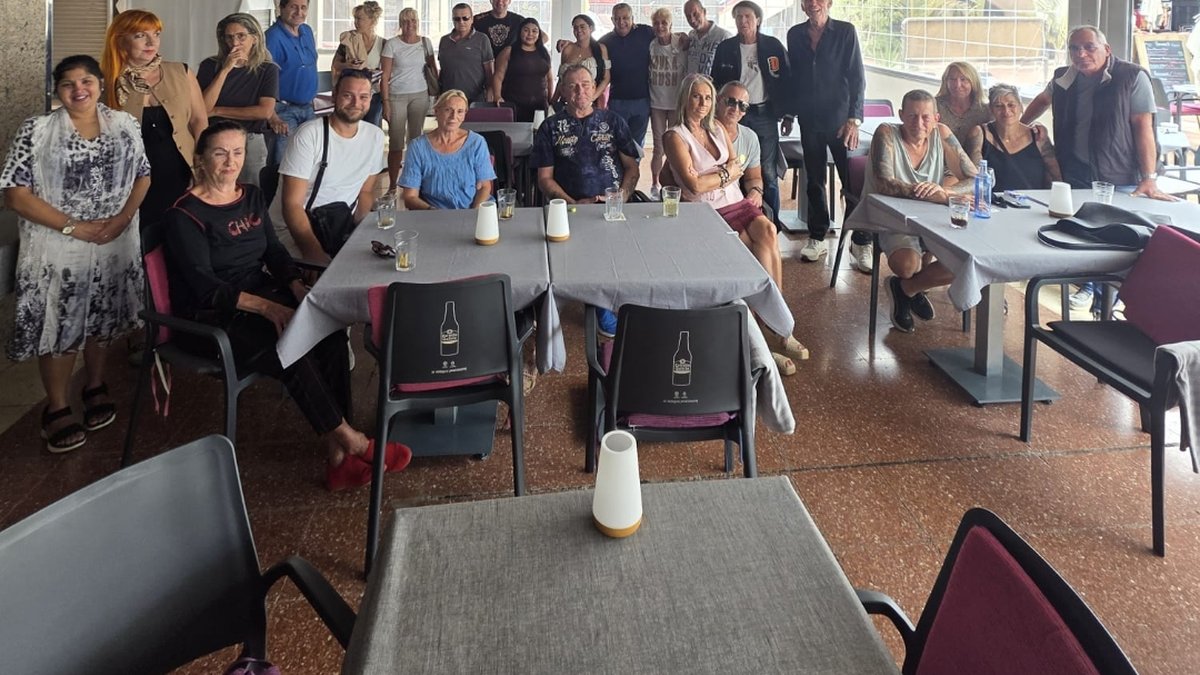
What happened on 30 April
The meeting lasted approximately one hour. On the terrace, entrepreneurs from all three floors — catering, retail, services — sat and stood together. Ramos explained the procedural path, which he describes as «paralelo a la comunidad» — parallel, not opposed. He said verbatim: "We invited the Comunidad, and the Comunidad says it is very busy." The proposed approach:
- The Asociación gathers proposals from the entrepreneurs
- An architecture firm develops a concrete project design
- The design is submitted to the Comunidad de Propietarios
- If approved, the Comunidad forwards the project to the Cabildo for funding
The funds are to come from the Cabildo as a «fondo perdido» — a non-repayable grant. No figure was specified. Vice-president Teodoro Sosa had given a verbal commitment, Ramos said, pointing to a press release from February.
Concrete proposals came from the floor: a second lift, a working escalator, refurbished toilets, and an exterior renovation. One businesswoman said: "The only one who wins here is the hotels — nobody else." Ramos agreed but steered the discussion back to the project: "Without a project, there is no renovation." A third meeting is planned with the president of the Comunidad.
Who the Asociación is
The association was presented on 11 February 2026 under the umbrella of the Federación de Asociaciones Sur Atlántico FEDASUR. FEDASUR president Luis León moderated the press conference. Present alongside Ramos were the Vice-president II of the Cabildo de Gran Canaria Teodoro Sosa, the Concejal Delegado de Participación Ciudadana Ruymán Cardoso and the Concejala de Turismo Yilenia Vega (Activa Hits Radio).
The aim: revitalisation and modernisation through projects in leisure, entertainment and gastronomy. The Asociación sees itself as a link between entrepreneurs, the Comunidad and the public authorities.
From German pride to «reducto hortera»
The Cita is one of the oldest centros comerciales in Spain. Opened in 1970, its full name was Centro Internacional de Turistas Alemanes — hence the acronym CITA. It was built for the German package tourists who defined the Avenida de Tirajana during the 1970s. On its façade, replicas of the Brandenburg Gate, the Eiffel Tower and Tower Bridge stand to this day.
In August 2023, Jesús Montesdeoca wrote in La Provincia: "The Cita of Playa del Inglés descends from landmark of German tourism to a hortera (kitsch, tacky) refuge" (Antonio Garzón / La Provincia). «Hortera» is a sharp word in Spanish: it means cheap, tasteless, worn-out.
Current reviews on Tripadvisor paint a consistent picture: "Perfect film location for a horror movie." "Eery plastic and random superheroes." In the Sótano there are swingers' clubs, erotic shows and dark corridors. At the entrances, Tripadvisor users report individuals approaching passers-by to ask about their "sexual orientation" (Tripadvisor reviews). An RTVC report from 2022 counted almost 20 permanently closed units (RTVC, September 2022).
8 of 26 — on the municipal list
San Bartolomé de Tirajana has 26 centros comerciales in its tourist zone. An official municipal report classifies eight of them as "obsolete". On the list: Kasbah, Metro, Plaza, Anexo II, CITA, Oasis, Parque Europa, Faro II. The Yumbo does not appear on this list — it is the only one whose price per square metre has not fallen in 30 years (CITA News own research).
The party Primero Canarias called in September 2025 for the "immediate renovation" of the centros comerciales of Playa del Inglés, speaking of "abandonment, decay and insecurity" (Digital Faro Canarias). Metro and Plaza were said to be closed and in ruin; Gran Chaparral, La Sandía and Cita were described as presenting a "deplorable and deteriorated image".
According to CITA News own research, the difference lies not in location or age but in management strategy: Yumbo has invested since 2022 in security, photovoltaics and a delivery service — and has never applied for public money for renovations. Cita spent 3,568 euros in 2025 on lawyers to pursue 1.9 million euros in unpaid debts (CITA News, March 2026).
The recent record in brief
CITA News has documented the following events over the past twelve months:
- January Junta 2026: 22 attendees. Proxy votes dominated (CITA News)
- 2025 accounts: Approximately 1.9 million euros in outstanding debts; a further 93,251 euros in cheques and post-dated promissory notes (CITA News)
- Staff costs 2025: 353,000 euros (CITA News)
- February owner survey: 52 responses, widespread dissatisfaction with transparency (CITA News)
- 7 March Junta: Change of leadership; new president William Enrique Reyes (CITA News)
- Owners' rights: Broad debate over rights to information, voting and proxy before and after the Junta (CITA News)
- 18 April Junta: Several key functions consolidated in a single person; multiple owners assessed the staffing decision as contestable according to CITA News research; the Comunidad disputes this
- Active proceedings within the Comunidad: Several open legal and administrative matters on which CITA News continues to report
William Enrique Reyes, president since 7 March, has made no public statement on Ramos' initiative.
Why it is now coming from outside
The Asociación does not circumvent the Comunidad — Ramos states this explicitly in the audio recording of the meeting — but it creates a second track. Cabildo money does not flow directly to the Comunidad; instead it goes into a project that the Junta General must accept or reject. The Cabildo elections are in 2027 — a window of opportunity that Ramos intends to use.
What remains open
- How much money? Sosa's commitment is verbal; no figure has been placed on the table
- Who pays for the project? The architecture fee would normally be a matter for the owners' community. In the audio, Ramos openly discusses whether the subsidy would also cover the project costs
- Private property, public money: Ramos himself acknowledges: "This is a private zone." Channelling Cabildo funds into private premises is legally possible but politically sensitive
- Which projects? Lifts, toilets, façade — but no concept that addresses the fundamental brand question of «hortera versus modern»
The assessment
The Cita is caught in a documented cycle: debts drive decay, decay drives away customers, and fewer customers drive further debts. Yumbo shows that a way out is possible — but it requires a consistent ownership structure, which the Cita has so far lacked.
If renewal comes, it will come from outside — from the Cabildo, from the Asociación, from an architecture firm with a concrete plan. Whether the Junta General will accept that plan is the open question.
FAQ
Who is the Asociación de Empresarios del C.C. Cita?
An association of the entrepreneurs operating businesses in the Centro Comercial, founded in February 2026 under the umbrella of FEDASUR. It is not the same as the Comunidad de Propietarios, which is made up of the owners of the individual units.
What does "obsolete" mean in this context?
The official municipal report by San Bartolomé de Tirajana on the rehabilitation of centros comerciales classifies 8 of 26 centres as requiring renovation. The Cita is on the list. The Yumbo is not.
What did CITA originally stand for?
The acronym comes from Centro Internacional de Turistas Alemanes — International Centre for German Tourists. The centre opened in 1970.
Who decides on structural renovations?
Exclusively the Comunidad de Propietarios in a Junta General. The Asociación de Empresarios may propose projects and mobilise funding, but cannot take decisions itself.
How large is the Comunidad's debt?
According to the 2025 accounts, the Comunidad has approximately 1.9 million euros in outstanding claims against defaulting owners. In 2025, approximately 3,568 euros in legal fees were spent on debt recovery.
Has the Cabildo actually committed funds?
Vice-president Teodoro Sosa has publicly stated a commitment to financial participation. No written undertaking or specific figure has been presented to date.