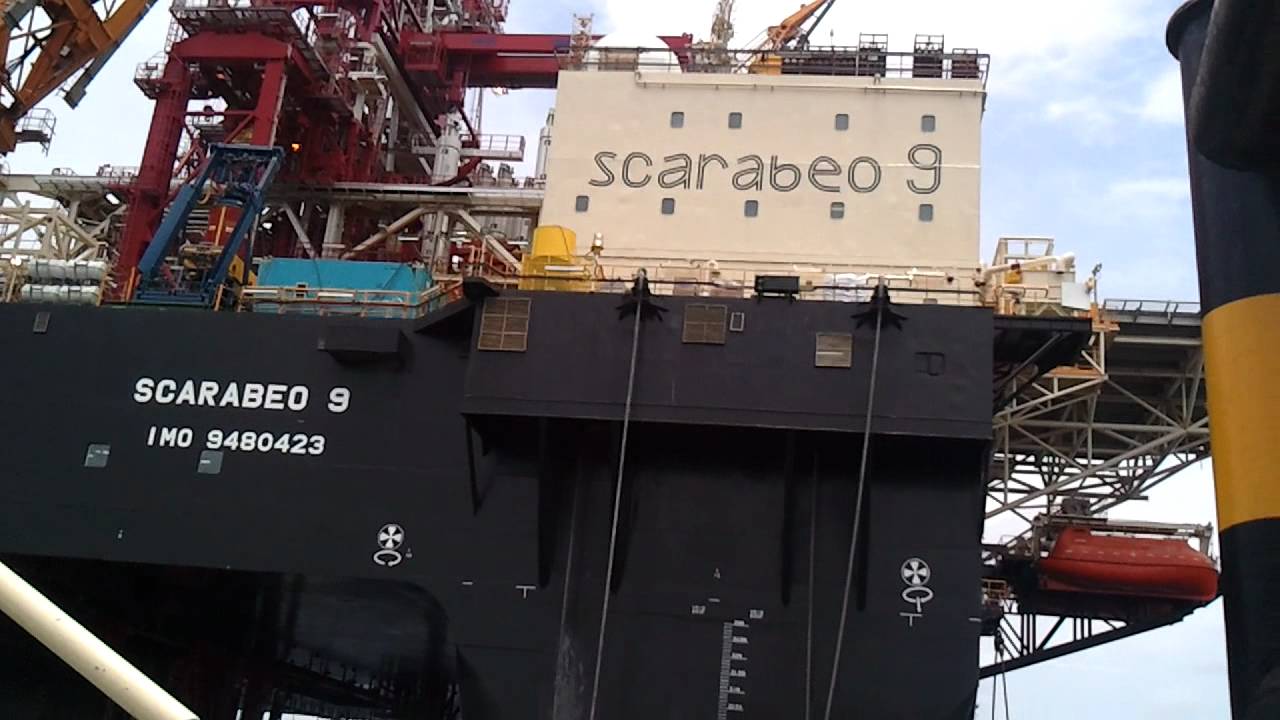
First, to be clear, since both versions circulate online: the Scarabeo 9 is not a research vessel but a semi-submersible ultra-deepwater drilling rig of the sixth generation — one of the largest in the world. It belongs to the Italian oilfield-services group Saipem (a company in the orbit of energy giant Eni), flies the flag of the Bahamas and has room for 200 people. It can work in up to 3,600 metres of water and drill to 15,000 metres deep.
And it is now back in the port of Las Palmas — a place that has played a role in its story more than once.
Built in China, with a Norwegian design — and that is exactly the catch
The genuinely striking thing about the Scarabeo 9 is its construction. It was built mostly in China, to a Norwegian design (the Frigstad D90 type). That sounds like a technical footnote but is the heart of the whole story: because there are barely any US components and no US design on board, the rig does not fall under those US sanctions that restrict the use of American technology — even by non-American companies.
In 2017 the business agency Bloomberg made it famous as the "sanction-proof" rig for exactly this reason. How sensitive the detail was is shown by an episode from 2014: the US supplier National Oilwell Varco confirmed to the US Securities and Exchange Commission that it had sold a so-called blowout preventer — a key safety component — to the Scarabeo 9. As soon as the company learned where the rig would be deployed, it stopped its deliveries.
The most sensitive job: Russia's Black Sea
The Scarabeo 9 drilled its first well off Cuba. But it became famous — or notorious — through a different job. In late 2017 it drilled for Italy's Eni and Russia's state group Rosneft in the Russian part of the Black Sea, in more than 2,000 metres of water. It was, as Bloomberg wrote at the time, the first well drilled by a Western company at a Russian oil project that fell squarely under the US sector sanctions imposed in 2014 — imposed after the annexation of Crimea.
To reach the Black Sea at all, the rig had to be extensively modified: its derrick was lowered so it could pass under the three bridges of the Bosphorus in Istanbul. Some of these conversions and maintenance works took place over the years in Spanish ports — including Las Palmas and Cartagena. In this global offshore business the islands are not bystanders but an established workshop.
Crucial for today: Saipem left Russia long ago
Here is the crucial context, so no false impression arises: the Black Sea project with Rosneft was already ended in March 2018, when the sanctions forced Eni to exit. After Russia's invasion of Ukraine, Saipem withdrew fully from Russia and in 2022/2023 also completed its exit from the Russian Arctic-2 LNG project.
The Scarabeo 9 itself, according to Saipem's most recent corporate report from late 2025, works today in the Mediterranean for Eni — most recently moved from Egypt to Libya. Its presence in Las Palmas therefore has nothing to do with current sanctions evasion; it is part of the normal shipyard and maintenance routine of a rig that, between contracts, repeatedly needs a port. What remains is the remarkable design — and a piece of history that shows how porous international sanctions can be when technology is deliberately built around them.
The bigger picture: Russia's "shadow fleet" off the Canaries
That the story of a "sanction-proof" rig is drawing attention again right now has a current backdrop. Off the Canaries, Russia's "shadow fleet" (dark fleet) has become a constant theme — a web of ageing tankers with frequently changing names, flags and opaque ownership structures that smuggles Russian oil past Western sanctions.
The Spanish government conceded in its most recent National Security report that around 50 such ships are detected near the Canaries every week. It cites risks ranging from accidents and pollution to — as a very unlikely but mentioned scenario — possible use as a launch platform for drones. In January 2026 an EU-sanctioned Russian tanker carrying more than 425,000 barrels of refined products drifted off Almería; it was escorted to Morocco without being detained.
The Scarabeo 9 is not part of this shadow fleet — it is a legally operating industrial asset of a listed EU group. But its story and the shadow fleet tell the same larger theme: the Canaries sit in the middle of an Atlantic crossroads where energy, geopolitics and the grey zones of international law intersect — and the port of Las Palmas is right in the thick of it.
What this means for the islands
The offshore repair industry is an economic pillar for Las Palmas: before the pandemic its volume was estimated at around €400 million, with about 7,000 direct jobs. Rigs like the Scarabeo 9 are lucrative guests for the shipyards. At the same time, the case shows how closely business and geopolitics sit together here — and why the port that many residents drive past every day is more than a container terminal.
Frequently asked questions
- Is the Scarabeo 9 a Russian ship?
- No. It belongs to the Italian group Saipem and flies the flag of the Bahamas. The Russia link comes from a 2017/18 drilling job for Eni/Rosneft in the Black Sea, which ended long ago.
- Is it a research vessel?
- No. That is a confusion in circulation. The Scarabeo 9 is a deepwater drilling rig, not a research vessel.
- Is the rig currently evading sanctions?
- No. Saipem withdrew fully from Russia in 2022/2023. The rig works today in the Mediterranean for Eni. The sanctions angle is historical and concerns the construction and the 2017/18 deployment.
- How could it drill for Russia in 2017 despite sanctions?
- Because it was built in China to a Norwegian design and contains barely any US components. That put it outside US sanctions covering American technology. Bloomberg therefore called it "sanction-proof".
- What does this have to do with the Canaries?
- Las Palmas is an important hub for offshore repairs. The Scarabeo 9 has been serviced and modified there several times over the years. Add the current context of the Russian shadow fleet, which regularly appears off the islands.
Read on
- Gran Canaria: festivals and markets on 17 October 2026Gran Canaria · 17 October
- Maspalomas: NOON 26 festival at the lighthouse on 17 OctoberGran Canaria · 17 October
- An orchestra in Las Palmas's container port: 15 euros, and the shuttle bus is the only way inGran Canaria · 21 September
- Las Palmas Port Gets Green Light for €45.3 Million New Cargo DockGran Canaria · 29 July
- Vecindario: San Rafael fiestas to 1 November, Cristina RamosGran Canaria · 17 October
- All events on Gran Canaria →