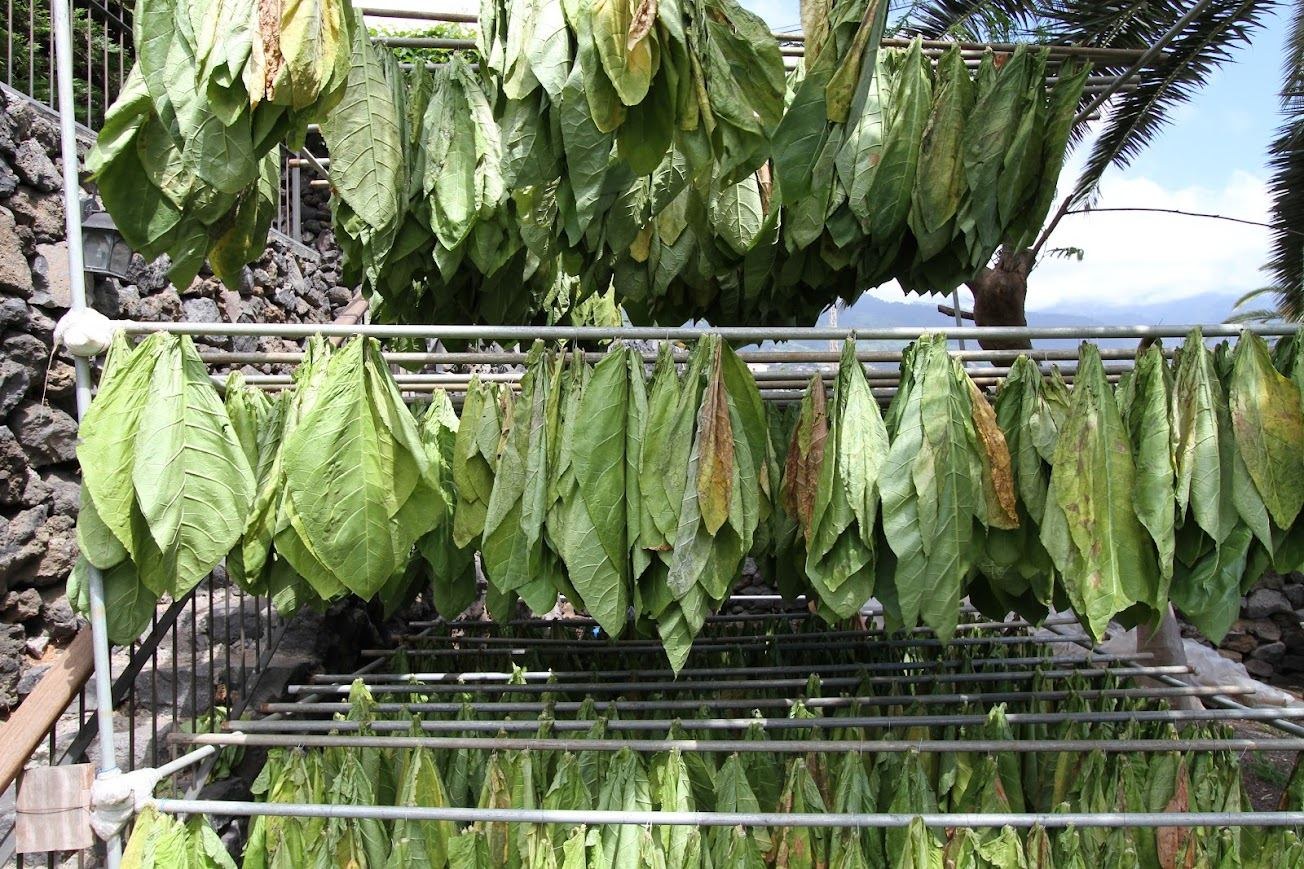
It is one of those stories barely anyone has on their radar — and yet it says a great deal about the Canarian economy. While the world associates the islands with sun, beaches and bananas, an industry has developed in the background that last year won a symbolic race: tobacco has overtaken the banana as the Canaries' most valuable traditional export.
Tobacco beats banana
The figures are striking. In 2024 the Canaries exported tobacco products worth around €127 million — against €112 million for the banana. It was the first time tobacco pulled ahead. And it did not stop there: for 2025 the sector reports exports of over €275 million, more than a doubling. In just three years, Canarian tobacco exports have thus tripled. For comparison: in 2000 they stood at a meagre €20 million, while the banana exported over €90 million.
Today, according to the report by the Mesa del Tabaco, prepared by Analistas Financieros Internacionales (AFI), the Canaries concentrate 68 percent of the industrial value added of the entire Spanish tobacco sector. Around €195 million in direct value added, almost 1,000 direct jobs and more than 4,000 indirect — tobacco now accounts for 6.6 percent of the islands' industrial gross domestic product.
The secret: import, process, refine
How does an archipelago with no significant tobacco-growing of its own come by this title? The key lies in the business model. Unlike Extremadura, the Spanish centre of raw-tobacco cultivation, the Canaries focus on processing: the tobacco leaf is imported and refined on the islands into cigarettes, cigars and cigarillos, which then reach the Spanish and European market.
Several factors favour this. There is the tax regime: the Canaries apply not mainland Spanish VAT but the lower IGIC, plus the special tobacco-tax structure. There is the legal certainty that multinationals value. And there are the almost 18 million tourists a year — nearly half the tobacco sold on the islands is consumed by visitors. So worthwhile is the location that the Japanese group JTI recently even brought production back from Poland to the islands.
The industry: Tenerife and Gran Canaria
The industrial heart beats on Tenerife and Gran Canaria. In Santa Cruz de Tenerife stands the JTI (Japan Tobacco International) factory — descended from CITA, the «Centro Industrial Tabaqueros Canarios», founded in 1958 as an association of Canarian tobacco entrepreneurs to protect the traditional family businesses. Since 2007 the plant has belonged entirely to Japan Tobacco and is today Spain's largest industrial tobacco production site. Over 70 percent of Canarian cigarette production rolls off the line here. Add to that names like Dos Santos (which produces for Philip Morris, among others), TABSA (for British American Tobacco and Altadis-Imperial Brands) and the historic cigar factory El Guajiro.
The craft: La Palma's cigar tradition
But perhaps the loveliest side of the story plays out on La Palma — and it works quite differently. Here there are no high-tech lines, but hands. The «Isla Bonita» is the home of the hand-rolled cigar, made in small workshops by experienced rollers, the torcedores. Each cigar goes through a process of selecting, preparing and rolling the leaves that depends solely on the experience and skill of the craftsperson.
The roots run deep. The Compañía Insular de Tabaco de La Palma, founded in 1917 in Las Vueltas in Breña Alta, is the oldest still-active tobacco factory in the Canaries. The «puro palmero» is considered a unique speciality thanks to the island's particular climatic conditions — a product that, as one maker puts it, is «unique and spectacular». Manufacturers like Tabacos El Rubio carry on the family tradition to this day. Unlike the mass production on the other islands, La Palma's output remains strongly artisanal; a large part goes to local retail and consumption.
It is this duality that makes the archipelago special: on one side the highly mechanised industry, on the other the historic craft. The president of the Mesa del Tabaco calls it a «unique reference point» in the sector, where tradition, specialisation and state-of-the-art processes coexist.
What remains
The Canaries as Spain's tobacco champion — that is one of those quiet success stories that rarely make headlines but secure jobs and preserve a piece of island culture. From the imported leaf that becomes a labelled packet in the factories of Santa Cruz to the hand-rolled cigar from Breña Alta: tobacco has, almost unnoticed, become a load-bearing pillar of Canarian industry. That it has, of all things, overtaken the banana — the islands' iconic symbol — gives the story its particular twist.
Frequently asked questions
- Are the Canaries really Spain's biggest tobacco hub?
- In industrial processing, yes: the islands concentrate, according to AFI/Mesa del Tabaco, 68 percent of the industrial value added of the Spanish tobacco sector. Raw-tobacco cultivation, by contrast, is led by Extremadura.
- Has tobacco really overtaken the banana?
- In export value: in 2024 tobacco, at €127m, was ahead of the banana (€112m) for the first time; for 2025 the sector reported over €275m.
- Where is it produced?
- The big industry (above all cigarettes) is on Tenerife and Gran Canaria (JTI, Dos Santos, TABSA, El Guajiro). La Palma stands for the hand-rolling of cigars.
- What is special about La Palma?
- There, cigars are rolled by hand in small workshops. The oldest active factory in the Canaries, the Compañía Insular de Tabaco, has existed since 1917 in Breña Alta.
- Why are the Canaries an attractive location?
- A more favourable tax regime (IGIC instead of IVA, plus the special tobacco-tax structure), legal certainty and almost 18 million tourists, who consume around half the tobacco sold.
Read on
- €224 a day: why the Canaries grew at only a third of Spain's pace in AugustCanary Islands · 2 October
- 140,303 unemployed: Canaries down, Spain up by 23,587Canary Islands · 2 October
- 11.9 per cent: why new-build prices in the Canaries are outrunning SpainCanary Islands · 14 September
- La Palma: Carnival 2027 poster contest, 700 eurosLa Palma · 28 October
- La Palma TriJazz: 3 jazz trios, 31 Oct to 14 Nov, 20:00La Palma · 27 October
- All events on La Palma →
As of 14.06.2026. Sources include the Mesa del Tabaco / Analistas Financieros Internacionales (AFI), El Confidencial, eldiario.es, Canarias7 and El Time. The 2025 export figure is per sector estimates (El Confidencial). Tobacco consumption is harmful to health; this article serves economic and cultural information and is not a promotion of tobacco products.