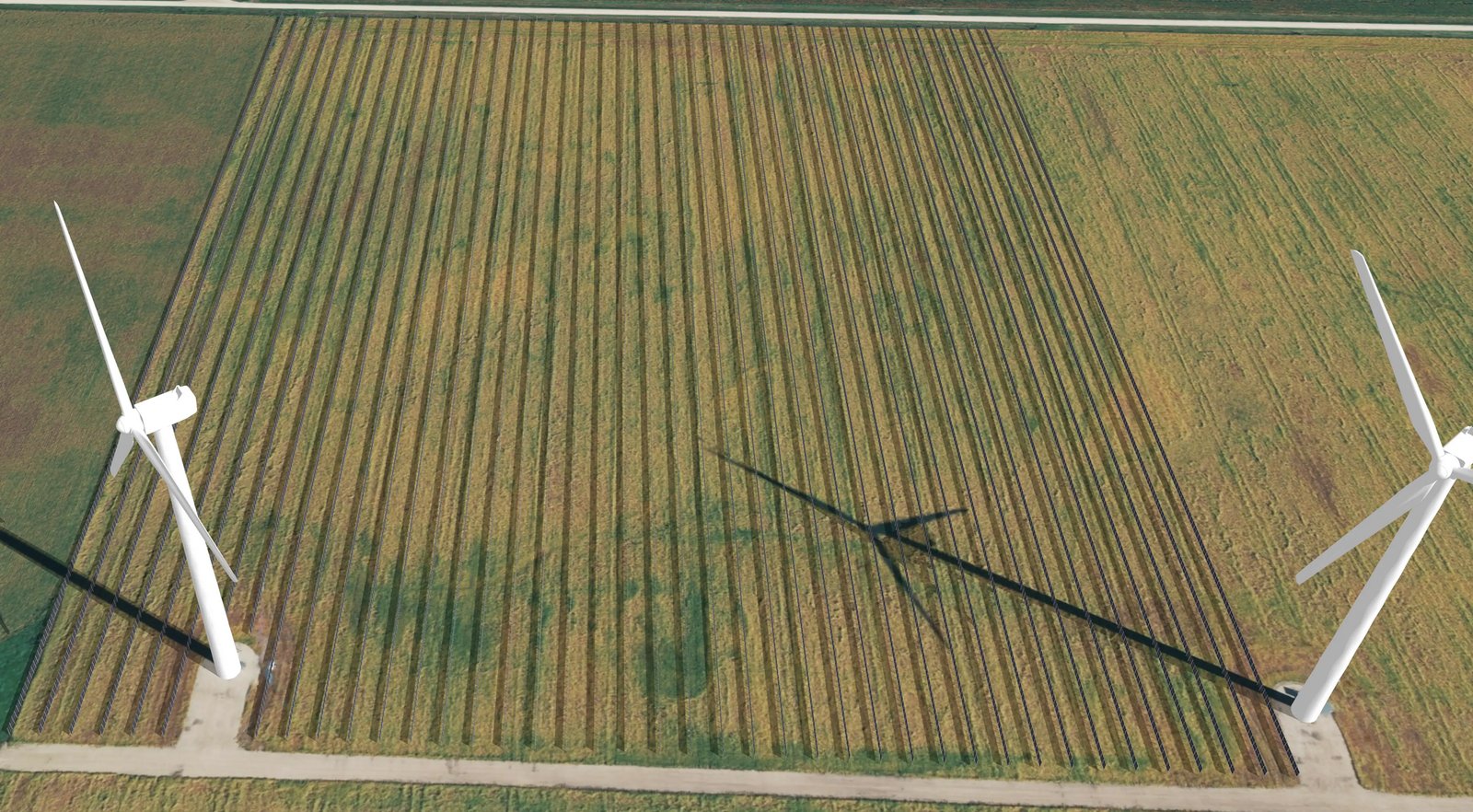
Gran Canaria has just switched on a small but significant piece of its energy future. At the La Estación experimental farm in Santa Lucía de Tirajana, a new kind of solar installation is now generating electricity — not from tilted panels covering entire fields, but from vertical bifacial modules standing in rows with space for crops in between. This is the island's first experimental vertical agrivoltaic plant, a 25 kWp pilot project run by the Canary Islands Institute for Agricultural Research (ICIA) under the regional government.
The idea is elegantly simple: instead of forcing a choice between solar parks and farmland, you combine them. The panels capture sunlight on both sides, producing power in the morning and afternoon, while the strips of land between the rows remain available for agriculture. For an island like Gran Canaria, where land is scarce, water is precious, and the sun is abundant, this dual-use approach could be a genuine game-changer. The project cost just under 98,000 euros and was financed through the EU's Next Generation recovery funds, part of Spain's national resilience plan.
What makes these solar panels different
Walk past a conventional solar farm and you will see rows of panels tilted towards the southern sky, packed closely together with bare ground underneath. The vertical agrivoltaic system at La Estación looks completely different. Sixty bifacial modules stand upright in north-south rows, like fences of glass and silicon. Because they are vertical, they catch the morning sun on one face and the afternoon sun on the other, creating two daily production peaks rather than one big midday surge.
This twin-peak profile is particularly interesting for Gran Canaria's isolated electricity grid, where too much solar power at noon can already cause curtailment problems. A generation curve that spreads output more evenly across the day could ease integration headaches. The plant is designed for isolated self-consumption, meaning the electricity it produces — an estimated 42,900 kilowatt-hours per year — will be used directly on the research farm, powering equipment, pumps, and facilities without feeding into the wider grid. It is a modest amount, roughly the annual consumption of a handful of Canarian households, but the real value lies in the data it will generate.
Why water matters as much as watts
Ask any farmer in south-east Gran Canaria what keeps them awake at night and water will be near the top of the list. The region is semi-arid, windy, and increasingly exposed to heatwaves and drought. Irrigation is expensive and every drop counts. This is where agrivoltaics gets really interesting. Research from similar dryland settings — including a well-documented case study in Chile — shows that vertical panels can act as windbreaks and partial shade structures, reducing evaporation from soil and plants.
In the Chilean study, the combination of lower wind speeds and reduced solar radiation under vertical bifacial modules cut reference evapotranspiration by up to about 14 percent, translating into water savings of roughly 1,410 cubic metres per hectare per year for irrigated crops. Broader agrivoltaic research points to potential irrigation reductions in the range of 15 to 40 percent, depending on panel coverage and local climate. At La Estación, ICIA researchers will now be able to measure these effects under real Canarian conditions — salty air, intense UV, and gusty trade winds included. The installation is equipped with inverters and monitoring systems that track both energy performance and agronomic behaviour, so every kilowatt-hour and every drop of water saved can be quantified.
A strategic testbed for the islands
At 25 kilowatts peak, this is not a power plant that will transform Gran Canaria's energy mix overnight. But its importance goes well beyond the numbers on the inverter. Spain currently has no specific regulations for agrivoltaics; projects fall under general photovoltaic rules, which do not account for the agricultural dimension. The Canary Islands government has been actively studying agrivoltaic models to help shape future legislation, and having a publicly owned, fully monitored pilot at a respected research institute gives policymakers hard evidence rather than just theory.
The La Estación project also connects to a growing network of agrivoltaic initiatives across the island. The Cabildo de Gran Canaria is advancing a separate pilot at Finca El Galeón in Santa Brígida, and there are plans for an agrivoltaic banana farm in Gáldar. Taken together, these projects are building a coordinated island strategy for multi-use land. In a territory where every square metre is contested — between housing, tourism, farming, and conservation — proving that energy and food production can coexist is not just an academic exercise. It is a practical necessity.
What we still do not know
For all the promise, there are gaps in what has been publicly shared about the La Estación pilot. ICIA has not yet detailed which specific crops will be grown between the vertical panel rows, though it is reasonable to expect they will test species representative of Canarian agriculture. The precise water savings at this particular site remain to be measured; the figures from Chile and other dryland studies offer an encouraging benchmark, but Gran Canaria's unique combination of salt spray, calima dust, and intense sunlight may produce different results.
There is also no official roadmap yet for scaling up. A successful 25 kW experiment does not automatically lead to megawatt-scale vertical agrivoltaic parks across the south-east. But the institutional interest is real. The regional government has visited other agrivoltaic installations on the island, including the El Vivero plant in Agüimes run by Ayagaures Medioambiente, and the EU funding behind La Estación signals a political willingness to invest in the concept. For now, the panels are up, the monitoring systems are running, and the data is starting to flow. The answers will come in growing seasons, not press releases.
Common questions
- Where exactly is the new agrivoltaic plant located?
- It is at the La Estación experimental farm, run by ICIA, in the municipality of Santa Lucía de Tirajana in south-east Gran Canaria.
- What does "vertical bifacial" mean?
- The solar panels stand upright rather than tilted, and they generate electricity from both the front and back faces, capturing sunlight in the morning and afternoon.
- Can crops really grow between the panel rows?
- Yes. The vertical design leaves usable strips of land between the north-south rows, allowing farming to continue alongside electricity generation.
- How much water can agrivoltaics save?
- Studies from similar dryland regions suggest irrigation savings of roughly 15 to 40 percent, though exact figures for this Gran Canaria site are still being measured.
- Who funded the project?
- The 97,613.83 euro investment came from EU Next Generation funds, channelled through Spain's Recovery, Transformation and Resilience Plan.
Read on
- Santa Lucía: concert tender closes after the showGran Canaria · 24 October
- Santa Cruz Bus Record: 8.8 Million Passengers in First Half of 2026Tenerife · 20 July
- La Graciosa Tests Europe's First Solar Desalination PlantLa Graciosa · 14 May
- Gran Canaria volcano: last eruption 2,000 years agoGran Canaria · 29 October
- Vecindario: San Rafael ends 1 November with Shaila DúrcalGran Canaria · 28 October
- All events on Gran Canaria →
Stand: 31 July 2026. This article is based on official information from the Canary Islands Government and ICIA.